HONG KONG — Sitting 10 feet apart on a bench in Hong Kong’s Tuen Mun Park, Dr. Alfred Wong and his pregnant wife briefly remove their protective masks before tucking into their take-out dinners and talking about their days.
It is a brief respite and return to normality for Wong, 38, a member of the “dirty team” at the Tuen Mun Hospital nearby. There, he is tasked with treating patients infected with the coronavirus.
Wong told NBC News that he was so concerned about his wife and unborn child that he would not go any closer to her than 10 feet. Physical contact is off limits and he has been staying at a hotel near the hospital rather than going home after work, he said.
As a result, he said he mostly communicated with his wife, who did not wish to be named due to the political sensitivities surrounding her husband’s work, by text message.
“Of course, it makes sense to the brain,” Wong said. “But doesn’t make sense to the heart.”
Wong, who volunteered to join the "dirty team" said he did feel "guilty" at times but he was proud to be “keeping this city healthy.” His patients needed him, he added.
His story is not unique among the dirty team. Made up of 15 junior and senior doctors with multiple specialties, they are tasked with treating those diagnosed with COVID-19 and those suspected of having it.
Most other Hong Kong hospitals have similar teams in place, Wong said.
At the time of publication, two people had died from the respiratory illness in the semi-autonomous city, and there have been 103 confirmed cases.

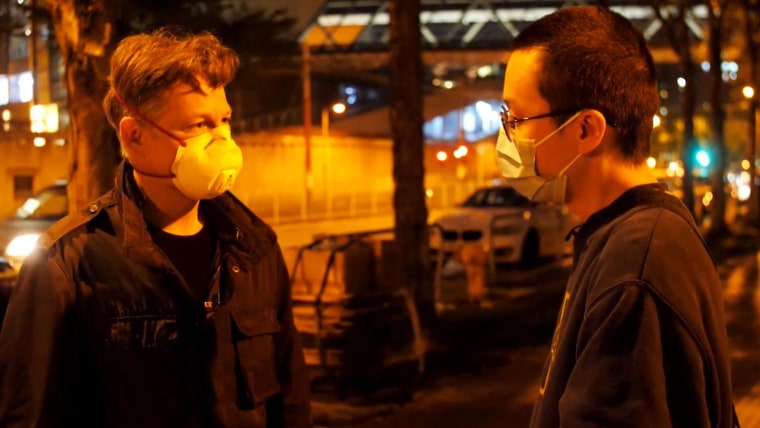
Doctors take no risks, wearing protective equipment including masks and visors.
“We have our own office. We don't eat inside canteens. We do takeaways. And after work, we don't go home,” Wong said. “Most of our colleagues have children or old parents at home. It's basically the same thing for every one of us.”
TUNE IN: On Assignment with Richard Engel, Outbreak airs on Sunday Mar. 8 at 10 p.m. ET, only on MSNBC.
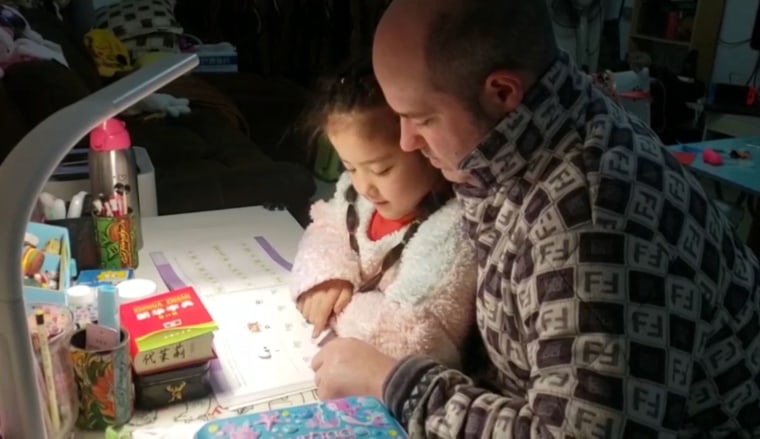
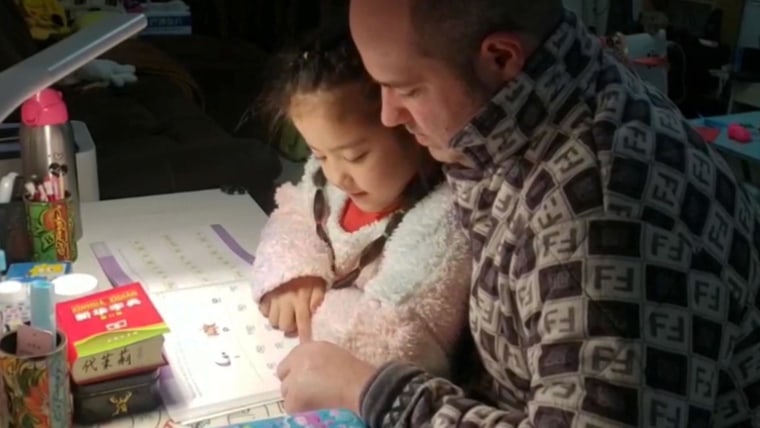
Less than 600 miles away in Wuhan — the Chinese city where the disease is believed to have originated — Benjamin Wilson has the opposite problem. A English teacher and restaurateur from Alexandria, Louisiana, he can only spend time with his wife, Lulu, 36, and 7-year-old daughter, Jasmine.
“Trapped,” Wilson, 38, told NBC News. “Couldn’t leave if we wanted to.”
He said that he felt like "astronauts being in space,” as they were “completely cut off and isolated" in their apartment.
“It has fallen into a routine,” he added. “It's not a bad thing, but God, it's boring.”
In an attempt to quarantine the disease, China’s government locked down the 11 million residents of Wuhan in late January, imposing travel restrictions that prevented people from entering and leaving the city.
These were eventually imposed in all of the other 15 cities in Hubei province, where Wuhan is, affecting almost 57 million people.