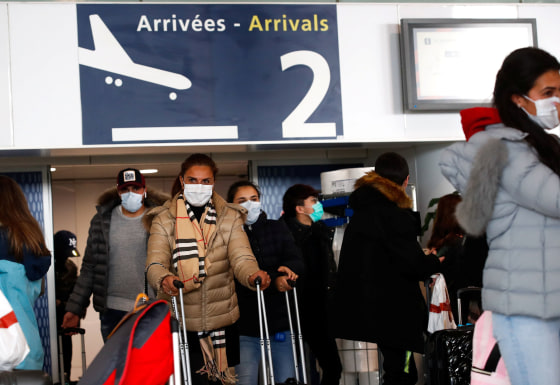
LONDON — The coronavirus outbreak has emptied streets, closed universities and filled hospitals around the world, but it has taken a more ominous turn in Europe, where right-wing populists are renewing calls to crack down on immigration, even making unsubstantiated claims that migrants from Africa brought the virus to the continent.
"The government has underestimated the coronavirus," said Matteo Salvini, the former interior minister of Italy, which has been Europe's epicenter of the coronavirus. "Allowing the migrants to land from Africa, where the presence of the virus was confirmed, is irresponsible."
Salvini is one of Europe's most hard-line voices on immigration, but no evidence has emerged that migrants brought the virus to Italy, where more than 4,500 people have been infected and almost 200 people have died as of Saturday.
In fact, the World Health Organization has warned that trying to restrict border security probably won't work — and might even hinder the global fight against the virus and the COVID-19 disease it causes.
Nevertheless, the pathogen is presenting a daunting challenge to an already beleaguered E.U., the world's largest political and economic club, home to 450 million people, and one that has made open borders a fundamental principle of its existence.

Still reeling from the United Kingdom’s exit from the bloc last month, the E.U. is also grappling with wider questions over migration, national budgets and how to balance the economic opportunity offered by China with concerns over security and human rights.
Vice President Mike Pence this week became the latest to suggest a connection between the outbreak and Europe's open borders.
"The nature of the European Union is one doesn't require a passport to move around," he told reporters at the White House when asked whether President Donald Trump was considering blocking travel with Europe. "Our task force spoke today about new cases, and there were some in several European countries. We're following that very closely."
The Trump administration has imposed travel restrictions on China, where the virus is believed to have originated, as well as Iran, South Korea and parts of Italy.
The E.U. has been far more reluctant to take such measures, vowing to uphold its Schengen Area — the 26 countries that allow travel without a passport — as well as the single market that affords the free movement of people, goods, services and money between member states.
"I welcome ... keeping the borders open and not resorting to what could at this point in time be considered disproportionate and inefficient measures," Stella Kyriakides, the European commissioner for health and food safety, said in a speech last month.
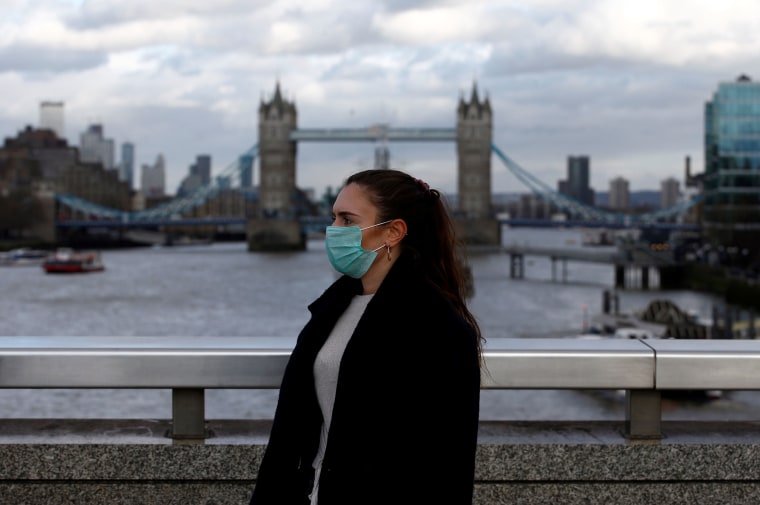
The WHO agrees that border restrictions are ineffective and may even "interrupt needed aid and technical support, may disrupt businesses and may have negative social and economic effects on the affected countries."
But despite the unified message from Europe's central institutions, officials in several countries have been singing a different tune.
Marine Le Pen, the French far-right former presidential candidate, has advocated closing the border with Italy as well as suspending the passport-free Schengen zone.
Aurélia Beigneux, a European lawmaker from Le Pen's National Rally party, explained the reasoning, saying last month, "The free circulation of goods and people, immigration policies and weak controls at the borders obviously allow the exponential spread of this type of virus."

Hungarian Prime Minister Viktor Orban — who has long been criticized by the E.U. for his record on civil liberties and the rule of law — has used the coronavirus crisis to crack down on immigration.
His government has "indefinitely suspended access to border transit areas for asylum-seekers," Orban's national security adviser, Gyorgy Bakondi, said this month.
"We observe a certain link between coronavirus and illegal migrants," he added, without providing evidence.