
MUNICH — Authorities probing the mysterious sabotage of the Nord Stream gas pipelines searched a vessel suspected of carrying explosives used in the blasts, German officials said Wednesday.
A vessel was searched from Jan. 18 to Jan. 20 this year “in connection with a suspicious ship rental,” the German Federal Prosecutor’s office said in a statement.
"There is the suspicion that the ship in question could have been used to transport explosive devices" that were used to blow up the Nord Stream 1 and Nord Stream 2 pipelines in the Baltic Sea last September, the statement added.
The explosions have become a highly sensitive geopolitical issue with potential ramifications for Russia's war in Ukraine, Western support for Kyiv and Europe’s drastic reduction in the amount of Russian energy it consumes. Initial suspicions fell on the Kremlin, but there has been little clarity from the ongoing investigations.
German prosecutors said Wednesday that their "evaluation of the seized traces and objects is ongoing," adding that the German company that rented the searched vessel was not suspected of involvement. "Reliable statements on this, especially on the question of state control, cannot be made at this time," the statement added.
It offered little detail and said the nationality and identity of the perpetrators, who have yet to be arrested or publicly identified, was the subject of ongoing investigation.
The German authorities' announcement comes after multiple news outlets reported that U.S. intelligence suggested a pro-Ukrainian group may have been responsible. Kyiv has denied any involvement.
The Washington Post reported Tuesday that American and European intelligence officials believed pro-Ukrainian saboteurs may be responsible, after the New York Times reported that new intelligence reviewed by U.S. officials suggested the same. German daily newspaper Die Zeit and public broadcasters ARD and SWR reported Tuesday that the boat used in the attack was based in Poland and rented by two Ukrainians.
NBC News has not confirmed the reports. Both the CIA and Office of the Director of National intelligence declined to comment.
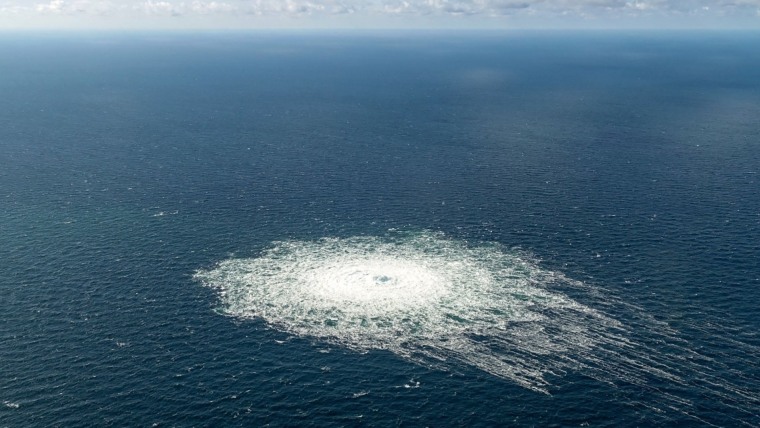
Germany's defense minister urged caution Wednesday and suggested the blasts could have been a "false flag" attack to try and smear Ukraine.
“We have to make a clear distinction whether it was a Ukrainian group, whether it may have happened at Ukrainian orders, or a pro-Ukrainian group (acting) without knowledge of the government. But I am warning against jumping to conclusions,” Boris Pistorius said on the sidelines of a summit in Stockholm. He said earlier the likelihood was “equally high” that it could have been a “false flag operation staged to blame Ukraine.”
Ukrainian officials strongly denied any involvement.
Mykhailo Podolyak, an adviser to President Volodymyr Zelenskyy told NBC News that his country was "absolutely not involved in the attacks."
"It does not make any tactical sense, because it does not affect the course of the war at all, does not reduce the resource capabilities of the Russian military, and does not provoke the withdrawal of Russians from the territory of Ukraine," he said.
Ukraine's Defense Minister Oleksii Reznikov called the reports a “little bit strange” and said the sabotage had “nothing to do” with his government.
Speaking at the summit in Stockholm, he said he was not concerned that the reports might weaken support in the West for his country's defensive fight.
“It’s like a compliment for our special forces,” Reznikov said jokingly. “But this is not our activity.”
"Although I like to collect interesting conspiracy theories about the Ukrainian government, I must point out that Ukraine has no connection to the incident in the Baltic Sea and no information about ‘pro-Ukrainian sabotage groups,'" presidential adviser Mikhailo Podolyak said on Twitter Tuesday.