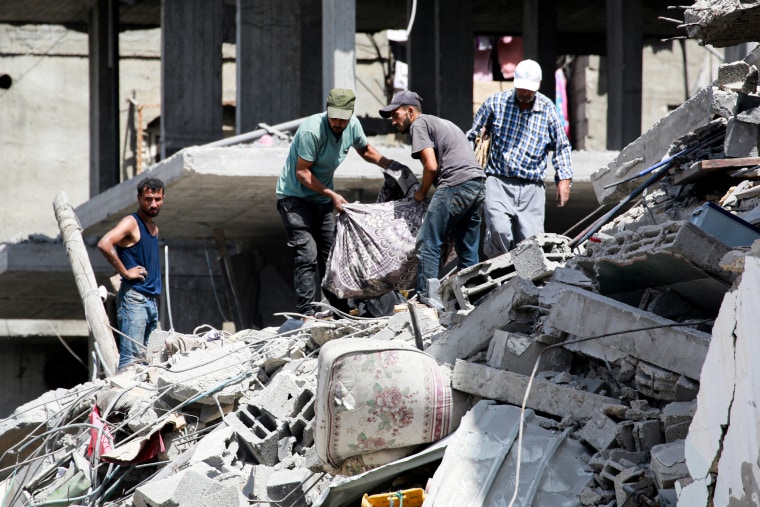
TEL AVIV — It’s become a tragically familiar scene in the Gaza Strip: After seeing her slain son’s corpse, a Palestinian woman screams in agony.
Yet she points her anger not at the Israelis whose weapons killed him, but at Hamas.
“I hope that God will destroy you, Hamas, like you destroyed our children,” she yells in a video captured by NBC News crews in Gaza, her anger palpable, tears streaming down her face. Her startled companion reaches to cover her mouth, insisting the woman’s teenage son died a martyr as she quickly ushers her away.
Her comments are a sign of the shifting times: Nearly nine months after Hamas’ Oct. 7 terror attacks, people in Gaza are increasingly voicing frustration with the Islamist group that has governed the Palestinian enclave since 2007, when it wrested power from Fatah, its internationally recognized rivals who still run the occupied West Bank, the larger of two Palestinian territories in the region.
Dissent against Hamas’ rule was once rare in the Gaza Strip, and speaking out remains risky. But the despair and chaos of war has cleaved open a small space for defiance.
Hamas’ popularity in the enclave has sunk considerably in the months since the Oct. 7 attacks on Israel that saw 1,200 people killed and resulted in around 250 taken hostage.
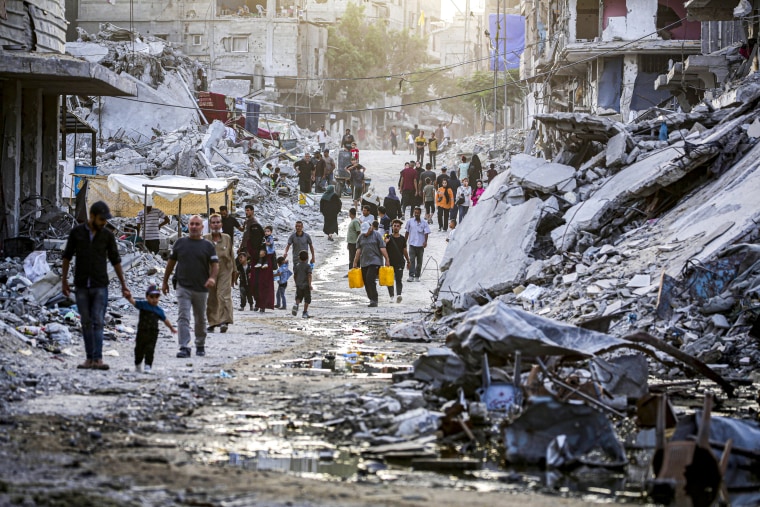
Only about a fifth of people in the enclave support those attacks, down from nearly half in November, according to polling conducted in May by the West Bank-based Arab World for Research and Development (AWRAD), an independent organization that conducted 1,500 personal surveys across the Palestinian territories.
The poll also showed that Hamas only has the support of about a quarter of residents in the enclave, where the death toll since Oct. 7 passed 38,000 this week, according to Palestinian health officials.
“Hamas popularity among the populace who are actually living now in shelters, in tents and makeshift, you know, communities is declining,” said Nader Said, the polling organization’s president.
In a separate video that went viral after it was posted to social media last month, a man can be seen screaming before a small crowd gathered in front of a hospital in Gaza.
He identifies himself as an academic called Muhammad Judeh. His face and shirt were covered in blood.
“We have a filthy leadership. They got used to our bloodshed,” he said. “May God curse them. They are scum.”
Continuing his diatribe as worry washed over faces in the crowd, he said the Palestinian leadership of Gaza — referring to Hamas — has dealt unwisely with “the Zionists” — referring to the Israelis.
Then he turns his rage on the crowd. “I’m one of you,” he said. “But you are cowardly people. We could have avoided this attack.”
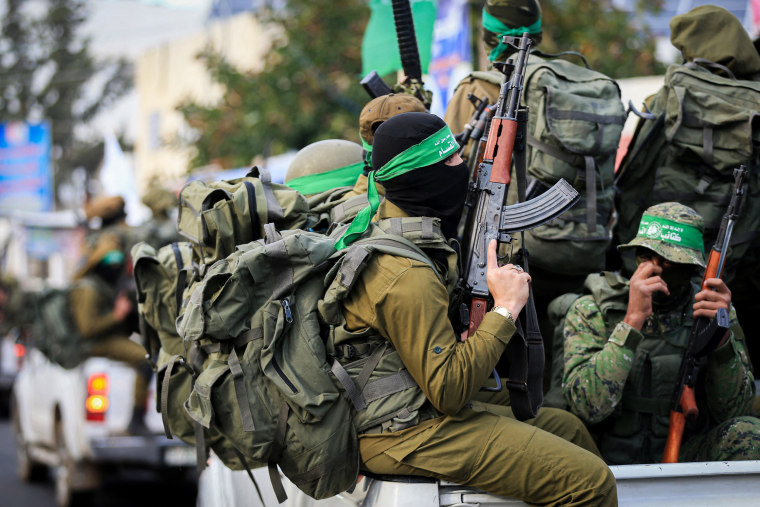
The crowd’s fears are well-founded. Hamas, which was established in the late 1980s, has exercised a strict style of rule over Gaza for nearly two decades. During that time advocacy groups including UN Watch, Amnesty International and Human Rights Watch routinely accused the group of torture, beatings, solitary confinement and other similar tactics against its own people.
The group’s regular bombing barrages on Israel have also invited fearsome retaliation that has left tens of thousands of Palestinians dead.
The militant group has never enjoyed overwhelming popularity in the Gaza Strip. Their maximalist positions set them apart from the Palestinian Authority, who rule over the occupied West Bank, recognize Israel and are seen by many Hamas supporters as cowardly collaborators.
AWRAD’s May polling data from the West Bank confirms that impression. Where Hamas’ popularity has plummeted in Gaza, it has surged in the West Bank, where many see the group as delivering a more powerful response to Israel.