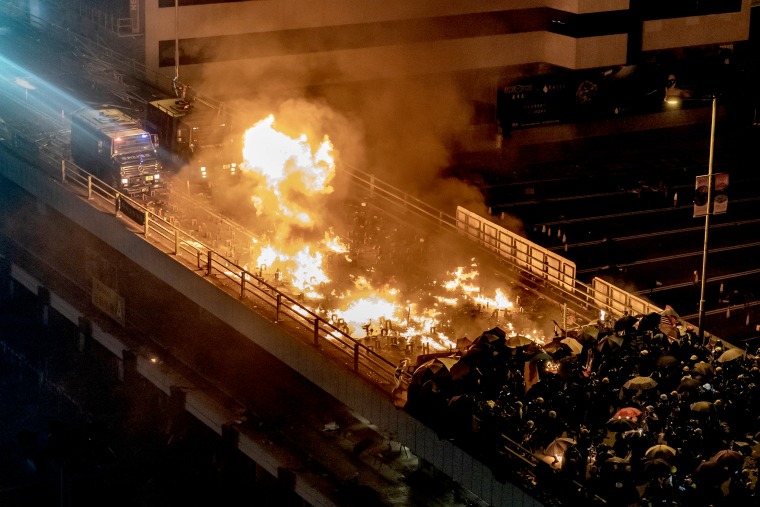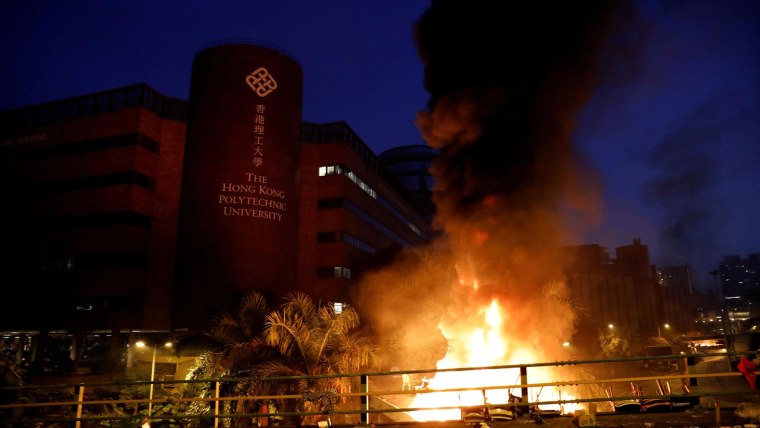
HONG KONG — The president of a Hong Kong University said Monday that police have agreed to suspend their use of force after they tried to flush out protesters occupying the campus.
Hong Kong Polytechnic University President Jin-Guang Teng said police would allow protesters to leave the campus, and he would accompany them to the police station to ensure their cases “will be fairly processed.”
He said in a recorded video message that he hopes protesters “will accept the proposed temporary suspension of force and leave the campus in a peaceful manner.”
The announcement came after Hong Kong police stormed the university campus following an all-night standoff.
Police fired volleys of tear gas and water cannons outside the university, while protesters hurled bricks and gasoline bombs, setting an overhead footbridge on fire.
The clashes threatened to escalate the violence as protesters sought to hold off a police advance.
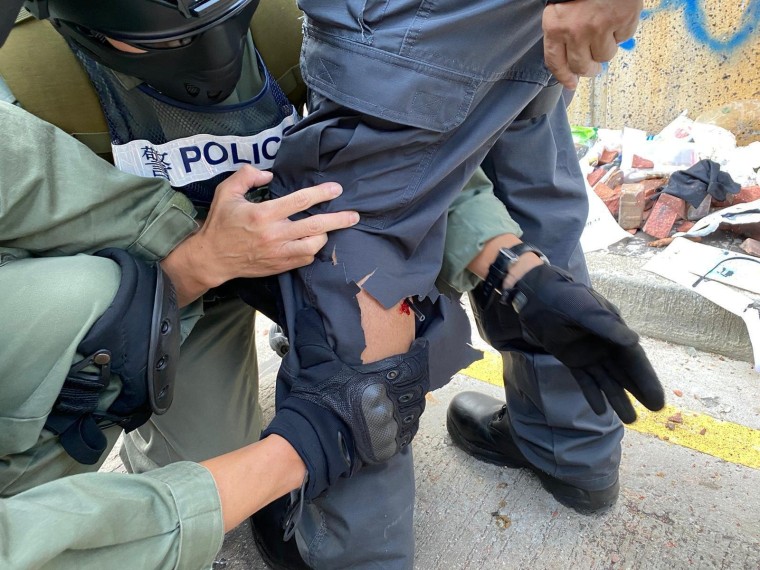
Amid the skirmishes, Hong Kong police said their media officer was struck with an arrow and taken to a hospital. Photos on the department's Facebook page showed the arrow sticking out of the back of the officer's lower leg through his pants.
Police later released a statement condemning the incident, adding that the officer remained conscious after he was taken to hospital.
The territory's hospital authority could not immediately confirm the officer's condition.
Meanwhile, police deployed a long-range acoustic device, which emitted a loud noise for five to 10 seconds without warning, for the first time to help disperse the crowds.
Police said in a tweet that the device was used as a broadcasting system, not as a weapon, after speculation online that its use could cause dizziness, nausea or loss of sense of direction.
Sunday's daytime faceoff came after a pitched battle overnight in which the two sides exchanged tear gas and gasoline bombs that left fires blazing in the street.
Many protesters retreated inside the Polytechnic campus, where they have barricaded entrances and set up narrow access control points.
Universities have become a new battleground for the protests after months of unrest in the semi-autonomous territory.
Related

Traffic disruptions and class suspensions have become routine as protesters try to paralyze the city.
Protesters have largely retreated from several major campuses they held last week, except for the contingent at Polytechnic.
That group has employed new tactics involving flammable arrows and catapults. The demonstrators are also blocking access to Cross Harbour Tunnel, one of the three main road tunnels that links Hong Kong Island with the rest of the city.
"It's not about the campus. It's about what's next to it," said a 23-year-old masked protester who gave only his last name, Chow.