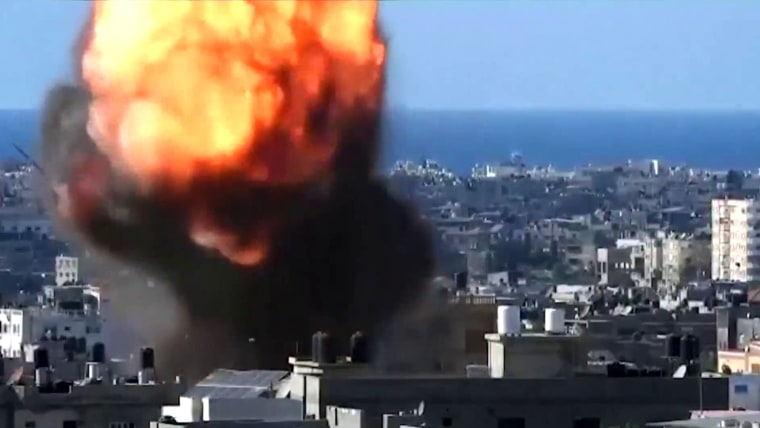
TEL AVIV — After almost two weeks of airstrikes and rocket attacks, civilians from Gaza to Tel Aviv awoke Friday to an uneasy calm.
Despite fresh clashes between Palestinians and the Israeli police at Al-Aqsa Mosque compound in Jerusalem, the cease-fire reached after 11 days of intense fighting appeared to hold in its early hours.
But with so many people dead — 243 Palestinians and 12 Israelis, according to officials on both sides — parts of the Gaza Strip in ruins and Israel facing fierce internal divisions, the truce was greeted in the region with a mix of jubilation, relief and skepticism.
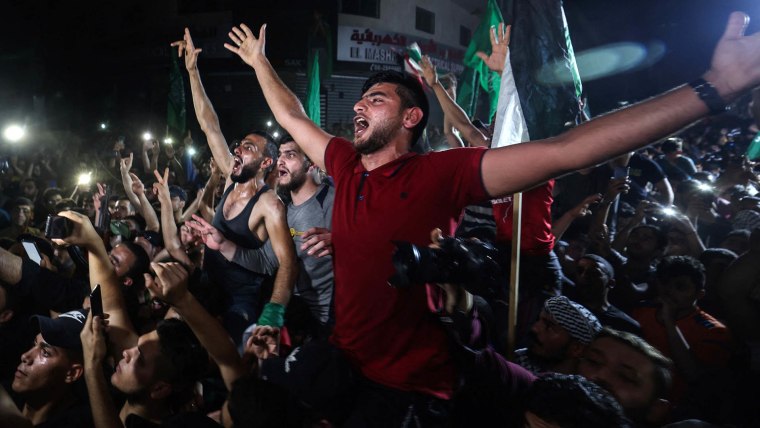
Though the exact terms of the cease-fire were unclear, Palestinians rallied by their thousands early Friday to celebrate.
Young men waved Palestinian and Hamas flags, honked horns and set off fireworks. Spontaneous celebrations also broke out across the occupied West Bank and in east Jerusalem — where plans to evict Palestinian families from land claimed by Jewish settlers in the neighborhood of Sheikh Jarrah had helped stoke tensions that ignited the conflict.
"The people are happy now because the war has ended,” Shams Oadeh, 46, a journalist, told NBC News, speaking near one of the many buildings reduced to rubble in Gaza, home to 2 million Palestinians.
“Now, when they wake up and see all this damage and all the blood … all Palestinians are in shock,” he said.
At least 66 Palestinian children were among those killed in Israel's bombardment of the Gaza Strip, according to the Gaza Ministry of Health. Nearly 2,000 people were injured and tens of thousands displaced as the fighting dealt a heavy blow to Gaza's already crumbling infrastructure.
Oadehsaid there could be no long-term “happiness” until the blockade of the tiny impoverished enclave was lifted and its inhabitants given free movement and equal opportunities.
“We are asking now, please, please stand with us because I think it’s enough,” he added.
Hala Al-Sammak, a teenager, said she was keen to get back to regular life, playing soccer and practicing her drums.
The 16-year-old said the Israeli bombardment had "made us so scared — we sleep and we don’t know if we’ll stand up the next day,” she said.
'It’s not going to end'
Israeli Prime Minister Benjamin Netanyahu quickly came under heavy criticism from his nationalist base for agreeing to end the military campaign.
Gideon Saar, a former ally who now leads a small party opposed to Netanyahu, called the cease-fire “embarrassing.” Itamar Ben Gvir, head of the far-right Jewish Power party, said it was “a grave surrender to terrorism and the dictates of Hamas.”
In a speech Friday, Netanyahu said Israel had done “daring and new things, and this without being dragged into unnecessary adventures.” He added that Israeli forces had caused “maximum damage to Hamas with a minimum of casualties in Israel.”
In Washington, President Joe Biden said Thursday that he sees a "genuine opportunity" to move toward a peaceful long-term solution to the conflict.
Related

But on the streets of Tel Aviv — Israel's bustling metropolis — there was less optimism.
None of the commuters, early morning dog walkers or those sipping coffee on the city's leafy boulevards thought this would be the last of the violence between Gaza and Israel, though all were at least thankful for the respite.