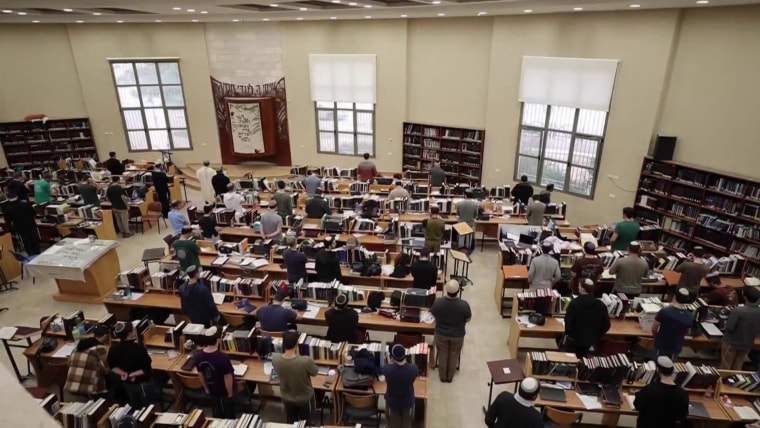
YERUCHAM, Israel — Peering over tightly packed rows of books in the great hall of the white-brick seminary, the students pause their study of the Torah and Talmud each day for afternoon prayers, chanting the same words that Jews have been recited for centuries.
But these days, as the young men rock back and forth gently in worship, they add a new prayer.
“May the one who blessed our forefathers bless our soldiers standing guard from the Lebanese border to Egypt, from the sea, air and land,” they pray in Hebrew. “God will look after and save our soldiers from the enemy.”
Yet not all are saved.
At Yeshivat Hesder Yerucham, a seminary for young men in Israel’s Negev desert, eight students have already been killed in the Israel-Hamas war. The eighth died just last week.
It’s a crushing loss for the community of some 300 students, aged from around 19 to their early 20s.
Gilad Palmer, a teacher at the yeshiva, told NBC News last week that members have been “going from funeral to funeral.”
“Judaism is a religion that believes in life,” Palmer said. “We celebrate the life and not the death. But we also know that sometimes we have to pay the ultimate price for our people, our nation.”
Recalling the first of his students to die in the war, Palmer said Ariel Eliyahu, 19, was “always smiling” and “always searching to volunteer” within the school. He died when his tank was struck by Hamas fighters on Oct. 7, Palmer added, the day the militant group launched multipronged attacks on Israel that killed 1,200 and saw 240 kidnapped.
That so many students join Israel’s military is a point of pride for this yeshiva, where roughly 95% of the student body is ultimately drafted into combat units, the school said. Palmer said while it may seem counterintuitive for a religious institution to prize military service, it fits neatly into the ideals of selflessness and caring for others that the school strives to promote.
“It comes from the same values that you know that you’re there for each other,” he said.
Yet within the complex tapestry of religious Israeli society, such high levels of military service are relatively rare.
Among the ultra-Orthodox, known in Israel as Haredim, the vast majority do not serve in the Israel Defense Forces, having been granted legal exemptions — a major source of conflict between the country’s ultra-Orthodox and secular Jews.
Out of a population of more than 1.2 million ultra-Orthodox, as few as 1,200 have been drafted annually in recent years, according to the IDF’s Manpower Directorate. In December, just 188 ultra-Orthodox Israelis were recruited, the IDF said.
Within Israel’s modern Orthodox community, which includes Yeshivat Hesder Yerucham, military service is more common. Modern Orthodox, a distinct stream of Judaism, share with the ultra-Orthodox a commitment to abiding by traditional Jewish law, but tend to participate more fully in broader Israeli society and engage more directly with the secular world.
Those yeshiva students who do opt to serve generally enlist under an arrangement with the IDF known as the “hesder,” in which students alternate between periods of army service and full-time religious study.
When NBC News visited Yeshivat Hesder Yerucham, a group of students took a break from studies when a classmate now in the military returned for a visit. His white tzitzit, or knotted Jewish tassels, dangled from above the pants of his green IDF uniform.
He was greeted like a hero on the front steps by his classmates, including Yehuda Corn, 19, whose older brother is currently in the IDF and stationed in the occupied West Bank.