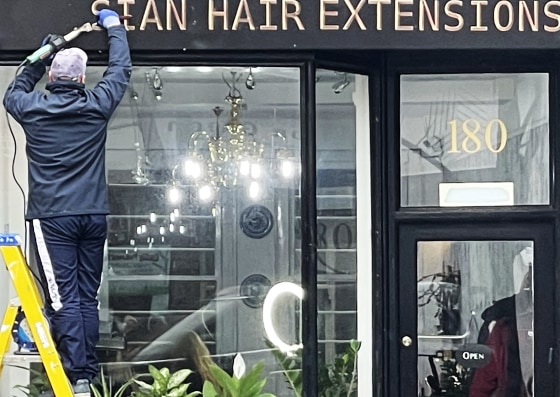
LONDON — It may be a small but subtle sign of a shifting tide — a man on a ladder removing the word “Russian” from the sign above the Russian Hair Extensions salon in London’s exclusive Kensington neighborhood.
A short drive away is Chelsea FC, the soccer club put up for sale Wednesday by its owner, the Russian oligarch Roman Abramovich.
The British capital dubbed “Londongrad” because of its popularity with Russia’s wealthy and Kremlin-aligned elite is no longer quite as welcoming after Russian President Vladimir Putin’s invasion of Ukraine.
Whereas once they could live relatively anonymously amid the gleaming high-end mansions of Kensington, Knightsbridge and nearby Belgravia, the oligarchs and their money are now sharply in the spotlight amid public condemnation and calls for more severe sanctions from global political leaders.
The collapse of the Soviet Union in 1991 and Russia’s economic crisis seven years later “encouraged people who had wealth to move it out of the country,” Tom Keatinge, the director of the Centre for Financial Crime and Security Studies at the Royal United Services Institute, a London based think tank, told NBC News by telephone Thursday.
London drew them because of its education system, excellent shopping and attractive visa regime that allowed people to move to the United Kingdom relatively easily, he said.
It also had deeper capital markets than Europe. “If you’re going to be investing hundreds of millions, you’re going to be investing in a market that can accommodate that size of investment,” Keatinge added.
Abramovich’s 2003 purchase of Chelsea, based in the capital’s fashionable southwest, and his subsequent investment of millions of dollars on the team, turned them into trophy winners almost overnight.
But as well as transforming the club’s fortunes, for some his arrival became a symbol for the influx of wealthy Russians eager to snap up British companies and make the most of an opportunity to help soften their public image.
Announcing his decision to sell, Abramovich said in a statement that he had instructed his team to set up a charitable foundation “where all net proceeds will be donated.” He added that the “foundation will be for the benefit of all victims of the war in Ukraine,” as well as “supporting the long-term work of recovery.”
With backlash to Putin’s war prompting a broader reckoning in the West, Abramovich’s move has been viewed by some as a sign that the era of Russian oligarchs flaunting their wealth in European luxury hot spots may be over.
The oligarchs “are going to have to make some pretty tough decisions,” Keatinge said, with the threat of sanctions forcing them “to choose between their wealth, their luxury, their future and supporting Vladimir Putin.”
Some have already been targeted by the British government and the European Union, which have imposed sanctions on Russian banks, business owners and members of Putin’s inner circle, although Abramovich is not among them.
However, he has been named as a potential target for punitive action. His connections to Putin have been the subject of speculation for years, with his vast assets growing from the fortune he made in oil and aluminum during the chaotic years that followed the collapse of the Soviet Union.
NBC News has approached Abramovich’s spokesperson for further comment about his reasons for selling the club.
The Biden administration announced a new round of sanctions against Russian oligarchs and their families Thursday, with mining and mineral magnate Alisher Usmanov at the top of the list.
Usmanov is perhaps best known in Britain for his former investment in another London soccer club, Arsenal FC.
U.S. authorities said they had blocked his superyacht, the Dilbar, which has two helipads and one of the world’s largest indoor pools on a boat. As a result any transactions related to it “such as maintenance, the hiring of operating personnel, or payment of docking or landing fees, conducted with U.S. persons or in U.S. dollars, are prohibited,” according to the Department of the Treasury.

