HONG KONG — Frustrated by what it sees as the U.S.’s determination to thwart its rise as a global superpower, China is pushing ahead with efforts to promote a new international order that has Beijing at its center.
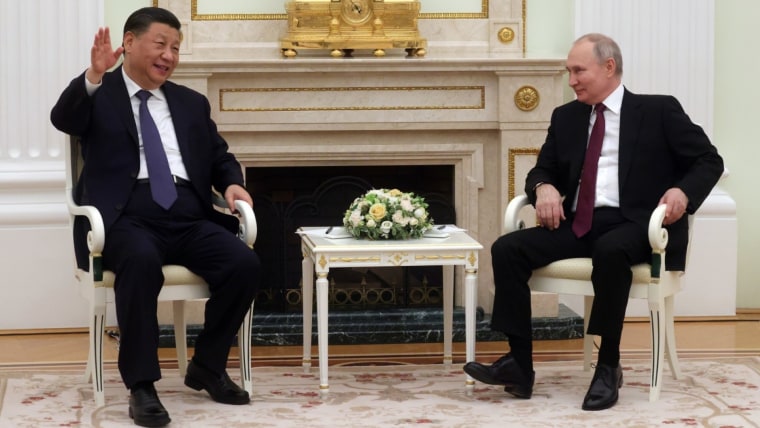
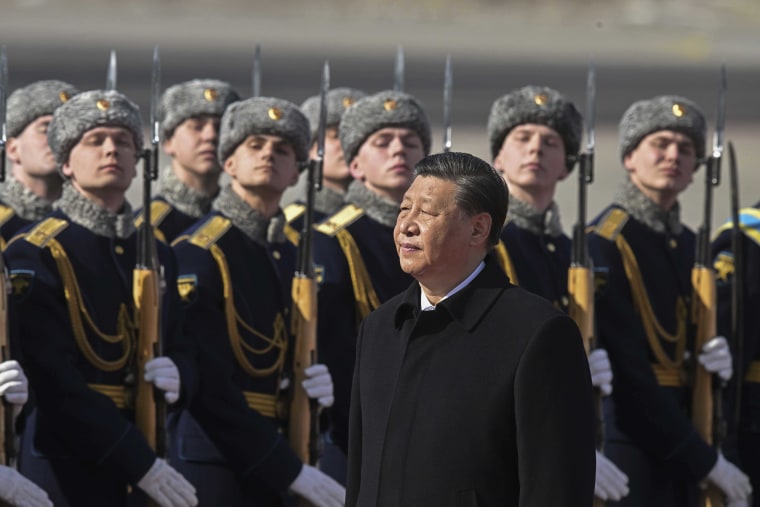
In recent weeks, China has spoken more robustly about the prospect of conflict unless the U.S. changes course and reveled in a major diplomatic victory in the Middle East. Now its leader, Xi Jinping, is in Moscow to meet with Russian President Vladimir Putin, signaling Beijing’s growing embrace of its rising power on the global stage and the potential for it to further deepen conflict with the U.S. and its allies.
Xi’s visit to Russia, his first since Putin’s invasion of Ukraine last February, could serve as an even greater show of solidarity after the International Criminal Court issued an arrest warrant for the Russian leader Friday, accusing him of being responsible for war crimes in Ukraine. Russia, China and the U.S. are not members of the court.
“I am pleased to once again set foot on the soil of our friendly neighbor Russia,” Xi said in a statement after arriving in Moscow on Monday for the three-day state visit.
The two leaders will hold talks Monday, followed by meetings with larger delegations Tuesday, the Russian state news agency Tass reported, citing a Putin aide.
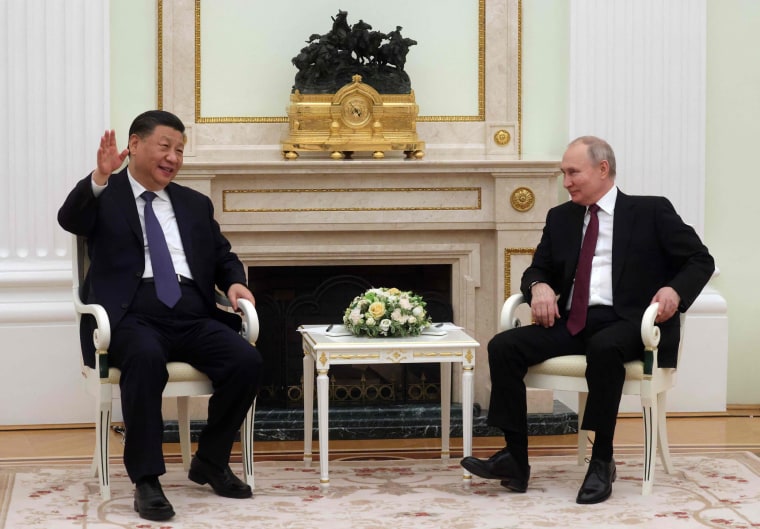
Tass later quoted Putin as saying Moscow had carefully reviewed Beijing's proposals to resolve the war in Ukraine and respected China’s initiatives for a peaceful settlement.
Earlier, in an article published Sunday in the People’s Daily, the ruling Chinese Communist Party’s flagship newspaper, Putin said he had high hopes for the visit by his “good old friend” Xi, with whom he declared a “no limits” partnership weeks before the invasion of Ukraine last year. The Russian leader, who made a defiant visit to occupied eastern Ukraine over the weekend, also welcomed China’s willingness to make a “meaningful contribution” to solving the conflict.
Xi followed with an article Monday promoting China’s peace plan for Ukraine, saying it “reflects the broadest common understanding of the international community on the crisis.” The 12-point proposal, part of China’s efforts to project itself as an international peacemaker, has been dismissed by the West as too favorable to Russia.
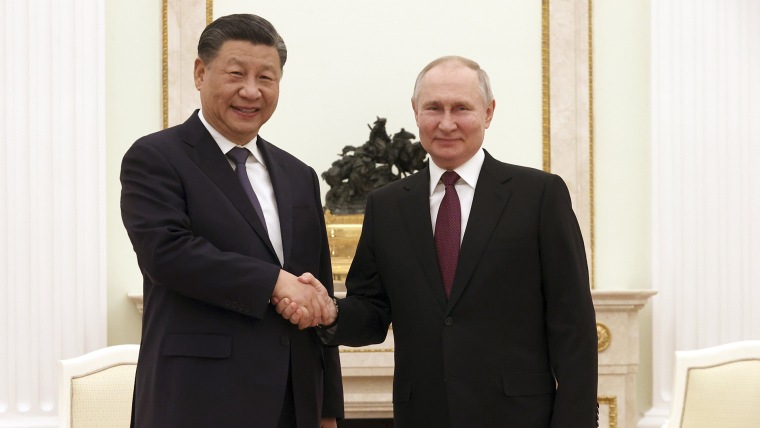
Xi said his Russia trip was intended to strengthen the strategic partnership between the two countries in a world faced with “damaging acts of hegemony, domination and bullying.”
“The international community has recognized that no country is superior to others, no model of governance is universal, and no single country should dictate the international order,” he said in the article in Rossiiskaya Gazeta, a daily newspaper published by the Russian government, according to an English-language translation carried by the Chinese state media.
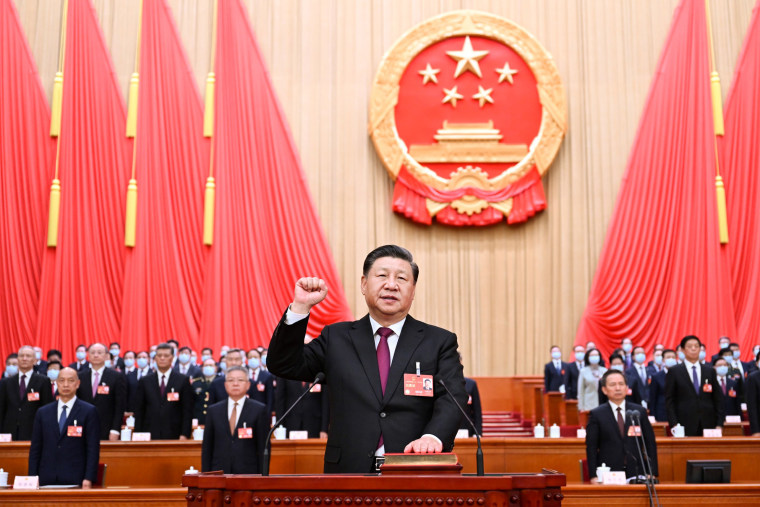
With U.S.-China relations seemingly stuck in a downward spiral, Xi and his top officials are sharpening their rhetoric. In a speech this month to delegates at the annual meeting of China’s ceremonial legislature, where he formally received an unprecedented third term as president, Xi said the U.S. was leading a campaign of “containment, encirclement and suppression” that had created “severe challenges” for China.
China’s new foreign minister, Qin Gang, later echoed Xi’s remarks, warning that “confrontation and conflict” between the world’s two largest economies was inevitable unless Washington eased its policies.
Xi’s comments were the strongest and most direct anti-U.S. comment from any Chinese leader in decades, said Ian Bremmer, president of Eurasia Group, a consulting firm based in New York. By making the comments himself, he said, Xi was expressing his dissatisfaction with Washington “in a very public way.”
While President Joe Biden has a personal relationship with Xi and has emphasized the potential for bilateral cooperation, the way U.S. politicians talk about China issues — from trade to Taiwan to TikTok — gives Beijing the impression that “everything is adversarial,” Bremmer said.
“They think this is deeper than anything that can be fixed with the two leaders just talking,” he said.
The Biden administration says that while it views China as a strategic competitor, it does not seek conflict. Biden, who has spoken with Xi multiple times by phone and met with him in November, said last week that he expected to have a phone call with the Chinese leader “soon.”
In the meantime, Xi is continuing a surge of diplomatic activity aimed at offering a Chinese alternative to the U.S.-led global order — one that emphasizes “mutual respect” and “noninterference” and shuns the Western framework of democracies versus autocracies. His ambitions for China as a responsible great power were advanced this month with the surprise announcement of a deal it brokered to restore relations between Saudi Arabia and Iran for the first time in seven years.
“It’s a low risk, high-reward move that boosts Chinese legitimacy and prestige and Xi Jinping in particular as someone who personally, according to Chinese sources, facilitated this détente,” said Tuvia Gering, a researcher with the Diane and Guilford Glazer Israel-China Policy Center at the Institute for National Security Studies in Tel Aviv and a nonresident fellow at the Atlantic Council.