President Donald Trump said Saturday that he has asked the king of Jordan to take in more Palestinians, adding that Palestinians should leave the Gaza Strip to “clean out” the enclave.
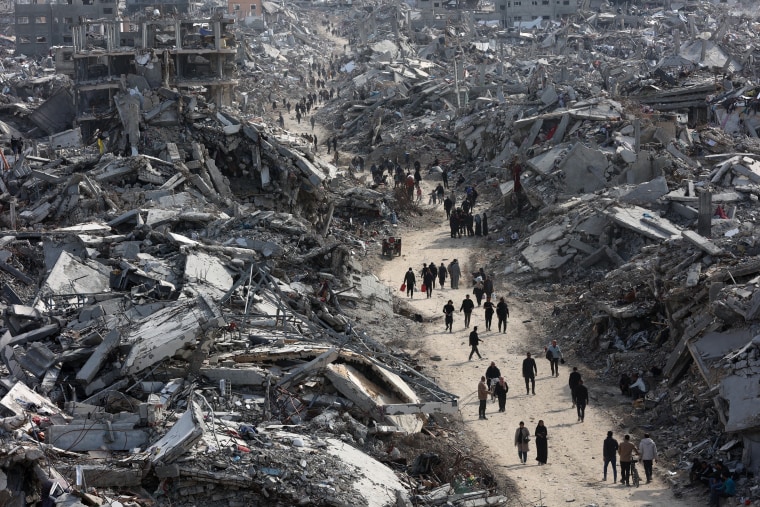
The president’s comments, which key figures from Israel’s far right have taken as a boost, came as thousands of Palestinians waited to return to their homes in northern Gaza after the Israeli government accused Hamas of breaching a ceasefire agreement and refused to open crossing points.
“You’re talking about probably a million and a half people, and we just clean out that whole thing," Trump said to reporters aboard Air Force One on Saturday.
“I’d rather get involved with some of the Arab nations and build housing at a different location where they can maybe live in peace for a change,” he added.

Trump suggested Egypt and Jordan could be among the countries to accept more refugees.
Referring to an earlier conversation with Jordan’s King Abdullah, Trump said he had told the monarch, “I’d love you to take on more” Palestinians, adding that he would raise the matter with Egyptian President Abdel Fattah el-Sissi on Sunday.
While the Israeli prime minister’s office had yet to respond to NBC News’ request for comment regarding Trump’s remarks, the president’s sentiments were welcomed by ultranationalist Israeli politicians, including Finance Minister Bezalel Smotrich and Itamar Ben-Gvir, who resigned as national security minister after Prime Minister Netanyahu’s government voted to accept the ceasefire agreement.
Smotrich called the idea of finding new homes for Gaza residents “wonderful,” telling Israeli broadcaster Channel 12 on Sunday that “only out-of-the-box thinking and new solutions will bring peace and security.”
Ben-Gvir also congratulated Trump on the initiative in a post on X.
But Sami Abu Zuhri, a senior Hamas spokesperson, said, “The people of Gaza had endured death in order not to leave the homeland and will not leave it for any other reasons.”
“Implementing the agreement is sufficient to solve the problems of the Gaza Strip,” he added.
And United Nations Special Rapporteur Francesca Albanese said on X on Sunday that “ethnic cleansing is anything but ‘out-of-the-box’ thinking no matter how one packages it.”

The Jordanian and Egyptian governments had yet to respond to a request for comment on the matter.
Trump also confirmed he had instructed the U.S. military to resume shipments of 2,000-pound bombs to Israel, which had been paused under President Joe Biden over concerns about civilian casualties. When asked why he had authorized the release of these bombs, Trump responded, “because they bought them.”
Despite the resumption of those shipments, a fragile ceasefire between Israel and Hamas continued to hold Sunday, despite each side accusing the other of reneging on parts of the deal.
While Hamas officials said that Palestinians being allowed to return to their homes in the north of the Gaza Strip was a key condition of the truce, Israeli officials contended that Hamas was supposed to release all female civilians it is holding hostage before it released four female soldiers in an exchange for prisoners and detainees on Saturday.
The future of the ceasefire may now hinge on what happens with one specific hostage: 29-year-old Arbel Yehud.
The Israeli prime minister’s office said Saturday that the IDF will not allow Gazans to return to north of the strip “until the release of the citizen Arbel Yehud.”