Iran and the U.S. met on Saturday and have agreed to resume talks on nuclear issues and sanctions next week, the White House said.
In a statement released after the talks concluded earlier in the day, the White House described the discussions as "positive and constructive," a sentiment echoed by Iran's foreign ministry.
The stakes for the talks could not be higher, as they represent a rare instance of interaction between the two nations after decades of tension.
U.S Mideast envoy Steve Witkoff and Iranian Foreign Minister Abbas Araghchi had a brief exchange in the presence of Oman's foreign minister at the end of Saturday's talks, the Associated Press reported, citing Iranian state TV.
“Both sides made serious efforts to show their willingness for a fair and suitable agreement,” Araghchi said, adding that the next round of talks will be in one week.
Israel, which views Iran as an existential threat, and the U.S. see Iran as a rogue regime intent on pursuing weapons of mass destruction that will stop at little to undermine its opponents.
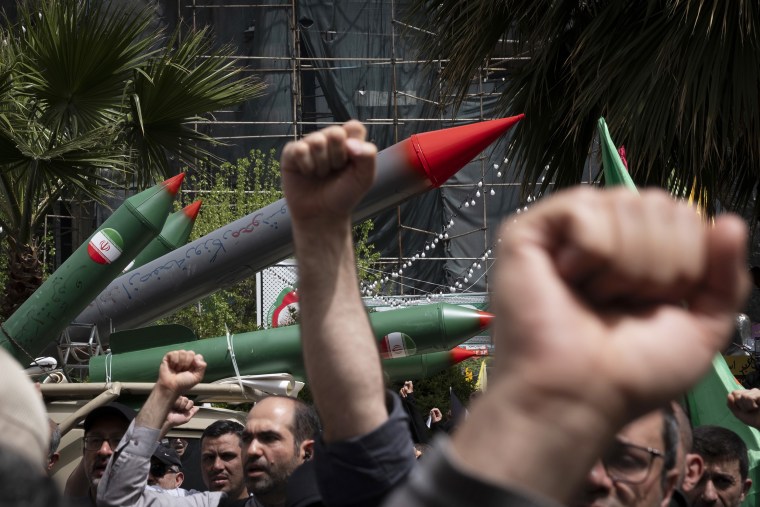
Iran‘s leadership, meanwhile, faces a choice between giving up its nuclear aspirations, which would most likely render it more vulnerable in the long run, or continuing along the path of nuclear development and dramatically raise the risk of an attack from Israel and the U.S.

While Iran has always denied that it wants to develop nuclear weapons, top officials have repeatedly said that if it is attacked, this will change and eventually push it toward building a nuclear bomb.
President Donald Trump revealed the negotiations in a surprise announcement Monday while standing alongside the leader of Iran's arch enemy, Israeli Prime Minister Benjamin Netanyahu.
While Trump touted the discussions as "direct" talks with Tehran, Araghchi quickly countered by saying the negotiations would be indirect, at least for now.
The White House has not responded to questions about the discrepancy.
On Saturday Iranian Foreign Ministry spokesman Esmail Baghaei wrote on the social platform X that the “indirect talks” had begun.
Indirect talks would likely function as a “starting point and a communication bridge” to help both sides understand each other’s positions, according to Aniseh Bassiri Tabrizi, an associate fellow at Chatham House’s Middle East and North Africa program and a senior analyst at global specialist risk consultancy Control Risks.
“It’s probably going to be more maximalist than any follow-up conversation that they might have,” she said. “We have to remember there has not been any direct engagement between the U.S. and Iran for awhile.”
Tough talk
The American team is taking a tough stance as it goes into talks this weekend, with the U.S. issuing fresh sanctions Wednesday.
Hanging over discussions in the Gulf kingdom of Oman will be Trump‘s threat that if the talks fail to yield results, “Iran is going to be in great danger.” Trump has threatened to bomb Iran if it refuses to strike a deal on the future of its nuclear program.
The bid to end Iran's nuclear program is one that Trump has resumed from his first term, when he pulled the U.S. out of the landmark 2015 Iranian nuclear deal, officially known as the Joint Comprehensive Plan of Action. Under the JCPOA, Iran agreed to dismantle much of its nuclear program and allow inspections of its facilities in exchange for sanctions relief.
Trump withdrew from the JCPOA because, he said, it was a "horrible one-sided deal" that did not address Tehran's ballistic missile program nor its network of proxies throughout the region. The U.S. move infuriated the Iranian government after it had adhered to the terms the agreement signed with the Obama administration and five other world powers.