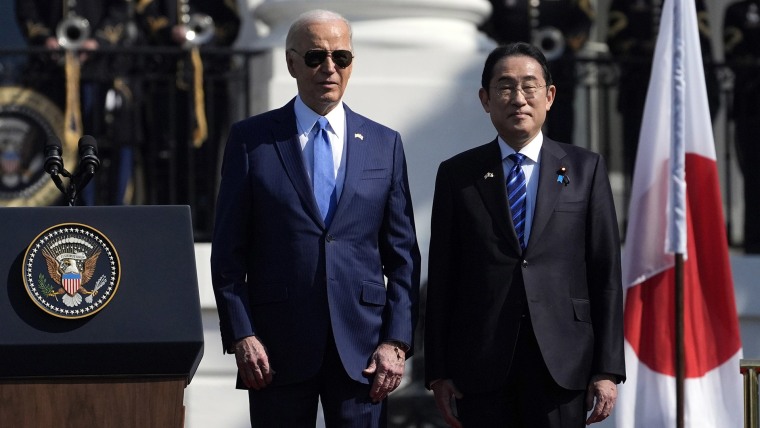
The U.S. and Japan announced a historic upgrade to their security alliance Wednesday, as President Joe Biden hosts Japanese Prime Minister Fumio Kishida for an official visit that highlights Japan’s role in countering China in the Asia-Pacific.
“Through our partnership, we have strengthened the alliance. We have expanded our work together. We’ve raised our shared ambitions,” Biden said in his opening remarks at a joint news conference in the White House Rose Garden. “And now the U.S.-Japan alliance is a beacon to the entire world.”
The official visit, the first by a Japanese leader in nine years, comes amid differences between the two countries over the proposed acquisition of U.S. Steel by a Japanese company.
Kishida addressed Biden’s opposition to the deal at the news conference, saying he hoped “these discussions will unfold in directions that would be positive for both sides,” according to the translation.
“Investment from Japan to the U.S. can only increase upwards in the months and years to come,” Kishida said. “And we wish to cement this win-win relationship.”
Biden said he stands by his commitment to American workers: “I’m a man of my word. I’m going to keep it.”
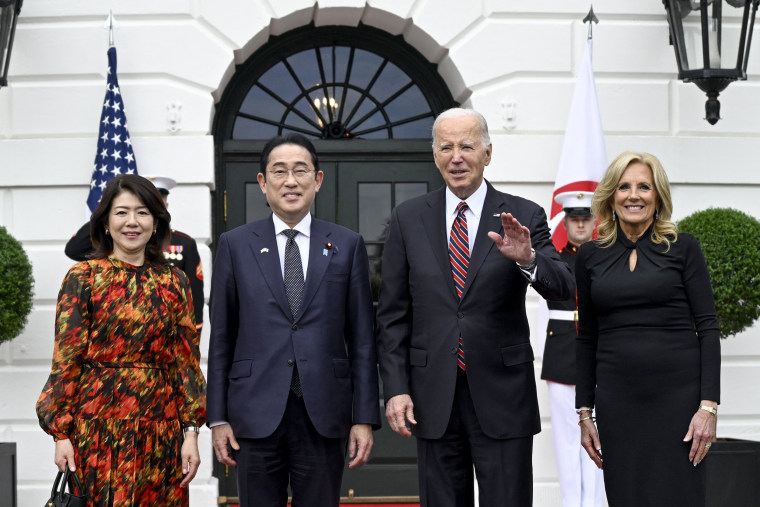
On Tuesday, the Bidens welcomed Kishida and his wife at the White House before they had dinner. The Biden-Kishida summit Wednesday was followed by a formal state dinner featuring dry-aged rib-eye steak, cherry blossoms and a performance by Paul Simon.
On Thursday, Kishida will address a joint meeting of Congress, becoming only the second Japanese leader to do so after Prime Minister Shinzo Abe in 2015. Then he will participate in trilateral talks with the U.S. and the Philippines that are the first of their kind.
Kishida concludes his trip Friday with a stop in North Carolina, where, according to Japanese media, he will visit the construction site of a new electric vehicle battery factory for the Japanese automaker Toyota that is expected to generate 5,000 jobs for U.S. workers.
In recent years, Japan has experienced a “sea change” in its perceptions of its security environment, as well as its role in it, said John Hemmings, senior associate director at the Pacific Forum research institute in Honolulu.
“They’ve become this sort of key enabler for the evolution of our security architecture,” he said.
Since he took office in 2021, Kishida has increased defense spending in Japan, a major shift in a country whose pacifist constitution has limited its military to self-defense since it lost World War II. Japan has also eased a postwar ban on the export of lethal weapons and has been a leader in establishing security groupings such as the Quad, which also includes the U.S., India and Australia.
The changes are driven by what Tokyo views as growing aggression by China, as well as creeping doubts about the U.S.’ presence in the Indo-Pacific and its reliability as an ally.

The U.S.-Japan summit, which is focused primarily on security, is meant to reassure Tokyo about the U.S. commitment to the security alliance, said Rana Mitter, a professor of U.S.-Asia relations at the Harvard Kennedy School.
It’s a “very public signal” that even though the Biden administration has been working to improve relations with China, it is not turning away from its allies in the region, he said.
Biden and Kishida announced plans to upgrade the U.S. military command structure in Japan, which hosts about 54,000 U.S. personnel, as Tokyo prepares for a new joint headquarters that will oversee all of its military operations. The two countries will also establish a military-industrial council to explore what kinds of defense weapons the U.S. and Japan can produce together.
The idea, Hemmings said, is to make the U.S. and Japanese militaries “much more capable of dealing with a near-peer adversary.”
The two leaders said Japan was among the countries being considered for participation in advanced capabilities projects under AUKUS, a security alliance between the U.S., Britain and Australia.

