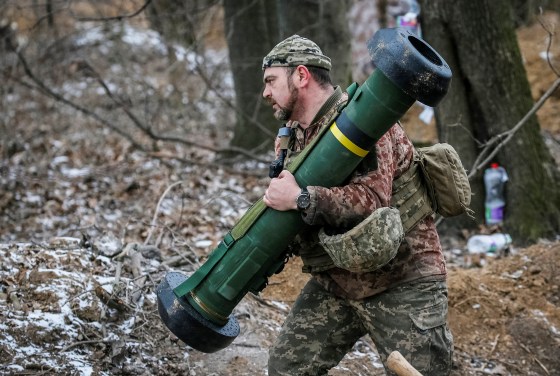
The Javelin antitank missiles that figured in former President Donald Trump’s first impeachment for deliberately delaying military aid to Ukraine are now wreaking havoc on the Russian invaders.
The lightweight but lethal weapon has, military experts said, helped the underdog Ukrainians inflict major damage on Moscow’s much-vaunted military and stymie their advance.
Not only has the United States-made weapon become a symbol of resistance, it’s been dubbed “Saint Javelin” in a meme circulating on the web created by Canadian marketer Christian Borys, which shows Mary Magdalene, a saint of the Orthodox church, cradling a Javelin in her arms.
“The Javelin, very specifically that system’s advanced capabilities, have been vital to Ukrainian military survival and ability to hold ground” against the Russians, said John Spencer, chair of urban warfare studies at the nonpartisan Madison Policy Forum in New York City.
Produced by defense contractors Raytheon and Lockheed Martin, the 46-pound weapon is shoulder-fired and has the “lethality to penetrate any tank or mobile vehicle on the battlefield,” Spencer said.
“It can also shoot down helicopters,” he said.
Mark Cancian of the Center for Strategic and International Studies agreed that the Javelins “have taken on a symbolic meaning beyond the military.”
“The Javelins are the most sophisticated and most effective weapon the Ukrainians have, but not the most numerous,” Cancian said.
The Ukrainians have more Israeli-made NLOS “Spike” antitank missiles in their arsenal as well as German Panzerfaust 3 antitank weapons, Cancian said.
“The short answer is that infantry antitank weapons (of which Javelin is one) seem to be quite effective,” Cancian said in an email to NBC News. “There are lots of social media videos of their use. Further, the Russians seem to be moving very slowly, if not actually stalled, and these weapons must be part of what has given the relatively small and weak Ukrainian forces so much ability to resist.”
Russia has roughly four times as many troops as Ukraine's 130,000-strong army. It also spends about $78 billion on its armed forces annually, compared to the $1.6 billion Ukraine has been able to budget for its military.
But Russia has only a quarter of its forces fighting in Ukraine, with the rest deployed in the Caucasus or defending the border with China. Meanwhile, Ukraine has some 900,000 reserves and is fighting on its home turf.
The FGM-148 Javelin is one of the more than 1,700 antitank weapons that have been rushed by NATO via Poland to Ukraine since Moscow’s forces invaded more than three weeks ago, and the evidence of their effectiveness soon became clear when the Russian tank advance on the capital city, Kyiv, was quickly stopped in its tracks, the experts said.
Manned most often by a team of two soldiers, the Javelin fires a heat-seeking missile with a range of up to 2.5 miles. It has what’s known as a “fire and forget” system, which allows the soldiers to quickly take cover after firing, before the enemy can detect them. It’s called a Javelin because it strikes tanks from the top like a spear, the experts said.
The Javelins can also fire directly at a target, making them a threat against low-flying helicopters, they said.
Also, they said, the Javelin is easy to use, which is a plus because much of the fighting in Ukraine is being done by civilians with very little military training.
The Ukrainians have touted the success of the Javelin by sharing images of their soldiers hefting the weapons along with photos of destroyed Russian tanks.
Kyiv put in its first order for a little over 200 Javelin missiles in 2018, according to various published reports. That same year, Trump signed an agreement to give Ukraine $250 million in military aid.