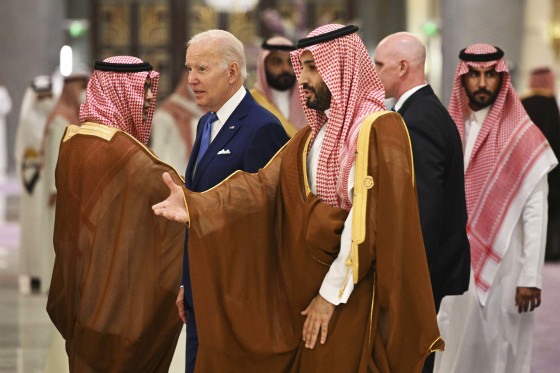
The United States is making progress toward a landmark agreement that would see Saudi Arabia normalize relations with Israel in exchange for a U.S. defense pact and help developing its own civilian nuclear program, two diplomatic sources told NBC News.
The complex talks are picking up steam and officials on all sides have voiced growing optimism in recent days that they could soon come together in a deal that would transform the political landscape of the Middle East and deliver a major foreign policy victory to President Joe Biden.
Formal recognition of the Jewish state by the Arab world’s most influential power would represent a tectonic shift in the region after more than half a century of conflict and animosity. It could also represent a diplomatic coup for the Biden administration, which has reversed its hard-line stance on Saudi Arabia in a bid to bring together two close U.S. allies as it seeks to ward off China’s growing ambitions.
But significant hurdles remain, including Israel's ongoing conflict with the Palestinians. The deal would see the Palestinians granted as-yet undefined land in the West Bank, the two sources said, but huge questions persist over what it would mean for their future.
Offering Riyadh a formal pact of mutual defense, an arrangement on par with U.S. guarantees to key allies such as Japan and South Korea, could also complicate the domestic politics of any deal.
If the deal were to come together, U.S. officials believe it would be early next year, before the presidential election campaign makes it difficult to get 67 votes in the Senate, which has to ratify the defense treaty and would need to approve helping the Gulf kingdom’s de facto ruler, the powerful Crown Prince Mohammed bin Salman, in his civilian nuclear ambitions.
Discussions about the Saudi defense pact were first reported by The New York Times.
'Still a challenge'
According to a senior U.S. official, Israel also wants a defense treaty with the U.S. to match any new Saudi treaty but the U.S. has not agreed to that. Israel already gets almost $4 billion a year in U.S. military assistance and administration officials believe that may make it harder to get an already complicated agreement through the Senate.
A recent poll from the Quincy Institute showed that just more than half of Americans would oppose an agreement between the U.S. and Saudi Arabia that would see Washington committing U.S. soldiers to defend the Saudis in the event of a war. The exact terms of any defense pact are unclear.
But a deal of this scale would be “transformative,” Secretary of State Antony Blinken told MSNBC on Thursday. He cautioned that there were still “a lot of moving pieces,” and that landing all of them would take “a tremendous amount of work.”
“We’re in the middle of it; it’s still a challenge,” he added.
National security adviser Jake Sullivan has made two trips to Saudi Arabia in recent weeks and sources familiar with his travel said he was actively engaged in the talks.

For Biden, the deal could offer a boost ahead of the 2024 presidential election, rivaling then-President Donald Trump’s Abraham Accords — a series of historic agreements signed in 2020 normalizing ties between Israel and Gulf states the United Arab Emirates and Bahrain.
Relations between Israel and Saudi Arabia have warmed up in recent years but this has remained informal.
Recognizing Israel would likely be seen as a betrayal by the Palestinians and those who support Palestinian statehood, and who have relied on Riyadh as a bedrock of the Arab world’s support.
In his address to the U.N. General Assembly on Thursday, Palestinian President Mahmoud Abbas dismissed as “delusional” the idea of peace in the Middle East without full rights for the Palestinian people. An agreement that doesn’t include real concessions to their cause could feed anger in the region.
In a separate statement to Palestinian news agency WAFA on Friday, Nabil Abu Rudeina, a spokesperson for Abbas said, “Peace begins with Palestine, and stability begins with the Palestinian people obtaining their legitimate national rights and establishing their independent Palestinian state with East Jerusalem as its capital. Without that, there is no peace, no security and no stability in the region.”
The growing Israel-Saudi ties have been driven in large part by mutual acrimony toward Iran.


