
MAINZ, Germany — While countries around the globe struggle to cope with the death, panic, restrictions and economic dislocation wrought by the coronavirus pandemic, a different picture has emerged in Germany.
Experts are scrambling to figure out why the country has around 34,000 confirmed infections — the fifth most in the world — but far fewer deaths than other countries.
There have been 172 recorded coronavirus deaths in Germany. That's just 0.5 percent of the total cases, higher than for the seasonal flu but drastically lower than Italy's soaring case death rate of almost 10 percent.
In fact, no other major country comes close to Germany. By comparison, the United States has about 55,000 recorded cases, and around 1.4 percent of those, about 800 people as of Wednesday, have died.

Experts have a number of theories about why Germany appears to be such an outlier, but they are cautious about holding up the country as an example during what is still likely to be the early stages of the pandemic.
"I would be happy if we can come back in two months' time and still be able to talk about what Germany did right," said Hajo Zeeb, a professor at the Leibniz Institute for Prevention Research and Epidemiology. "But right now it's simply too early to say that."
What is known is that Germany, with 82 million people, has recorded more cases per capita than Iran, France and the U.S.
Full coverage of the coronavirus outbreak
But in contrast to countries like Italy and the U.K. and large parts of the U.S., it has not shut down daily life, although it has banned public gatherings of more than two people. Its chancellor, Angela Merkel, tested negative but has isolated herself awaiting further results after one of her doctors became infected.
Germany is also better equipped than most countries when it comes to health care. It has 28,000 intensive care beds, considerably higher than the European average. Because it was not hit as early as Italy and elsewhere, it has also had time to prepare.

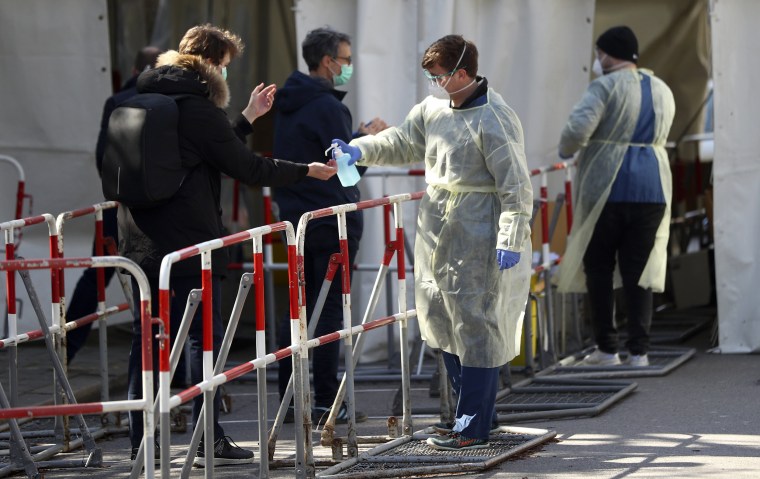
But many experts believe that the main reason behind its relatively low death rate is the large number of tests it has been able to conduct.
The government has not released official figures, but it says it has the capacity to test about 160,000 people every week.
As well as potentially helping identify and slow the spread of the contagion, widespread tests are likely to detect more mild cases that are going unrecorded in other countries, according to Dr. Mike Ryan, health emergencies director at the World Health Organization.
"They've had a very aggressive testing process," Ryan said at a briefing last week. "So the number of tests and the number of confirmed cases may be detecting more mild cases as a proportion of overall cases — that's an important determination."
The thinking is that other countries may be catching only the more severe cases of COVID-19, the disease caused by the virus, a larger proportion of whom are likely to die. Germany's death rate is effectively watered down, the theory goes, because its figure takes account of the many mild cases missed by other nations.
This question drives at the heart of a huge unknown in the coronavirus crisis: How many people have been infected but don't know it? Getting closer to that figure will give experts and officials a better idea how deadly the outbreak really is — more like Germany or more like Italy?
"The numbers we're getting from the other countries have probably overestimated the infection fatality rate, so that's Italy, Spain, France, the U.K. and the U.S., because there is not enough testing," said Miguel Hernan, a professor of epidemiology at Harvard University.
"Having said that, the 0.4 percent we're seeing in Germany is strikingly low when you compare it with other countries with similar health care systems and even more testing, like South Korea," he added.

