HONG KONG — Chinese leader Xi Jinping’s first two terms in power were marked by intensifying competition and tensions with the U.S. As he starts an unprecedented third term with tightened control over his party, relations between the two countries look set to get tenser.
“External attempts to suppress and contain China may escalate at any time,” he said at the start of a twice-a-decade congress of the ruling Communist Party of China last week.
Without naming Washington, Xi said China should “be ready to withstand high winds, choppy waters and even dangerous storms.”
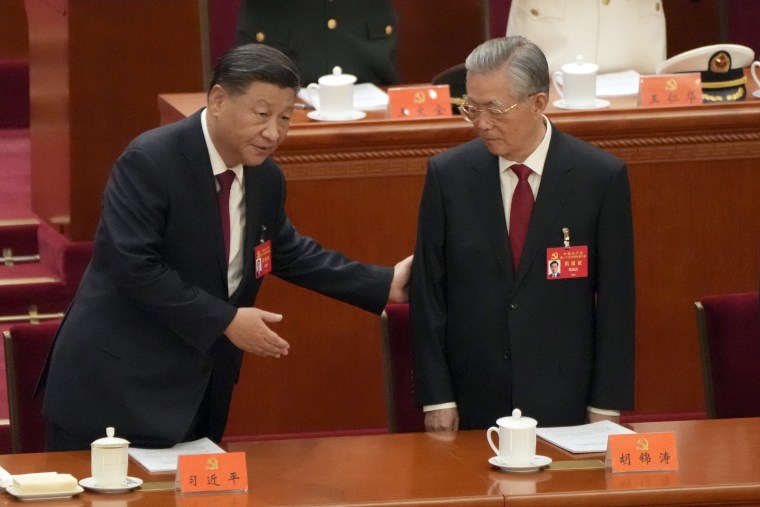
Days later, he emerged from the congress with a new leadership lineup that seems to exclude anyone who might question his hard-line policies.
“The message is that ‘I’m in control, I can do whatever I want.’”
Henry Gao, law professor at Singapore Management University said
The composition of the Politburo Standing Committee, China’s top decision-making body — made up of Xi and six of his close allies, all men — “confirms what most China watchers have long suspected: Collective leadership in China, long on life support, is now officially dead,” said Craig Singleton, a senior fellow at the Foundation for Defense of Democracies, a think tank in Washington.
“Xi has transformed the once powerful Standing Committee into a committee of one: himself.”
Meanwhile, promotions for Foreign Minister Wang Yi and Qin Gang, the Chinese ambassador to the U.S., were implicit endorsements of their aggressive “wolf warrior” style of diplomacy, he said.
At the same time, Liu He and Yang Jiechi, two key contacts for U.S. trade and foreign policy officials, were dropped from the party’s new 205-member Central Committee, both having surpassed the customary retirement age of 68.
“Their dismissal, and the relative dearth of other Chinese interlocutors with robust U.S. experience, will almost certainly complicate the Biden administration’s already difficult task of establishing so-called guardrails in Washington’s strategic rivalry with Beijing,” Singleton said in an email.
The recent developments follow at least a decade of worsening relations with China.
While the U.S. and China are not in a cold war, they are getting closer to one, said Jia Qingguo, a former dean of the School of International Studies at Peking University in Beijing.
“China certainly hopes that the Sino-U.S. relationship will be relatively stable, and ideally it can be improved” to the benefit of both countries, he said in an interview with The Carter Center in Atlanta published this week.
The problem, he said, is that many influential U.S. lawmakers and policymakers don’t see it that way. U.S. policy on China could remain tough in the short term, Jia said, particularly if Republicans make gains in congressional elections next month.
He cited U.S. lawmakers’ visits to Taiwan, the self-ruling democracy that Beijing claims as its territory, and newly expanded export controls on the sale of advanced semiconductor chips to China.
“The United States doing these things will cause China to react,” Jia said, “especially on the Taiwan issue.”
China saw House Speaker Nancy Pelosi’s contentious trip to the island in August as a further “hollowing out” of the “One China” principle that has underpinned U.S. policy on Taiwan for decades. Since then, Xi has made “reunification” with the island an even more central part of his agenda, although there is a consensus that China is unlikely to use force against Taiwan soon.
“There will be even less tolerance of countries that go against [China’s] view of Taiwan, so that could lead to more tensions,” said Ian Johnson, a senior fellow for China studies at the Council on Foreign Relations.
Taiwan’s foreign minister said Wednesday that China was likely to increase diplomatic pressure on the island, including trying to win over the 14 remaining countries that officially recognize Taipei rather than Beijing.
“Looking forward, our situation is becoming more difficult,” Foreign Minister Joseph Wu said in a report to the Taiwanese Parliament.