WASHINGTON — President Donald Trump's re-election message is that America is his.
Everything else at the Republican National Convention was a big muddle: China's a bad actor but Trump wants to make deals with China; Democratic nominee Joe Biden was too tough on crime in the 1990s but is too soft on it now; and the Confederate flag had to come down in South Carolina, but the Trump family won't let anyone "erase" history.
Some claims about Trump's were true; many were not.
As a point of contrast, the mixed messages bring the main theme about Trump more to the fore, but they also leave the GOP without a coherent plan to offer voters at a time of twin public health and economic crises. In both ways, they reflect how far Trump's transience has pushed the Republican Party into rallying around him rather than any fixed set of principles.
The Republican Party's agenda and ethos are defined by one principle: Trump first.
For the first time in its 166-year history, the GOP didn't bother to issue a new platform for its national convention. Instead, Trump and his aides previewed the four-day gathering as a moment for the party and the country to look hopefully toward a brighter future under his leadership.
Then the convention got underway.
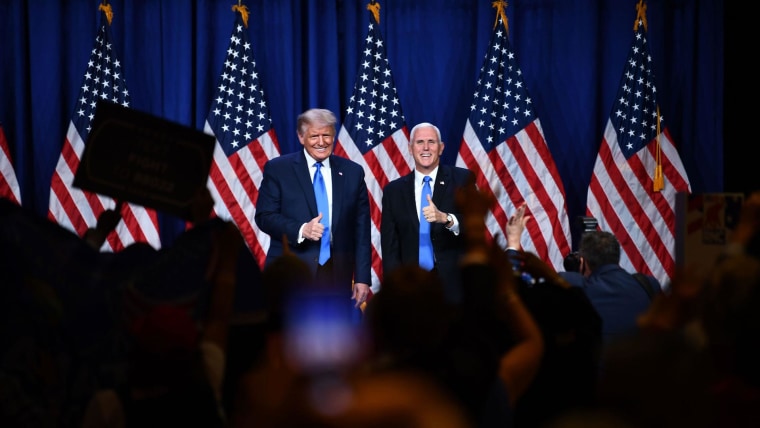
"The American way of life is being dismantled by a group of bitter, deceitful, vengeful activists who wish to tear down this gift we have been given," the first prime-time speaker, Turning Point USA's Charlie Kirk, said. "By re-electing Trump, we will ensure that our kids are raised to love America, not taught to hate our beautiful country."
While Trump has closed the sale on the idea that the Republican Party and its values are indistinguishable from him, there's plenty of evidence to suggest that his interests and broader national interests are often misaligned.
He was impeached over using federal money to try to extort Ukraine into announcing an investigation into Biden; his trade war with China has been so calamitous for many farmers that he was forced to implement socialist-style federal subsidies to offset the harm; and he has lurched through a coronavirus response in which his only consistent message or strategy has been trying to convince Americans that it's not that bad.
"It is what it is," he recently told Axios when informed of a death toll more than triple his onetime prediction of 50,000.
As the convention opened, U.S. and Chinese officials were working on the next round of a trade deal. Earlier in the day, Trump seemed to distance himself from his own previous agreement with Beijing, citing his term for the coronavirus as the reason.
"I feel so differently because the ink wasn't even dry on that trade deal when we got hit with the China virus," Trump said after boasting about China buying corn and soybeans as part of the initial accord. "I feel very differently about it."
Similarly, Mark and Patricia McCloskey, who were charged with illegal use of firearms after brandishing their weapons at peaceful protesters in St. Louis this summer, were allotted time to speak to the convention about the mayhem they predict if Biden is elected president.
"Whether it’s defunding the police, ending cash bail so criminals can be released back out on the streets the same day to riot again, or encouraging anarchy and chaos on our streets, it seems as if Democrats no longer view the government’s job as protecting honest citizens from criminals, but rather protecting criminals from honest citizens," Mark McCloskey said.
Biden, who does not support defunding the police, was also excoriated for the effects of the 1994 anti-crime law he sponsored in the Senate. Georgia state Rep. Vernon Jones, a Democrat, praised Trump for his support for a criminal justice law that seeks to reduce recidivism, lowers the mandatory minimum prison time for multiple drug offenses, and retroactively applies sentencing parity law for crack and powder cocaine.
"He ended, once and for all, the policy of incarceration of black people, which has decimated our communities, caused by no other than Joe Biden," Jones said.
Nikki Haley, the former U.S. ambassador to the United Nations, and Donald Trump Jr. provided another choose-your-own-version of Trumpism over memorials to the Confederacy that the Republican Party once fought.