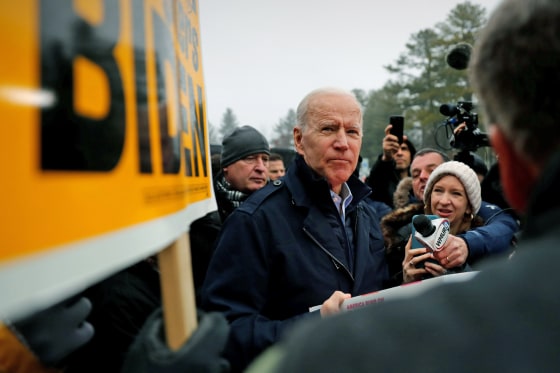
MANCHESTER, N.H. — Things will only get worse for Joe Biden before they get better, and his campaign knows it.
"You just have to keep going," said former Rep. Carol Shea-Porter, a Democrat from New Hampshire who is backing Biden. "It's tough, but nobody said this was going to be easy."
The former vice president has already written off Tuesday’s primary in New Hampshire, announcing hours after polls opened that he's fleeing the state to spend the evening in South Carolina, where he’s counting on his strength with black voters to redeem his struggling campaign in the state's Feb. 29 primary.
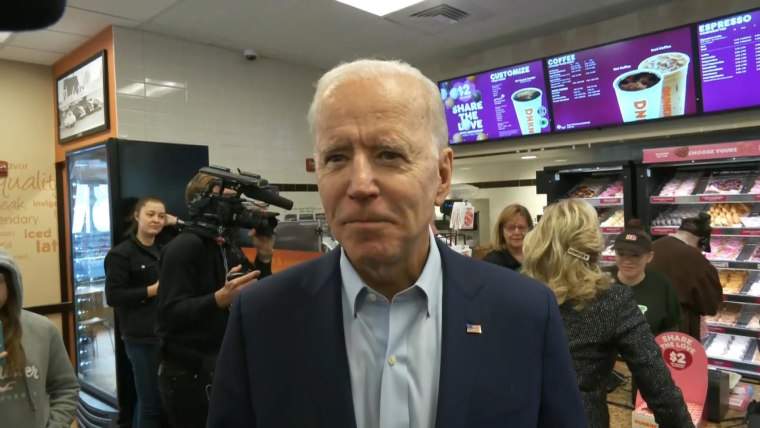
But to get there, he’ll have to suffer through 18 days of misery with no obvious source of reinforcements and plenty of battles left to fight that will determine whether he can regain momentum.
Anita Dunn, the veteran Democratic strategist and senior adviser who was recently elevated in a post-Iowa campaign shakeup, said Biden always knew the first two states were going to be rough.
"Even though there’s a huge amount of hyperventilating out there, the reality is this was basically what was always going to happen," Dunn told NBC News. "Once we get out of the first few states and go to states where the vice president has real electoral strength and other candidates do not, we’re confident that we will be able to compete and win.”
Dunn argued Biden’s support from labor unions and political leaders will become more valuable as the primary map expands and forces candidates to rely on allies to campaign for them. And she said voters in delegate-rich states that vote in March won't make up their mind until later.
"They’re not going to make up their minds based on what happens in February," she said.
The Biden campaign has always felt a bind about the first two contests, but advisers have said any discussion of skipping them was shortlived. They felt doing so would run counter to their argument about electability and the need for the elder statesman to demonstrate he wasn’t taking the nomination for granted.
The campaign ultimately made the decision in the late fall to ramp up their efforts in Iowa, sensing a chance to potentially preempt what they had long expected to be a drawn-out battle with early victories.
Then, amid troubling signs on the eve of the Iowa Caucuses, Biden again began downplaying the importance of overwhelmingly white first two states of Iowa and New Hampshire.
Now, Biden will have to retain his two core advantages in the face of likely back-to-back losses: his support among African American voters and the perception that he's the most electable Democrat against President Donald Trump.
A new Quinnipiac Poll showed Biden's support among black voters slipping amid growth for former New York Mayor Mike Bloomberg, who is looking to supplant Biden in the moderate lane of Democratic presidential field on Super Tuesday, March 3, when 14 states vote.
Rep. Cedric Richmond, D-La., the former chairman of the Congressional Black Caucus and a national co-chair of Biden’s campaign, downplayed the results of one poll and suggested pressure on Biden to quit the race amounts to silencing black voters.
"What I don’t want to do as the Democratic Party is declare a winner before African Americans have had a chance to speak," he told NBC News. "I don't think the Democratic Party should even have a formula where two nondiverse states can make a decision."
Biden advisers suggest that he will start drawing sharper contrasts with his untested rivals, who may not survive the scrutiny. And Richmond warned that other candidates have "fatal flaws" for the general election against Trump.
"Do I think that Bernie, do I think Pete, do I think Elizabeth, do I think Amy, do I think Bloomberg or any of those people may beat Trump in the popular vote? Possibly," Richmond said. "Do I think they’d beat Trump in the Electoral College? Absolutely not."
Bloomberg and his billions are clearly on the campaign's minds with Dunn noting that Bloomberg has "gotten almost no scrutiny" since entering the race, and saying she looked forward to him having to defend his record as mayor on a debate stage.

