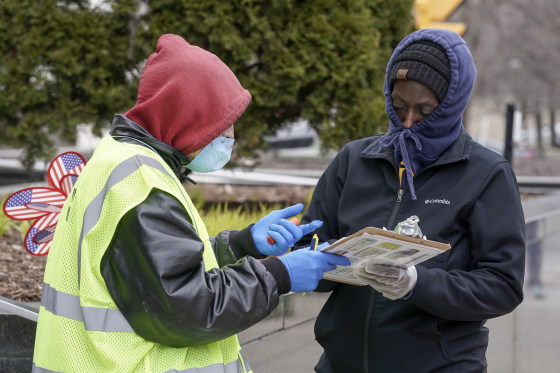
WASHINGTON — Wisconsin has ordered residents to stay at home, shuttered non-essential businesses, and banned "all public and private gatherings of any number of people" — but is still planning to proceed with an election Tuesday amid the coronavirus crisis.
Every other state that was supposed to hold a presidential primary contest in late March or April has postponed their elections or switched to vote-by-mail, leaving perhaps the most critical battleground state in the country alone in a now deserted stretch of the electoral calendar.
Bernie Sanders, who is to face off against Joe Biden in the election, joined calls to delay the primary Wednesday, but the state's Democratic governor and Republican legislative leaders have resisted calls to move the election, prompting lawsuits, strains on election infrastructure and outcry that voters will have to choose between their health and their right to vote.
"People should not be forced to put their lives on the line to vote, which is why 15 states are now following the advice of public health experts and delaying their elections. We urge Wisconsin to join them," Sanders said in a statement.
Biden has not yet commented on whether he believes the election should proceed.
A federal court may still call off the election this week, but officials preparing for the vote on Tuesday, say nearly 60 percent of municipalities have reported a shortage of poll workers, including 111 jurisdictions that cannot staff even a single polling place.
Residents have been urged to vote absentee instead, leading to an unprecedented surge in demand for mail-in ballots that has overwhelmed some local clerks.
"There’s no one place where we're seeing shortages — it truly is all across the state," Wisconsin Elections Commission administrator Meagan Wolfe said during a public teleconference meeting Tuesday.
The stakes are especially high in Wisconsin because the election is not just a presidential primary between Joe Biden and Bernie Sanders, but also a general election for down-ballot offices, including a Wisconsin Supreme Court seat that could influence voting rules in a state crucial to President Donald Trump’s reelection in November.
The terms of most local officials on the ballot Tuesday, such the mayor of the state’s largest city, Milwaukee, expire on April 21, so delaying the election might technically leave those offices vacant, increasing pressure on officials to proceed with the current date.
Full coverage of the coronavirus outbreak
The state Supreme Court election is technically non-partisan, but Trump has endorsed incumbent Justice Dan Kelly, a former official in the conservative Federalist Society who was appointed by then-GOP Gov. Scott Walker, while Democrats are backing Jill Karofsky, a judge and a former domestic violence prosecutor.
The winner could help decide, among other things, whether the state was right to purge hundreds of thousands of voters from the rolls.
"There are multiple voting-rights cases that will affect the November election that will come before the court this year and Kelly has already indicated that he will stop recusing himself in them after this election," said Ben Wikler, the chairman of the Wisconsin Democratic Party.
The last presidential primaries were held on March 17 in Illinois and Florida, where at least three poll workers have since tested positive for COVID-19. Ohio abruptly canceled its primary also scheduled for that day.
Tony Evers, the Democrat elected governor in the party's 2018 wave, had said last month that "it's important that our democracy continues,” while Republicans have also favored pushing ahead with the election.
Now, the governor's allies says he's powerless to change the date of the election because it's set by state law and would require the legislature to come back into session and act.
Instead, Evers on Friday called on state lawmakers to allow the state to send an absentee ballot to every voter, as other states have done in response to the pandemic, but Republicans and non-partisan experts said it would be difficult if not impossible to print and mail enough ballots on short notice.


