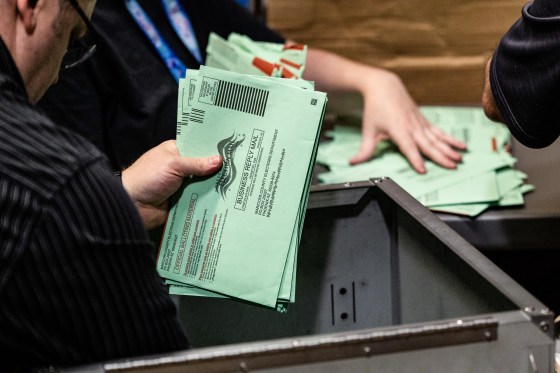
A top election official in Arizona filed a suit Tuesday that could bar almost 100,000 residents from voting in state and local races this fall, claiming they have not provided citizenship documents required under state law.
The suit from Maricopa County Recorder Stephen Richer is related to a specific part of Arizona election law that requires residents to provide documents that prove citizenship to vote in state and local elections. Such documents are not required for Arizona residents to register to vote or cast a ballot in federal elections. As is the case with many other states, Arizona requires that “U.S. citizenship must be sworn to” to participate in federal elections.
Under Arizona law, residents who fail to submit documentary proof of citizenship — or “whose U.S. citizenship cannot be verified” via their driver's license registration records “or other record in the statewide voter registration database” may only vote in federal elections.
In a lengthy post on X, Richer, who helps oversee elections in the battleground state's largest county, said his office had discovered a “flaw” in the way state officials and systems verify citizenship via driver's license registration records that resulted in 97,000 people who have sworn that they are U.S. citizens not having had provided documented proof of citizenship.
“All of these people have attested under penalty of law that they are U.S. citizens. And, in all likelihood, they [are] almost all U.S. Citizens,” Richer, a Republican elected official, wrote. “But they have NOT provided documented proof of citizenship.”
As a result, if those 97,000 people failed to provide such documentation, they won’t be able to vote in state and local races this fall, Richer said.
The suit, which will be filed to the state Supreme Court, comes as Republicans nationally have sought to crack down on noncitizen voting. Former President Donald Trump and his allies have portrayed it as a widespread problem, even though it is illegal and rarely occurs.
Richer, however, is an outspoken defender of the swing state’s election process who has forcefully pushed back against the unfounded voter fraud claims that spread after the 2020 and 2022 campaigns. He lost his GOP primary in July to Justin Heap, a critic of Maricopa County elections who has dodged questions about whether the 2020 election was fraudulent.
Regardless of the suit’s outcome, the affected group of voters will still be able to vote in Arizona's key presidential and Senate races this year. But it remains possible they could be barred from casting ballots in competitive elections further down the ballot, including state legislative races and a proposed constitutional amendment that seeks to enshrine abortion access.
At a news conference Tuesday, state Secretary of State Adrian Fontes positioned the legal battle as one designed simply to get a quick ruling on an ambiguous issue.
“There are no fights in fact” and there are “no fights in process,” Fontes said. “We’re just taking differing legal positions so we can get the rule.”
He predicted the state Supreme Court would rule this week, as mail-in ballots are scheduled to be sent out in some counties to some military voters as early as Thursday.
Asked by NBC News whether the situation could spur new election conspiracy theories, Fontes replied that “this has already spurred new conspiracy theories about this election.”
“But those conspiracy theories are just as good as all of the other conspiracy theories are,” Fontes said. “We have the facts. We are bringing them forward in a very transparent way, some might argue a little too transparent, and we’re making sure that people understand that we are working on this diligently."
Earlier Tuesday, after news of the suit broke, Trump ally and right-wing activist Laura Loomer claimed on X that "Arizona may have just illegally registered 100,000 illegal aliens to vote!" She added, "The plot to steal 2024 is already underway."
Loomer has spread false conspiracy theories about undocumented immigrants registering to vote and about mass shootings helping Democrats get elected.
Fontes added at his news conference that one reason the legal question had to be settled so quickly and crucially in the first place was that “we’ve got policies that are being driven by conspiracy theories, and we have for a long time.”
“It has never been the case in the United States of America or in Arizona that noncitizen voting has been anything other than vanishingly rare,” Fontes said.

