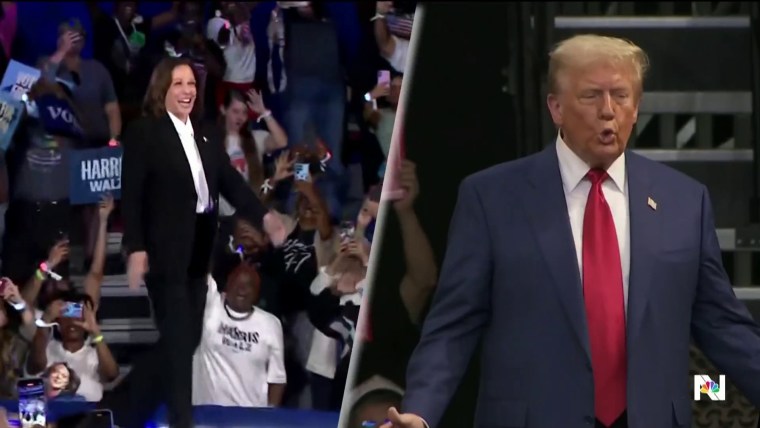
Vice President Kamala Harris’ campaign laid out what it sees as her path to victory in Pennsylvania in a memo shared exclusively with NBC News ahead of Monday night’s rally in bellwether Erie County.
The Harris team pointed to polls showing Harris, the Democratic presidential nominee, having made gains in the battleground state’s suburbs — which it dubbed “our own mini ‘blue wall’” in Pennsylvania — compared with President Joe Biden’s 2020 performance there.
The campaign also emphasized that a win involves boosting its popularity among educated suburbanites, including those who have voted for Republicans in recent elections. Nearly 160,000 voters in the state cast ballots for former U.N. Ambassador Nikki Haley in the GOP presidential primary this year — with her numbers proving stronger among suburban voters — even after she had already dropped out of the race against former President Donald Trump.
“The Harris campaign’s path to win Pennsylvania capitalizes on Trump’s unprecedented weakness in the suburbs,” reads the memo, which also highlighted the campaign’s focus on Haley voters. “We have flipped the suburbs from red to blue since Trump won them in 2020, and we have also grown our support with women and tripled our support among white college educated voters in the state.”
The campaign cited surveys last month from The Philadelphia Inquirer/The New York Times/Siena College and Marist College that both showed Harris up 6 percentage points over Trump in the suburbs — a notable improvement from Trump’s 3-point victory over Biden among suburban Pennsylvanians in 2020, as exit polls showed. (The results in both of the surveys last month fell within their margins of error.)
Recent surveys have found the overall race in Pennsylvania to be within the margin of error for polls, with a survey from Quinnipiac University this month finding Harris up 3 points, an Inquirer/Times/Siena survey finding her up 4 points and The Wall Street Journal having Trump up 1 point.
It’s the most sought-after battleground on the map, offering the most Electoral College votes among the hotly contested states, and it is the most frequent campaign destination for both Harris and Trump.
Trump’s “weakness in the suburbs means that for him to actually win, he has to double and triple down on his base in the reddest counties in the state,” said Brendan McPhillips, a senior adviser to Harris’ Pennsylvania campaign. “And so we are going on offense and going to places where he thinks he has a strength and competing.”
The campaign highlighted events that Harris and her running mate, Minnesota Gov. Tim Walz, have held in red-county towns like Johnstown, Lancaster and Rochester. It also detailed investments made in red parts of the state to “cut margins and stop Trump’s only hope of victory,” noting that 16 of its 50 statewide campaign offices are in counties Trump won by more than 10 points in 2020.
Recent presidential elections in Pennsylvania have been exceptionally close. Biden defeated Trump in 2020 by just over 1 point. In 2016, Trump beat former Secretary of State Hillary Clinton by an even slimmer margin.
“With most polls showing this to be a margin of error race, we are also going on offense with rural voters to cut into Trump’s margins — a critical advantage as Trump’s team lacks the ground game capacity to conduct persuasion and mobilization campaigns simultaneously,” the Harris campaign memo reads.
McPhillips said improving on Biden’s margins in those counties by just 1 to 2 points would effectively cut off Trump’s path to flipping the state red.
“We’re eating into his margins in a way that cannot sustain a victory,” he said. “And that is how we’re going to beat him, and it’s how we’re able to play offense on so many fronts.”
The campaign highlighted that as of Sunday it had knocked on more than 1 million doors across the state, including 250,000 over the weekend, since Harris replaced Biden atop the Democratic ticket. It also referred to its 50 offices and 450 on-the-ground staff members.
Harris has so far spent far more time in the western part of the state, including rural areas, than she has in the Philadelphia market, which McPhillips said is partly to help introduce her to voters who may be less familiar with her.
For Trump, billionaire mogul Elon Musk ramped up his political engagement in the state this month through his America PAC, which is working to turn out the vote for Trump.
McPhillips dismissed the potential impact of that effort.
“They can’t scale up to the level that we’re at,” he said. “Even with Elon Musk’s money, you can’t spend enough money to scale up an operation to match ours. It’s too late. You needed to start in March, February, January, and they’ve just been phoning it in for so long. It’s going to be close, for sure. We’ve always been planning for it to be so. But that planning manifests itself in the fact that we actually had a plan, not a concept of one.”