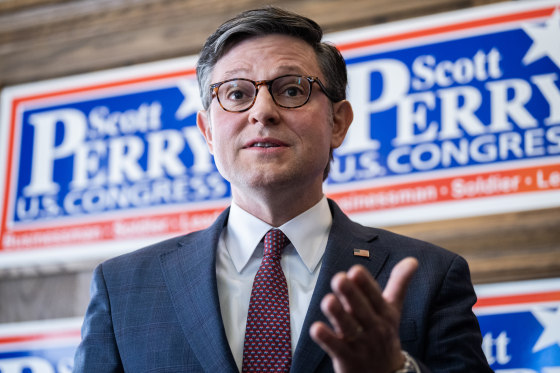
HELLERTOWN, Pa. — A country club audience of roughly 150 Republican supporters and donors gathered here at the Steel Club, noshing on barbecue ribs and sipping glasses of chardonnay and lemonade.
Just a floor above, Speaker Mike Johnson, R-La., sat in a quiet conference room detailing how Republicans will grow the House majority and win back the White House and Senate: by capturing a larger percentage of Hispanic, Black and Jewish voters as well as union workers than in past elections, he says.
“When we do the math on the other side of this election, this will bear out that we will have had a demographic shift,” Johnson said in an exclusive interview with NBC News before the campaign event in Hellertown.
“I think we’re going to have a record number of Hispanic and Latino voters. I think a record number of Black and African American voters, Jewish voters, union voters. I’m talking to all these groups of people,” he continued. “And they’re not just coming on board reluctantly; they are excited.”
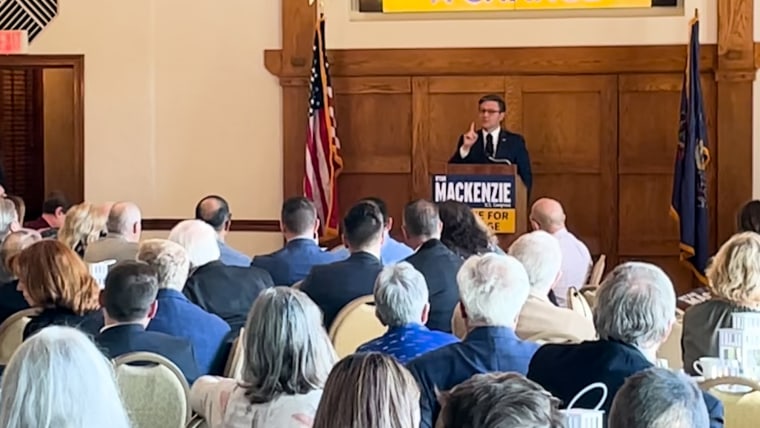
The 52-year-old speaker has campaigned this cycle in more than 220 cities in 40 states, including a swing last week through the Keystone State. In these final three weeks before Election Day, he'll set foot in 65 other cities in 24 states as Republicans seek to attract new voters to defend or increase their minuscule three-seat majority in the House.
Even as GOP nominee Donald Trump frequently deploys anti-immigrant rhetoric and racial attacks on Vice President Kamala Harris, recent polls show support for her party eroding among some of these reliable Democratic voting blocs — and Republicans say they are ready to capitalize.
An NBC News/Telemundo/CNBC poll last month showed Harris leading Trump among Latino voters nationally 54% to 40%, or by 14 percentage points, down from a 36-point advantage for Democrats in the presidential race in 2020 and a 50-point advantage in 2016.
A New York Times/Sienna College poll unveiled over the weekend found Harris still enjoys a huge advantage over Trump among Black voters but that number has also slipped slightly. Nearly 80% of likely Black voters back the vice president, down from 90% who backed Joe Biden in 2020. About 15% say they’d vote for Trump in November, up from 9% four years ago, the poll shows.
Asked for comment, the Harris campaign referred to a memo to reporters Sunday pushing back on the GOP suggestion that the vice president's support is eroding among key groups. They highlighted a CBS poll that showed Harris’ support among Latinos at 63%, roughly in line with where Biden was in 2020. That same poll also found that Harris leads Trump among Black voters 87% to 12%, matching Biden’s lead among that key voting bloc in exit polling.
Trump and Republicans hope to see a big turnout from their base, namely white, non-college-educated, working-class voters. But they also see opportunities to win over pockets of Jewish voters in critical swing states like Nevada and Pennsylvania who have felt alienated by liberal anti-Israel protests following the deadly Oct. 7, 2023, Hamas terror attack and Israel’s subsequent war in Gaza.
Johnson said he spoke to a standing-room-only crowd at an event in Las Vegas commemorating the anniversary of the Oct. 7 attack. “They were wearing red yarmulkes with Trump’s name on it," he said.
Republicans are also working to make inroads with union workers. Johnson pointed to the firefighters union deciding this month not to endorse either Harris or Trump as evidence union support is waning for the Democrats; the International Association of Fire Fighters was the first union to endorse Biden in 2020. The Teamsters also declined to endorse in the presidential race this cycle for the first time in decades.
“I’m not 100% certain that all of this is fully registered in the national polling, and we’ve all learned not to put too much stock in that,” Johnson said in the interview. “But I can tell you that what I’m seeing on the ground — and it’s not just red states, it’s the blue states — that there’s something happening. And I’m convinced we’re going to win the House, the White House and the Senate.”
220 cities, 40 states
At rallies, Trump and Johnson have blamed Harris for the high cost of goods and failing to secure the border — two top issues for voters — even as inflation has dropped significantly during the Biden-Harris administration and Trump helped kill a bipartisan Senate border deal.
“It’s a real erosion in their base,” Johnson said of the Democrats. "And the reason is because I think people are genuinely looking beyond party, beyond personality. I think they’re looking at the policies because they’re evaluating how their lives are now and how they were four years ago.”
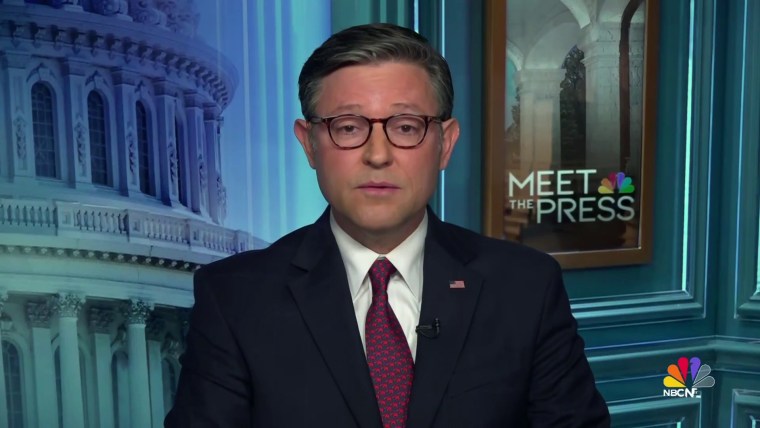
Moments later, downstairs at the Steel Club, Johnson spoke again about the “true, real and, I hope, lasting, demographic shift in the electorate" that will hand victory to Republicans.
It’s a message the speaker has been sharing in rooms full of GOP donors and party faithful as he barnstorms battleground Pennsylvania and the country in the final sprint of the 2024 campaign.
The bulk of his time on the campaign trail has been spent in battleground districts in California and New York, blue states where his party is defending a dozen seats and trying to flip a handful of others. The majority could be won or lost in either of those two states, given how closely divided the House is. But Pennsylvania could also be critical, boasting a handful of tight races in swing districts.
A test for the new speaker
Propelled from obscurity to second in line to the presidency after Kevin McCarthy’s shocking ouster, Johnson will mark one year as speaker of the House on Oct. 25. There were doubts about whether he could raise campaign cash like McCarthy, one of the party’s most prolific fundraisers and whether Johnson would be too conservative to campaign in the 18 GOP-held districts that Biden won in 2020, like Fitzpatrick’s.

