A year and a half after Donald Trump’s victory in Wisconsin, Democrats are sensing a vibe shift that could reshape the balance of power in the critical battleground state.
In the last three months, seven state Republican lawmakers have announced their retirements — including the party leaders in the Assembly and the Senate — providing a boost to Democrats’ hopes they could win control of at least one legislative chamber for the first time in 16 years.
A massive fundraising advantage in next month’s open Wisconsin Supreme Court race has liberals feeling confident about further expanding their majority on a bench that up until a few years ago was long dominated by conservatives. Liberals are already even eyeing another seat next year, after a conservative justice said she wouldn’t run for re-election.
And Democrats are hoping another state Supreme Court victory would provide a jolt of momentum heading into a governor’s contest that will bring significant change no matter the result. A crowded field of Democratic candidates is vying to succeed Gov. Tony Evers and likely take on GOP front-runner Rep. Tom Tiffany in November.
“These retirements have largely confirmed what we had already thought, which is that we have an extraordinary opportunity this year in Wisconsin,” Wisconsin Democratic Party Chairman Devin Remiker said in an interview, referring to the GOP lawmakers who declined to run for re-election. “I think that a very potent disaster is brewing for Republicans, and it is my desire to capitalize on it by winning the Democratic trifecta.”
Recent polling underscores that the political winds are currently blowing in Democrats’ direction. A Marquette University Law School poll conducted in mid-March found that about half of Wisconsin Democrats said they were very enthusiastic about voting in the technically nonpartisan Supreme Court election in April, compared to a third of Republicans. And the survey showed that 56% of registered voters disapproved of Trump’s job performance. That’s the highest share from any of Marquette’s Wisconsin polls during the president's two terms in office, the Milwaukee Journal Sentinel noted.
The 2026 elections mark a continuation of Democrats’ efforts to unravel Republicans’ hold on state power that began in 2010, when the GOP had a trifecta. Over two terms in office, Republican Gov. Scott Walker, with majorities in the Legislature and on the Supreme Court, enacted a sweeping conservative agenda.
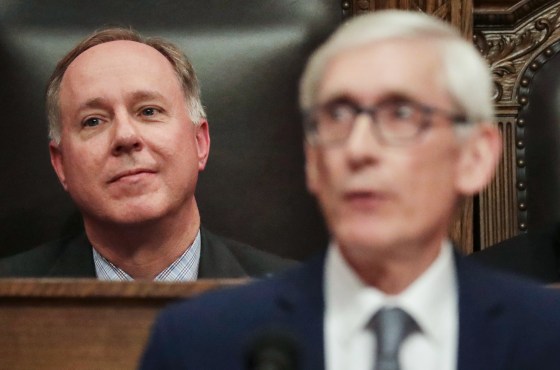
Since then, Democrats have gained control of the governorship and the Supreme Court, and now have their sights on maintaining their advantages there while making inroads in the Legislature this year, with more competitive maps in place. Most notable among the recent string of retirements was Assembly Speaker Robin Vos, who had held the position since 2013.
“There is certainly a changing of the guard. The top three people in the Capitol today are all not going to be there a year from now. It’s going to be a significant turnover in terms of who’s making decisions in that building come next year,” said Mark Graul, a Republican strategist in Wisconsin.
In addition to Vos, Wisconsin Senate President Devin LeMahieu, who has held the job since 2021, announced last week he would not seek another term. Of the seven retiring Republican lawmakers, all but one has served in the Legislature for at least a decade, and in many cases far longer.
The Republican lawmaker exodus is also inextricably linked with the liberals’ ascent on the state Supreme Court. Armed with their first majority on the high court in 15 years after an expensive and high-profile election in 2023, liberals quickly struck down the state’s legislative maps that heavily favored the GOP. Democrats then made substantial gains in both legislative chambers in the 2024 elections. This year, they would need to net two seats to control the state Senate and five seats to have a majority in the Assembly.
After retaining their majority in an even more expensive state Supreme Court race last year, liberals could put control of the bench out of reach for conservatives for at least the rest of the decade in less than two weeks.
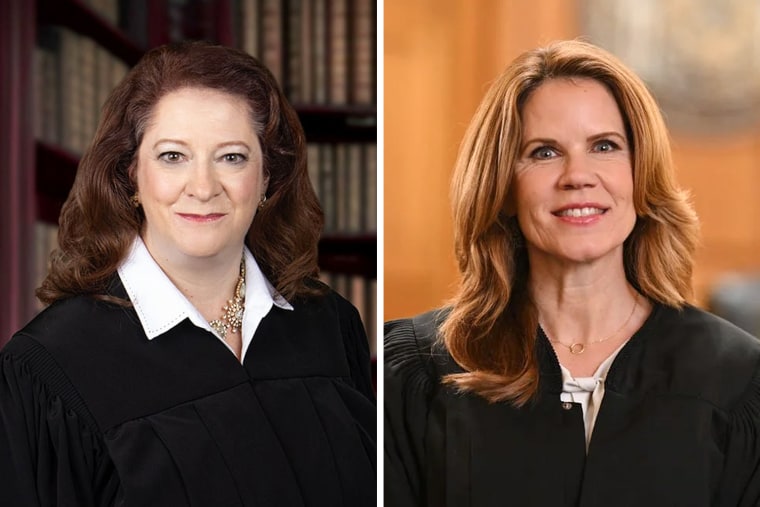
The Democratic-backed Chris Taylor holds a clear fundraising and ad spending advantage over Republican-backed Maria Lazar in the race to fill a seat held by retiring conservative Justice Rebecca Bradley. The election has been much quieter than the last two court races in Wisconsin, with 46% of voters saying they were undecided in the new Marquette poll. But Taylor held a slight lead with 30% support, compared to 22% for Lazar.
Democrats have said they’re encouraged by early voting data in the race, even as turnout is down so far from last year’s election.
Meanwhile, the governor’s race is still taking shape. Of the eight Democratic candidates included in Marquette’s poll, only one, former lieutenant governor and Senate candidate Mandela Barnes had name identification above 50%. The primary will mark a generational shift for the party, as the leading candidates are all much younger than Evers, 74.
Wisconsin Republican Party spokesperson Anika Rickard rejected that the raft of GOP lawmaker retirements would fuel Democratic gains and expressed optimism around her party’s prospects in the Supreme Court and governor races, too.
“I don’t think their departures indicate anything when it comes to flipping the Senate or the Assembly. We’re very confident we’ll hold both of those,” she said. “The energy is still on our side, not with Democrats.”
Democrats and Democratic-backed candidates have won 18 of the last 23 statewide races in Wisconsin. But that hasn’t affected its swing state status. The last three presidential elections in Wisconsin, two of which Trump won, were decided by less than 1 point. Regardless of what happens in the state this year over the next seven months, it will once again be at the center of the 2028 map.

