Six years after President Donald Trump attempted to overturn the 2020 election results, that campaign is still shaping Georgia’s next big vote.
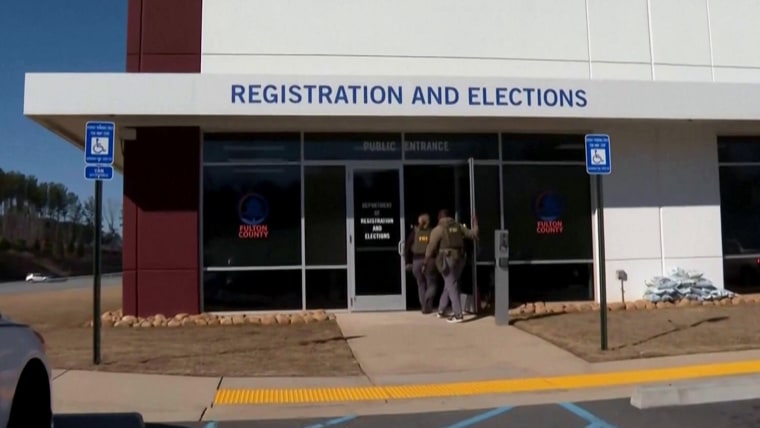
The race to be Georgia’s next governor features a handful of Republican candidates who played integral roles on both sides of Trump’s obsession with the 2020 race. And the saga is far from over: Last week, the FBI searched an election hub in Fulton County seeking records related to the 2020 election.
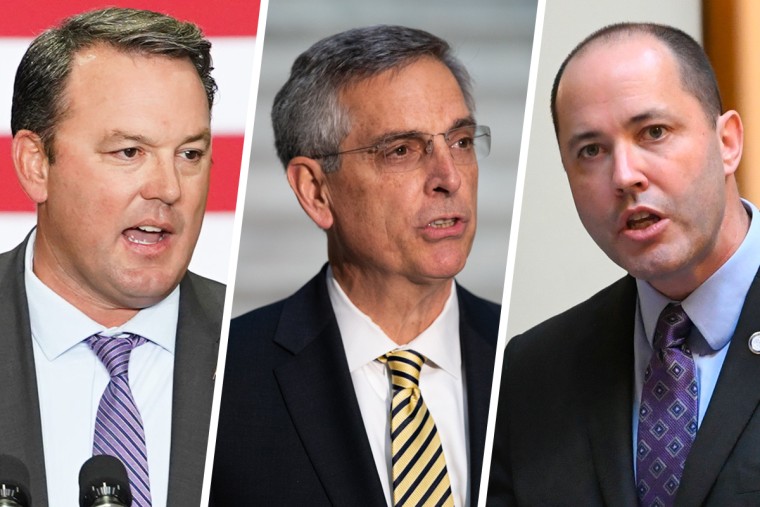
Lt. Gov. Burt Jones — who was on the alternate slate of presidential electors who cast votes for Trump at the state Capitol after an official tally confirmed his defeat by Joe Biden — has Trump’s endorsement in the crowded primary for governor.
Also running are two key Republican state officials who refused Trump’s demands to flip the election: Secretary of State Brad Raffensperger, who rejected Trump’s plea to “find” more votes in Georgia, and state Attorney General Chris Carr, who repeatedly said there was no widespread voter fraud in the state, earning the wrath of Trump.
The race to succeed outgoing Republican Gov. Brian Kemp, who is term-limited, is heating up just as news surrounding the 2020 election has re-emerged in the Peach State, with Trump’s Justice Department getting a search warrant for the Fulton County election facility.
What the FBI is investigating remains unclear, though Fulton County, in particular, has been a fixation of Trump’s since his 2020 loss.
Biden won the 2020 election in Georgia and nationally, and there is no evidence of widespread voter fraud. Trump and his allies have continued to make false claims about voter fraud and the results of the 2020 race in many swing states.
Jones, for his part, has continued to highlight that election.
In a recent op-ed in The Federalist, a conservative website, Jones wrote that Americans had been “told to stop asking questions” about the 2020 results, lamenting that “in Georgia, as in much of the country, anyone who raised concerns about the 2020 election was mocked, dismissed, or accused of undermining democracy itself.”
He attacked Raffensperger for being “at the center of that effort” because he “repeatedly assured voters there were no problems — no violations, no misconduct, nothing to see — publicly stating there was ‘no sign of widespread fraud’ during Georgia’s election process, refuting claims of irregularities in a letter to Congress, and again asserting that officials had not found systemic fraud.”
Last week, Jones requested that Raffensperger appear before the state Senate Ethics Committee to respond to questions about a crop of Fulton County ballots from the 2020 election. The tabulation tapes for those ballots were not signed by poll workers as they should have been, but Raffensperger called it a “clerical error” and said the voters were verified via other checks.
On Wednesday, Jones defended the FBI action in Fulton County and criticized Raffensperger and Carr in a post on X.
“Fulton County Elections couldn’t run a bake sale. And unfortunately, our Secretary of State hasn’t fixed the corruption and our Attorney General hasn’t prosecuted it,” Jones wrote.
In response to questions from NBC News for this article, Jones’ campaign spokesperson Kayla Lott pointed to that post. Raffensperger’s and Carr’s campaigns did not respond to questions.
While the FBI search put the 2020 race back into focus, this issue has been such a relentless focus for Trump and his allies that it may help Jones energize MAGA loyalists.
“This is all about trying to appeal to the Republican primary voters, of whom the large majority are still very much supportive of Trump,” said Alan Abramowitz, an expert on Georgia elections and a political scientist at Emory University in Atlanta. “How you appeal to the Republican primary electorate is by trying to demonstrate that you remain loyal to the president.”
It’s no sure thing that Jones’ approach will result in success during the primary. Four years ago, in a 2022 GOP primary cycle divided sharply between candidates who did or did not back Trump’s claims about the 2020 election, Raffensperger overcame a primary challenge from then-Rep. Jody Hice, whom Trump endorsed and who built his entire campaign around claims that the 2020 election was stolen. Carr, too, beat a Trump-backed primary challenger and cruised to re-election as attorney general.
Those rejections could foreshadow potential problems for Jones in a general election if he were to advance through the spring gubernatorial primary, Abramowitz said.


