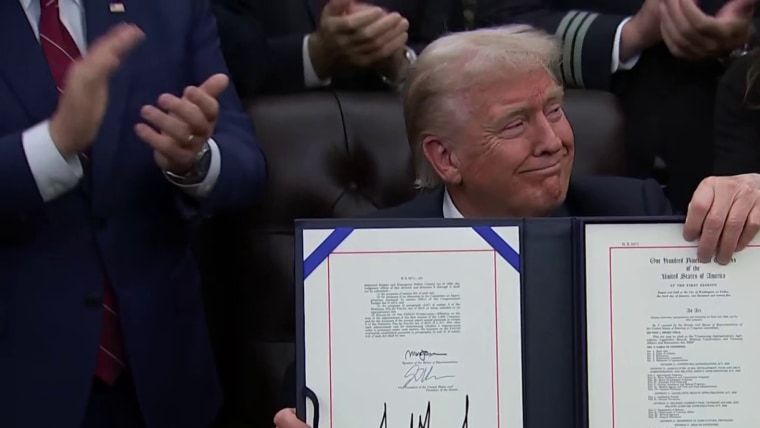
WASHINGTON — President Donald Trump on Wednesday night signed into law legislation that reopens the federal government and ends an acrimonious 43-day shutdown, the longest in American history.
Trump’s signature, which restores funding that has been frozen or halted for weeks, came shortly after the House voted 222-209 to send him the measure. Six Democrats joined nearly all Republicans in voting yes, and two Republicans joined most Democrats in voting no.
The Senate approved the same legislation Monday when eight Democrats peeled off and voted with Republicans to break a filibuster and end the shutdown.
In Oval Office remarks, Trump blamed Democrats for the shutdown.
"So I just want to tell the American people, you should not forget this. When we come up to midterms and other things, don’t forget what they’ve done to our country," he said.
The successful House vote came after Speaker Mike Johnson, R-La., brought the Republican-controlled chamber back into session Wednesday for the first time since Sept. 19, wrapping up an extraordinarily long and unscheduled recess.
Johnson said he felt “very relieved,” before pointing the finger across the aisle, saying “Democrats were responsible for this.”
“Millions of American families went without food on their table. You had millions of Americans stranded in airports, their flights canceled and delayed. You had troops and federal employees wondering where their next paycheck would come from,” he told reporters. “I want to say that all this was utterly pointless and foolish.”

The legislative package includes a “minibus” of three appropriations bills providing funding through September and keeps the rest of the government open at current levels through Jan. 30.
It includes full funding for the Supplemental Nutrition Assistance Program, also known as food stamps, which will keep the program afloat through September. More than 40 million Americans rely on SNAP. Some people told NBC News that they ran out of food as the shutdown cut off money for the program, and the Trump administration fought in the courts against having to shift money around to fully fund it for the month of November.
The legislation also provides limited protections for federal workers who’ve been under assault since Trump’s inauguration. It reinstates thousands of government employees who were laid off during the shutdown and ensures there are no more reductions in force (known as “RIFs”), at least through the end of January. And it provides back pay for workers who were furloughed or working without pay these past six weeks.
But in a major concession from Democrats, the bill does not include an extension of enhanced subsidies under the Affordable Care Act, or Obamacare, after Republicans held firm against extending those funds beyond 2025. That means more than 20 million Americans could see their premiums spike next year.
Many House and Senate Democrats are fuming over the failure to secure health care funding as part of the bill. Senate Majority Leader John Thune, R-S.D., has promised a Senate vote on a to-be-determined ACA funding bill, with no guarantees that it will pass. Johnson has not promised a similar vote in the House.
"We cannot enable this kind of cruelty with our cowardice," said progressive Rep. Alexandria Ocasio-Cortez, D-N.Y.
In the House Rules Committee on Tuesday, Republicans rejected Democratic motions to guarantee a floor vote on an ACA funding extension, and turned away an amendment by Rep. Steven Horsford, D-Nev., to redirect Trump’s $40 billion “bailout” to Argentina and instead put that to extending ACA funding.
“I guess MAGA stands for MAKE ARGENTINA GREAT AGAIN,” Rep. Teresa Leger Fernández, D-N.M., said in response.
In a bullish sign for the legislation’s prospects heading into the floor vote, the sometimes rebellious House Freedom Caucus circulated talking points internally praising the bill, which were obtained by NBC News. The document called it a “responsible CR” that funds the government into 2026 and avoids a “bloated” omnibus to be negotiated over Christmas. And, it notes, the appropriations bills in the minibus either kept spending flat or contained only modest increases.
“The House Freedom Caucus has fought in lock-step with President Trump and Republican leadership in Congress,” the Freedom Caucus document said.