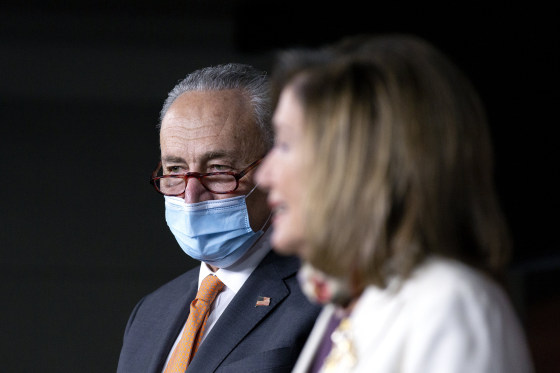
WASHINGTON — Democratic and White House negotiators trying to strike a deal for another round of coronavirus aid emerged after more than three hours of talks on Thursday warning a stalemate could be looming as division over provisions like jobless benefits remain.
“There are a lot of issues we are close to a compromise position on but I think there are a handful of very big issues we are still very far apart,” Treasury Secretary Steve Mnuchin said after meeting with Democratic congressional leaders.
After days of fruitless talks, frustration appeared to be boiling over. House Speaker Nancy Pelosi, D-Calif., said White House Chief of Staff Mark Meadows at one point slammed his hand on the table. Meadows called the description "fabricated."
President Donald Trump, who was attending a political fundraiser at a yacht club near Cleveland, Ohio, called in several times during the meeting, Mnuchin said.
Negotiations have focused on key points, including whether to continue boosted weekly unemployment payments and at what level, and whether to provide aid to local governments grappling with the pandemic.
The two sides — Democratic congressional leaders and the White House — have been unable to reach even a top-line spending agreement, with more than a trillion dollar difference in how much should be spent.
“We're very disappointed in the meeting," Senate Minority Leader Chuck Schumer, D-N.Y., said after Thursday's meeting. “We urge our Republican colleagues to come back and continue to negotiate,” Schumer said. “A few times, it looked like they weren't going to do that.” The issues that are yet to be resolved: state and local funding, unemployment insurance, how school funds are spent, food assistance and rental assistance.
The White House continued to warn a deal is needed by the end of the week. The arbitrary deadline was expressed after the $600-a-week boost in jobless benefits expired at the end of July.
Trump took to Twitter on Thursday to threaten to use an executive order to accomplish a myriad of elements currently being debated, including unemployment payments, an eviction moratorium and cutting the payroll tax. But without Congress, which has the constitutional authority to control spending, the threat may be mostly empty.
“If we conclude tomorrow that there is not a compromise position on the major issues the president has alternatives, executive orders but he’s instructed us his first choice is to try to get legislation,” Mnuchin said.
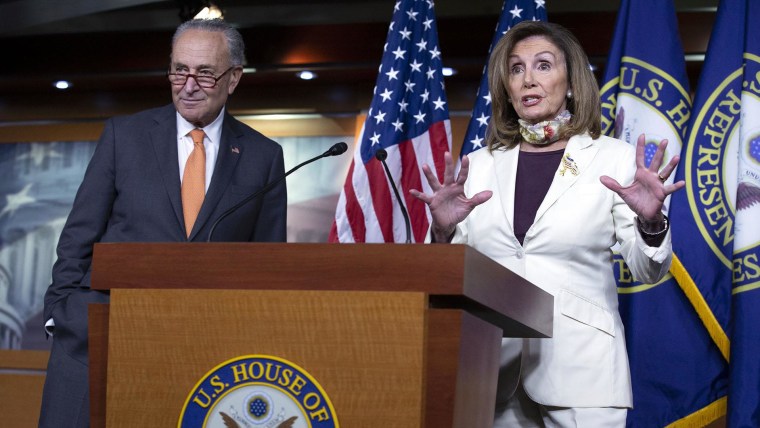
With less than three months until Election Day, the fourth round of coronavirus aid has proven to be elusive for lawmakers, with Democrats pushing for larger spending tabs and Republicans internally divided over how generous the federal government should be.
Earlier in the day, Senate Majority Leader Mitch McConnell, R-Ky., visited the White House and said he and Trump discussed "a variety of different topics," calling it a "good meeting." The top congressional Republican has largely remained outside negotiations and has said he will seek to pass whatever deal is struck between the White House and Democrats.
“I'm certainly not outside the room,” McConnell said Thursday morning on CNBC. “The argument is over how much is appropriate at this particular juncture as we struggle to get the economy back on its feet in a place to help themselves until we get a vaccine, which at the earliest is later this year or earlier next year.”
McConnell told fellow Republicans at a meeting on Thursday afternoon that he expected a deal to be struck over the weekend, according to senators leaving the lunch. Lawmakers were planning to return home on Thursday and return next week, cutting into a planned August recess.
"We're expecting maybe something to happen in the next few days, and then come back and vote on it," said Sen. Mike Braun, R-Ind.
Republicans also appeared to dismiss Trump's threats of executive order as empty.
"I assume he's contemplating it to send a signal that he's getting sick and tired that Democrats aren't negotiating," said Sen. Chuck Grassley, R-Iowa. "I doubt if he's serious about doing it."
The Democratic negotiators, Pelosi and Schumer, criticized Republicans for being unwilling to spend more.