Legislation in the works to combat the scourge of mass shootings in the United States may have a greater impact on another problem that claims more American lives each year.
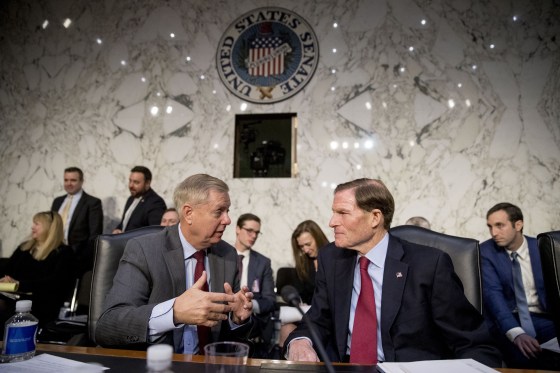
Sens. Lindsey Graham, R-S.C., and Richard Blumenthal, D-Conn., are working on a bill to encourage states to implement "red flag" laws, measures that would allow law enforcement to temporarily seize guns from people found to be a danger to themselves or to others.
"My goal is to have a system that can identify truly a person about to blow, and do something about it before it's too late," Graham told reporters Friday. He noted earlier in the week that many recent mass shootings “involved individuals who showed signs of violent behavior that are either ignored or not followed up. State red flag laws will provide the tools for law enforcement to do something about many of these situations before it’s too late."
\

Experts and law enforcement officials told NBC News that it's true that this type of legislation — one of a handful of gun control options that members of Congress are weighing after massacres in Gilroy, California, Dayton, Ohio, and El Paso, Texas — has real potential to reduce gun violence and save lives. It could stop some mass shootings, they said, as Graham suggested. But red flag laws are even more likely to prevent suicides, which annually account for the most gun deaths in America.
According to the most recent data from the Centers for Disease Control and Prevention, of the almost 40,000 Americans who died from guns in 2017, about 60 percent were suicides.
Some evidence that states with 'red flag' laws saw suicide rates drop
Even without the type of federal incentives Graham's and Blumenthal's bill might offer, 17 states and the District of Columbia have already enacted red flag legislation. Most of the laws were passed after a school shooting in Parkland, Florida, left 17 dead. The accused shooter had a history of making threats, red flag behavior that authorities had been warned about.
The laws generally provide for extreme-risk protection orders. They allow police, friends and relatives to report someone they fear is at risk of imminently harming themselves or someone else to the authorities. A judge may then decide to order police to temporarily seize the person’s firearms. The target of the removal can swiftly challenge the petition in court. If they lose, they can ask for the guns’ return after the risk of harm has passed.
Because it's a civil action, the orders don't leave the gun owners with a criminal record.
The states that have had the laws the longest are Connecticut, which passed its law in 1999, and Indiana, which passed it in 2005. An academic study last year found those measures helped lead to a 13.7 percent drop in the suicide gun rate in Connecticut, and to a 7.5 percent drop in Indiana.
A similar law went into effect in Washington state in 2016.
In the first year the law was in place, Seattle police seized 43 guns from people deemed to be a danger. Among those who had their firearms taken away were a man threatening to kill people at a church, a suicidal woman who'd shot herself in the leg, and a man brandishing a handgun in a residential apartment building, the Seattle Times reported.
While officials there say it's too early to gauge the impact of the law statistically, King County Prosecutor Kimberly Wyatt told NBC News it's helped them in "mitigating some of the risk" of gun violence.
"Close to 70 percent of firearm deaths here are suicides," Wyatt said of Seattle. "This is an effective tool for families and law enforcement to intervene."
And, she said, it appears to be helping stave off other types of gun violence, as well.
"In the beginning, we had more cases of suicidal ideation," but there's been a shift in the types of orders sought by law enforcement, Wyatt said.
"In 2018, we identified petitions where 45 percent were threats to self-harm, 33 percent were threats to others and then 22 percent was a combination of both," she said.
One struggle, she said, has been in making the public aware of the law, which allows citizens and law enforcement to seek help for people they fear could hurt themselves or others. To date, the vast majority of the petitions have been brought by law enforcement.