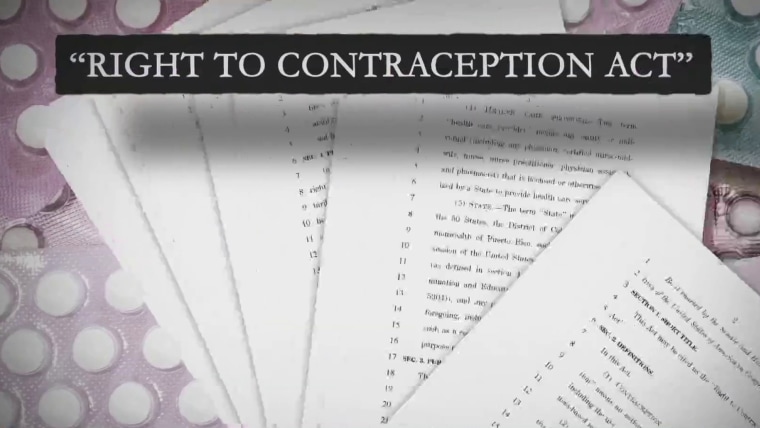
WASHINGTON — Senate Republicans blocked legislation Wednesday that would enshrine a federal right to access contraception, sinking the Democratic-led measure.
The vote on the Right to Contraception Act was 51-39, falling short of the 60 votes needed to defeat a filibuster and move the bill forward. Republicans said it was unnecessary because the use of birth control is already protected under Supreme Court precedent.
Republican Sens. Lisa Murkowski of Alaska and Susan Collins of Maine voted with Democrats in support of the bill. Senate Majority Leader Chuck Schumer, D-N.Y., switched his vote to “no” for procedural reasons so he could bring up the bill again at a later date.
Democrats expected the GOP to scuttle the measure and brought it up as an election-year "messaging" push to highlight the contrast between the two parties on reproductive rights, viewing it as a winning issue with independents and swing voters this fall.
“We saw what the Supreme Court did on abortion, and now there’s a real risk they may do the same thing on contraception,” Sen. Elizabeth Warren, D-Mass., said on MSNBC’s "Morning Joe." “I’m really sick of this idea that the Republicans think they can say two things simultaneously — they can talk to their extremist group and say, ‘I’ll give you everything you want. We are going to ban abortion, IVF, contraception, everything you want,’ and then try to say to the rest of America, ‘Boy, we don’t want any part in that.’”
The legislation, led by Sens. Ed Markey, D-Mass., and Mazie Hirono, D-Hawaii, would establish nationwide rights for individuals to “obtain contraceptives and to voluntarily engage in contraception” and protect health care providers who offer it. It defines contraceptives as “any drug, device, or biological product intended for use in the prevention of pregnancy” and prohibits the federal government or states from enforcing laws or standards that impede that right. It empowers the Justice Department and affected private entities to sue to enforce the new protections.
Top Republicans blasted the vote as a partisan stunt.
“This is a show vote. It’s not serious. It doesn’t mean anything. And, plus, it’s a huge overreach. It doesn’t make any exceptions for conscience, it creates mandates,” said Sen. John Cornyn, R-Texas, who is running to be the next GOP leader in the Senate. “It’s a phony vote because contraception, to my knowledge, is not illegal. And to suggest that somehow it’s in jeopardy, I think, should be embarrassing.”
Democrats argue the bill is necessary because the Supreme Court cannot be trusted to uphold its precedent on protecting the use of contraceptives in the 1965 case Griswold v. Connecticut. They note that when the court invalidated federal abortion rights in 2022, Justice Clarence Thomas wrote separately that the court “should reconsider” other precedents like Griswold. And they cite a recent survey that found 1 in 5 Americans believe the right to contraception is under threat.
“Today, we live in a country where not only tens of millions of women have been robbed of their reproductive freedoms — we also live in a country where tens of millions more worry about something as basic as birth control,” Schumer said on the floor. “That’s utterly medieval. It’s sickening. It should never happen here in the United States, but because of Donald Trump and the hard right, it’s reality.”
Murkowski, who has long supported reproductive rights, at times putting her at odds with her party, said she had no problem voting for the bill.
“If it's a messaging bill, my message is: I support a woman's access to contraception. Pretty simple. So if we're going to play messaging, that's my message,” Murkowski said.
Partisan divides
It’s one of several messaging bills being considered in Congress as the 2024 election nears. Senate Democrats recently brought up a bipartisan border security bill to try to neutralize their political vulnerability on immigration. And the Republican-controlled House recently voted on a bill to prevent noncitizens from voting, a practice that is already illegal and very rare, to elevate the issue with their voters.
Sen. Josh Hawley, R-Mo., said the contraception bill's concern was unfounded despite the overturning of Roe v. Wade and Thomas’ opinion.
“Nobody’s going to overturn Griswold,” he said. “No way.”
Hawley said he opposes the bill because it could veer into establishing rights for abortion medication. “It would also make the abortion drug mifepristone — not contraception, but mifepristone — available in all 50 states no matter what the state law is, and that would override my state’s law, bunch of states' laws. It would take it out of the hands of voters,” Hawley said. “That’s an abortion issue. That’s not a contraception issue.”
Mifepristone is an abortion drug, not a contraceptive designed to prevent pregnancy.
On Tuesday, Senate Republicans held a lengthy lunch meeting at which lawmakers disagreed on the path forward for Wednesday’s vote, according to two people in the room.