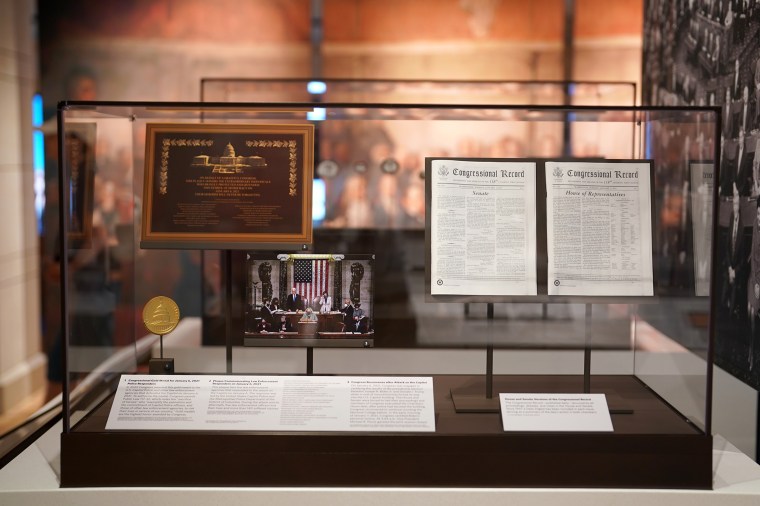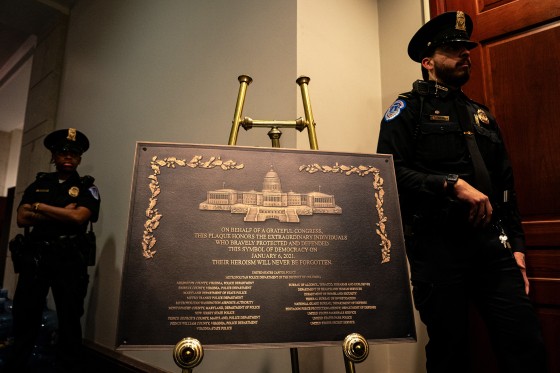
WASHINGTON — The Senate on Thursday unanimously agreed to hang a plaque honoring the officers who protected the Capitol when it was under attack by a pro-Trump mob on Jan. 6 five years ago.
The resolution requires the Architect of the Capitol “to prominently display, in a publicly accessible location in the Senate wing of the United States Capitol, a plaque honoring the members of law enforcement responding on January 6, 2021, until the plaque can be placed in its permanent location.”
The bipartisan resolution was introduced by Sen. Jeff Merkley, D-Ore., and Sen. Thom Tillis, R-N.C., after House Speaker Mike Johnson, R-La., refused to hang the plaque as required by a 2022 federal law. Johnson’s office has argued that the law was “not implementable” because the legislative language from that bill said the plaque should display the names of officers who protected the Capitol, while the plaque that was produced named the law enforcement agencies that responded to the Capitol siege.
Johnson played a key role in President Donald Trump’s efforts to overturn the 2020 election results, leading a legal brief that sought to disenfranchise voters in four key swing states that Joe Biden won. The Supreme Court in December 2020 rejected the eventual Texas lawsuit that Johnson and other Trump allies backed.
Tillis, who is not seeking re-election, told reporters after the resolution passed that there were two locations they think would be good places for the plaque: on the first floor where visitors check in for meetings in offices at the Capitol, or on the third floor where tours take visitors on their way to see the gallery above the Senate chamber to watch Senate proceedings.
Tillis, an outspoken supporter of the Capitol Police efforts on Jan. 6 and a critic of those who have downplayed the attack, called the resolution “a fast way to get it up, and then it will stay up until a final permanent place is found.”
“Until I heard the report of [Johnson] saying it was unimplementable, I just thought it was typical D.C. bureaucracy, because it’s hard to move things around here, you know, even little things in our offices, because of historic implications,” Tillis said. “So, I said, ‘All right, we got a defect, let’s fix it.’ So that’s how we fixed it in three days.”
The resolution passed by unanimous consent, meaning no roll call vote was needed since all 100 senators agreed not to object. It does not need to be passed by the House or signed by Trump to be implemented.