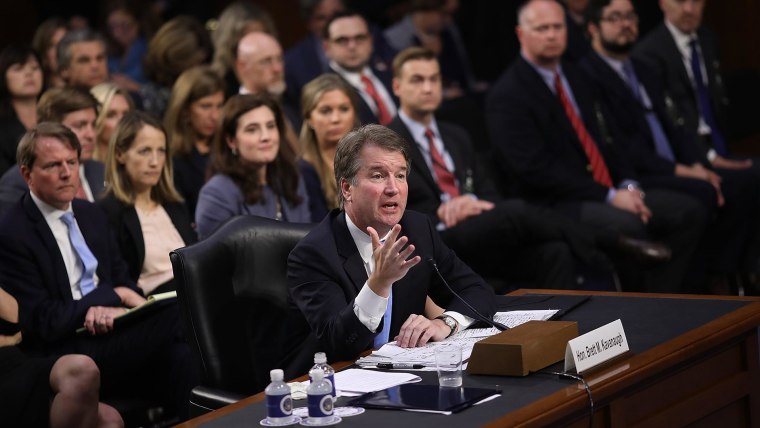
WASHINGTON — Supreme Court nominee Brett Kavanaugh faced some pointed questions over more than 12 hours Wednesday at his confirmation hearing, with many senators focused on his views on the limits of a president's power to influence investigations of his own conduct.
Here are some of the most memorable moments from the second day of Kavanaugh’s hearings:
Feinstein frustrated by Kavanaugh’s answers on assault weapons
Sen. Dianne Feinstein, D-Calif., the committee's ranking member, pressed Kavanaugh about his views on guns and assault weapons and why he specifically argued that the D.C. assault weapons ban was unconstitutional because the guns were in "common use." Kavanaugh argued that handguns and rifles are semi-automatic weapons and that millions of people own them.
"You're saying the numbers determine 'common use?'" said Feinstein, who said that common use is the activity.
"They're widely possessed in the United States, senator," Kavanaugh said.
Kavanaugh calls Roe v. Wade settled law
In response to a question from Feinstein, Kavanaugh said that the 1973 landmark Supreme Court decision Roe v. Wade “has been reaffirmed many times over the past 45 years” and the most prominent and most important case was Planned Parenthood v. Casey in 1992.
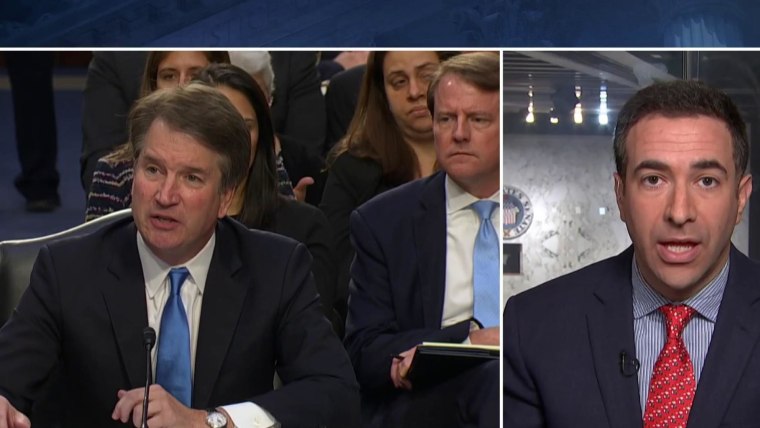
Feinstein had wondered in her opening statement on Tuesday if Kavanaugh believed whether Roe v. Wade is correct law, which Kavanaugh has not answered.
Democrats are deeply concerned about his views regarding women’s reproductive rights and some have claimed that he would overturn Roe v. Wade.
Hillary Clinton tweeted Wednesday morning, “A few weeks before Kavanaugh's name appeared on President Trump's short list for a new justice, Kavanaugh praised the dissent in the Roe v. Wade case and called former Supreme Court Chief Justice William Rehnquist his “hero,” noting that “he clearly wanted to overrule Roe.”
Leahy asks whether Trump has a right to pardon himself
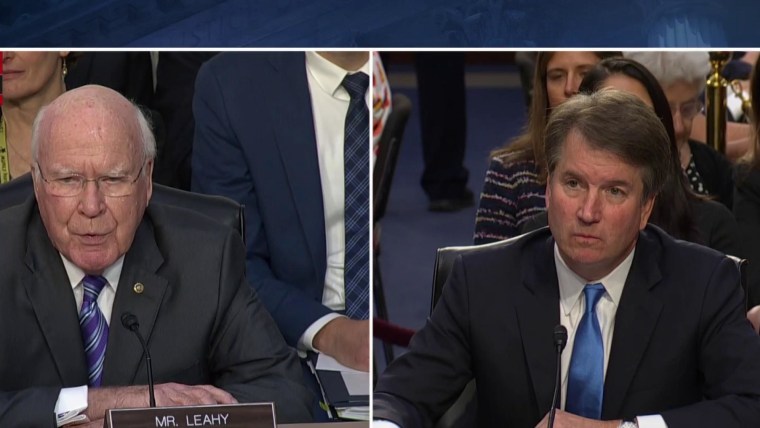
Leahy asked whether President Trump could legally pardon himself. Kavanaugh said that he couldn't respond because he hadn't explored the topic.
"The question of self-pardons is something I've never analyzed. It's a question I have not written about... It's a hypothetical question that I can't begin to answer in this context," Kavanaugh said.
Kavanaugh declines to say whether a sitting president can be required to respond to a subpoena
Feinstein also pressed Kavanaugh about whether a sitting president can be required to respond to a subpoena, but he said that he couldn’t answer that question because it’s a “hypothetical” scenario.
"I can't give you an answer on that," said Kavanaugh, who worked earlier in his career for independent counsel Ken Starr during his investigation of President Bill Clinton.
Flake says he's worried Trump is abusing his executive power
"I worry that the president may be using the executive power to advance personal, political interests," said Sen. Jeff Flake, R-Ariz.
Asked by Flake what limits there are to prevent the president from centralizing executive power and using it for political purposes, Kavanaugh pointed to congressional limits.
“First senator, there are constraints built into the Constitution: the appropriations power, the Senate confirmation power..." he said. "There’s remedies for how judges can be removed, for how members of Congress can be removed through the expulsion power and how presidents can be removed. Those are the ultimate checks."
Harris presses Kavanaugh about conversations about Mueller, Russia probe
Sen. Kamala Harris, D-Calif., a possible 2020 presidential contender, asked Kavanaugh if he'd had conversations about special counsel Robert Mueller or the Russia investigation with anyone who works for the law firm Kasowitz, Benson and Torres, founded by Trump's personal lawyer Marc Kasowitz.
"I'm not remembering," said Kavanaugh initially. "I don't know everyone who works at that law firm."
