Virginia Gov. Abigail Spanberger will deliver the official Democratic response to President Donald Trump's State of the Union address on Feb. 24.
The high-profile speaking slot has proved to be a mixed blessing in recent years, providing both a national platform for a rising star and the peril of being the follow-up act to a president who has just been wrapped in the trappings of a speech to a joint session of Congress.
Most of the response speeches, whether given from a quiet television studio in Washington, a Lousiana living room or a Kentucky diner, have been largely forgettable — or remembered for unflattering reasons.
But four presidents — Gerald Ford, George H.W. Bush, Bill Clinton and Joe Biden — were tapped by their parties, either solo or with colleagues, to rebut the State of the Union before they assumed the Oval Office. Secretary of State Marco Rubio, who was then a Republican senator from Florida, articulated the GOP's case against President Barack Obama in 2013 in both English and Spanish.
"We are at a defining moment in our nation’s history," Spanberger said in a Thursday statement. "Virginians and Americans across the country are contending with rising costs, chaos in their communities, and a real fear of what each day might bring. Next week, I look forward to laying out what these Americans expect and deserve — leaders who are working hard to deliver for them."
In Spanberger, Democrats are turning to a Virginian whose meteoric political rise has been something of a response to Trump in itself. Running in a district long held by Republicans in 2018, Spanberger won a narrow victory as part of a wave of Democrats who wrested control of the House for their party in that year's midterms.
She was one of a small clutch of national-security-minded moderates whose anger over Trump's decision to withhold aid to Ukraine helped convince then-Speaker Nancy Pelosi, D-Calif., to move forward with articles of impeachment against him in 2019.
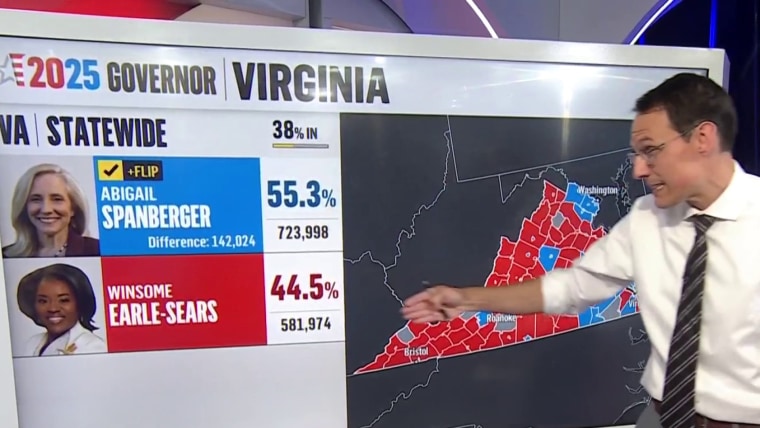
Partway through her third term in the House, Spanberger launched her 2025 campaign for governor. Running on a promise to improve daily life for Virginians — the "affordability" mantra embraced by Democrats in several key races last November — she trounced Republican Winsome Earle-Sears by nearly 16 percentage points. The margin, roughly three times the spread by which Democratic presidential nominee Kamala Harris beat Trump in Virginia in 2024, surprised many observers and elevated Spanberger's standing with national Democrats.
The pick of response speakers is the province of the top two Democrats in Congress, House Minority Leader Hakeem Jeffries, D-N.Y., and Senate Minority Leader Chuck Schumer, D-N.Y. The two offices alternate years for the main rebuttal — in some years members of the minority party give multiple responses — and this year the responsibility fell to Jeffries.
Schumer and Jeffries also announced that Sen. Alex Padilla, D-Calif., will be giving the Spanish-language response to Trump’s speech.
In a statement Thursday, Jeffries said Spanberger "stands in stark contrast to Donald Trump, who will lie, deflect and blame everyone but himself for his failed presidency on Tuesday evening."
In choosing Spanberger, he looked past two other Democrats who won in November: New York City Mayor Zohran Mamdani, who also ran on an affordability message — but one with a socialist flavor that places him far to the left of Spanberger — and New Jersey Gov. Mikie Sherrill, a close friend of Spanberger's who won by a wide margin in November after first being elected to the House in 2018.
A person familiar with the decision emphasized that Spanberger’s 2018 victory from red to blue in addition to her relentless focus on affordability in flipping the Virginia governor's mansion serve as a playbook to success that Democrats hope to emulate in 2026.
With polls showing that Trump is struggling on two issues that have long been strengths for him — the economy and immigration — some Democrats are looking to the Spanberger and Sherrill campaigns as models for November's midterms.

