The call that would upend his life came 11 years ago.
His daughter had hanged herself; she was now on life support.
He rushed to her bedside, but eventually the time came when the machine would be turned off.
The father placed his hand on his daughter’s chest, found her heartbeat and willed her to push through.
Her heart slowed and slowed and slowed. Then it stopped.
She was gone.
The anguish crashed down on him like a tank, compounding the despair he carried after another suicide 14 years earlier. He and his brother had found his father, a Vietnam War veteran, dead from a self-inflicted gunshot wound.
In an interview, the 54-year-old suicide prevention case manager with the Department of Veterans Affairs painfully recalled his agonizing journey, which also included beating cancer, as he grappled with a new crisis of his own.
The world he turned to for salvation — returning to school at age 46, specifically to become a social worker so he could work in suicide prevention with veterans — was now in turmoil.
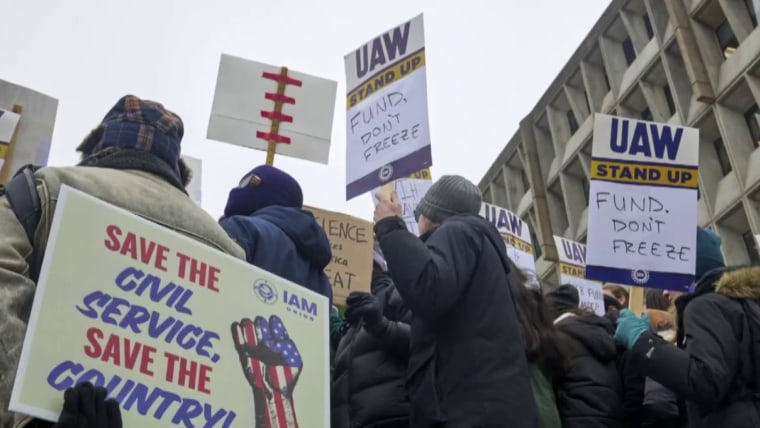
Like the roughly 2 million workers across the federal government, he is watching his colleagues and the veterans he’s trying to help lose their livelihoods or weather a barrage of messages that federal workers have no value — often coming directly from the president and the people he has empowered.
The White House did not return a request for comment.
“When you have a purpose in life and you found your thing, and then all of a sudden it’s being destroyed — you lose all hope,” the suicide prevention manager said, his voice fading. The federal worker, like others quoted in this story, asked that he remain anonymous for fear of reprisal. “I hurt for everybody who’s impacted by it, you know? I mean, I hate to say it, but I work in suicide prevention and I had thoughts. I’ve had thoughts of not wanting to be here anymore.”
NBC News spoke with 20 federal employees across agencies. Spanning the country, these workers lost their jobs, watched co-workers lose them or endured what amounted to a Goliath joyously stomping on David. In interviews, federal workers — many of whom are veterans — told of overwhelming stress, personal crises, suicidal ideation, rapid weight loss, prolonged lack of sleep, panic attacks and visiting the emergency room after a mental breakdown.
They’re facing bombardment from every angle, some showing screenshots to reporters of offensive messages delivered over text and social media, which in turn echo misinformation that billionaire Elon Musk has elevated on his X platform — for example that federal workers are lazy, that they themselves are a source of waste and fraud, and that they don’t bother to come to the office.
Some, particularly veterans or those who assist veterans, expressed fury they’re being denigrated by Musk and a president who never wore a military uniform. Trump, a president for whom some of them voted, even posted an insulting meme about federal workers on his Truth Social account that showed an image of the cartoon character SpongeBob holding a list.
It read, “Got done last week,” an apparent reference to Musk’s request of federal workers that they send an email pointing to five things they did at work. “Cried about Trump. Cried about Elon. Made it into the office for once. Read some emails. Cried about Trump and Elon some more.”
Sarah Boim, a 38-year-old who was fired from her job with the Centers for Disease Control and Prevention in Atlanta, said she grew so distraught that her therapist told her to find a psychiatrist and immediately get on an antidepressant. Boim said she and her husband cannot pay their mortgage on one income and she is desperately searching for work.
“Your career is ripped away from you, with no money to move forward,” Boim said. “I have bipolar. It’ll mess up my life if I have an episode. So we’re just trying to be really careful. I’m hearing stuff like that across the agency.”

