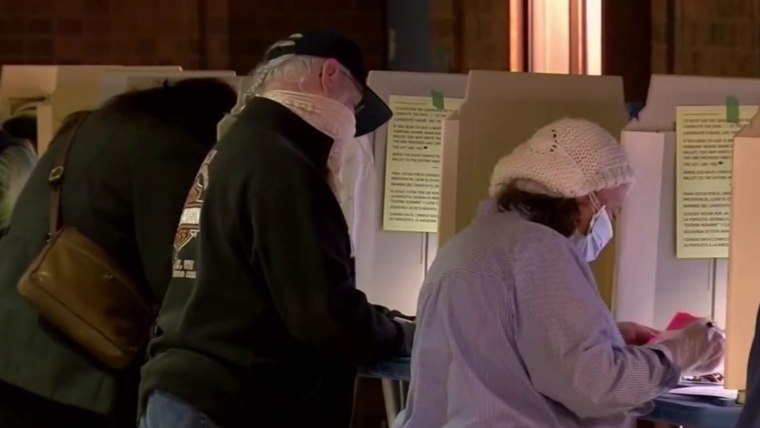
Republicans are recruiting an estimated 50,000 volunteers to act as "poll watchers" in November, part of a multimillion-dollar effort to police who votes and how.
That effort, coordinated by the Republican National Committee and President Donald Trump's re-election campaign, includes a $20 million fund for legal battles as well as the GOP's first national poll-patrol operation in nearly 40 years.
While poll watching is an ordinary part of elections — both parties do it — voting rights advocates worry that such a moneyed, large-scale offensive by the Republicans will intimidate and target minority voters who tend to vote Democratic and chill turnout in a pivotal contest already upended by the coronavirus pandemic.
Some states allow poll monitors to challenge a voter's eligibility, requiring that person's ballot undergo additional vetting to be counted. In Michigan, for example, a challenged voter will be removed from line and questioned about their citizenship, age, residency and date of voter registration if, according to election rules, a vote challenger has "good reason" to believe they are not eligible. They are required to take an oath attesting that their answers are true and are given a special ballot.
The Trump campaign says the aim is to prevent voter fraud before it happens, despite researchers, academics and the president's own voter fraud commission all failing to find evidence that widespread fraud exists in years of searching.

The poll-watch operation is part of a "voter suppression war machine," said Lauren Groh-Wargo, CEO of Fair Fight Action, the voting rights group founded by Democrat Stacey Abrams. Abrams lost her 2018 bid for governor in Georgia in a tight race clouded by allegations of voter suppression that drew national attention to issues of ballot access.
Groh-Wargo said the full "machine" includes everything from Trump's rhetoric on voter fraud to Republican-led state legislatures passing laws that may make voting more difficult for certain groups, as well as spending taxpayer dollars looking for the voter fraud the president and other Republicans claim occurs. Georgia, for example, established a voter fraud task force in April.
But a coordinated poll-watch effort, advocates warned, is particularly dangerous because of the GOP's history of using monitors to intimidate minority voters.
"We know that the targets of these actions, as we've seen in the past at our polls, are voters of color," said Barbara Arnwine, president and founder of Transformative Justice Coalition, in testimony to Congress in early June, in reference to the poll watchers.
While many states are working to expand mail voting to respond to the public health threat of the novel coronavirus, poll watchers can also monitor — and sometimes challenge — absentee ballots, too.
Freed from court restrictions, Trump team seizes 'new opportunity'
After the Democratic National Committee sued the RNC for allegedly sending armed, off-duty police officers to patrol the polls in minority neighborhoods in a 1981 election, a federal "consent decree" put in place a year later sharply curtailed the Republican Party's ability coordinate poll watchers by requiring prior judicial approval.
But that consent decree was allowed to expire at the end of 2017, and a judge in 2018 declined to extend it.
"What we haven't seen in a long time — in decades — is large-scale efforts to try to question and challenge voters' eligibility at the polls," said Wendy Weiser, who directs the Democracy Program at the Brennan Center for Justice at New York University School of Law. "The reports and the announcements that the RNC has been making suggest that that is part of the program that they're trying to mount."
At a panel about "defeating the left's voter fraud machine" at the Conservative Political Action Conference in February, Trump campaign senior counsel Justin Clark said the GOP had been hamstrung for decades by the legal ruling.
"For about 40 years, the Republican Party has been fighting this battle with one hand tied behind its back," he said. "In 2020, we have a brand-new opportunity to be able to activate an Election Day operation program that's really robust."
(Weiser noted the GOP wasn't barred from doing the work of poll watching — it was barred from doing it without getting court approval to ensure the efforts weren't discriminatory.)
Clark told the audience that the campaign and the party hoped to "leverage about 50,000 volunteers to be able to watch the polls" with the goal of preventing "systemic failures" and "malicious" fraud — people voting multiple times.
"Everybody in this country who wants to vote and is eligible to vote, should be able to vote — once," he said to a chuckling crowd.