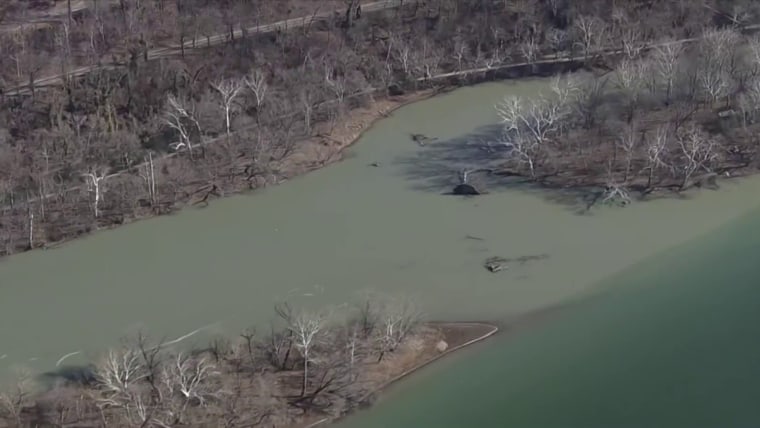
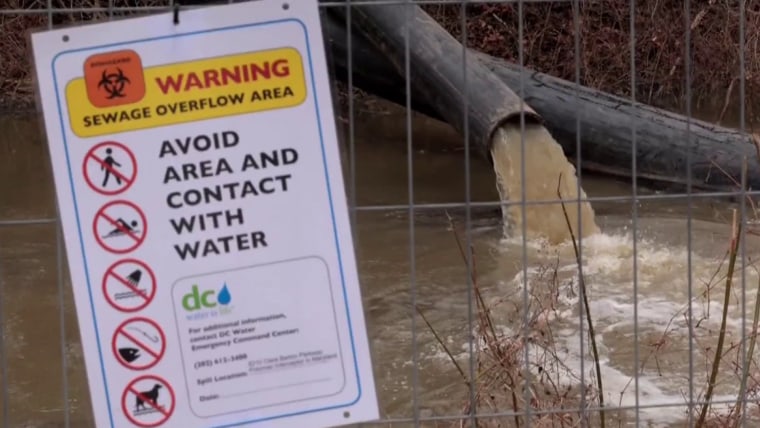
Since Jan. 19, residents of a Maryland county just outside of Washington, D.C., have been dealing with a broken sewer pipe that so far has pumped more than 240 million gallons of raw sewage into the Potomac River.
The smell is so pungent that “you can taste it when you’re talking,” according to NBC Washington reporter Mark Segraves, who has been at the site of the spill. The fire and rescue squad for Montgomery County, where the spill occurred, has warned its first responders to wear personal protective equipment for any assignments near the area.
The University of Maryland is calling it one of the largest sewage spills in U.S. history. The Environmental Protection Agency says it’s an ecological disaster of “historic proportion.”
Washington, D.C. officials declared a public emergency late Tuesday, and are asking the White House for a presidential emergency disaster declaration, which would open up funding for the repair and cleanup — expected to cost millions of dollars. Maryland has yet to do the same.
When asked why it took D.C. Mayor Muriel Bowser a month to request this assistance, an official with her administration said the mayor makes decisions “based upon her assessment of the situation.”
Local leaders told NBC News that they have been frustrated by how long it’s taken for the disaster to get attention from politicians — both at the state and federal level. And now that it’s come, much of the attention has led to finger-pointing. The situation has been complicated by the interwoven jurisdictions in the area, where two states, the district, the federal government and DC Water work in close coordination.
On Monday, 28 days after the pipe collapse, President Donald Trump made his first comments on the disaster. In a Truth Social post, Trump referenced the “massive Ecological Disaster” and blamed it on local Democratic leaders — particularly Maryland Gov. Wes Moore. Trump said he was directing federal authorities to “immediately provide all necessary Management, Direction, and Coordination.”
Soon after, Department of Homeland Security Secretary Kristi Noem, whose department runs FEMA, posted on X. She echoed Trump’s message blaming Democrats for the spill and said FEMA would be stepping in to coordinate cleanup efforts. Noem also, incorrectly, said that the spill was impacting DC’s water supply.
And the following day, Trump posted on Truth Social that if Democratic leaders in the region wanted the federal government’s help, they needed to call him and “politely” ask for his assistance.
Marc Elrich, the county executive for Montgomery County, Maryland — where the spill occurred — said it was “unhelpful” for Trump to be going after Moore.
“While we expect the federal government to fulfill its responsibilities regarding this incident, our residents deserve accurate information about the facts surrounding this spill,” he said in a media briefing on Wednesday. “Does he actually really care? Or is this just a nice little talking point for him?”
Moore responded by suggesting the president is “lying” about who is responsible for the spill.
“For the past century, the federal government has been responsible for the Potomac Interceptor — not Maryland,” Moore wrote in a post on X. “The sewage pipe is on federal land.”
The pipe that collapsed is indeed within the C&O Canal National Historic Park, which is property controlled by the federal government in Maryland. DC Water owns and operates the Potomac Interceptor, while the Environmental Protection Agency regulates and oversees it.
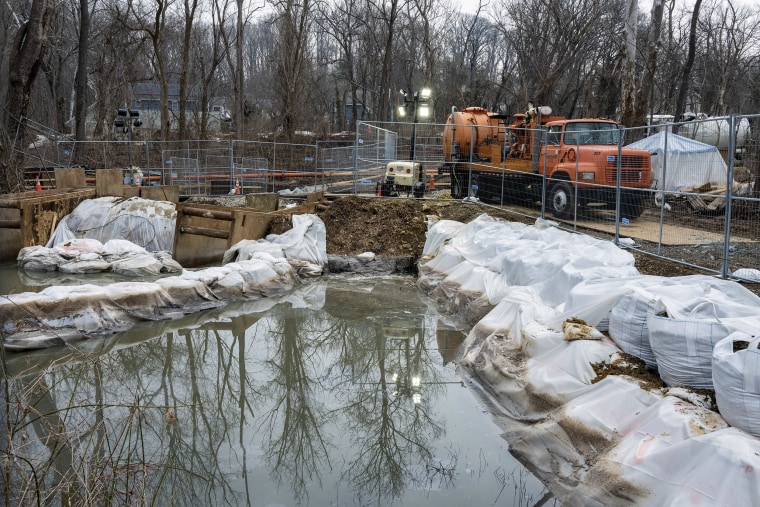
The White House convened its first meeting with stakeholders from Virginia, Maryland, D.C. and DC Water on Wednesday, 30 days after the spill.
FEMA and EPA officials were also on the ground at the site of the collapsed Potomac Interceptor on Wednesday, marking FEMA’s first visit to the site, according to a source familiar with the federal government’s involvement.
FEMA did not return a request for comment.
Dia Costello, mayor of Glen Echo, a Maryland town that runs along the Potomac near where the collapse took place, said she’s had a hard time getting in touch with anyone from the federal government — particularly the EPA.