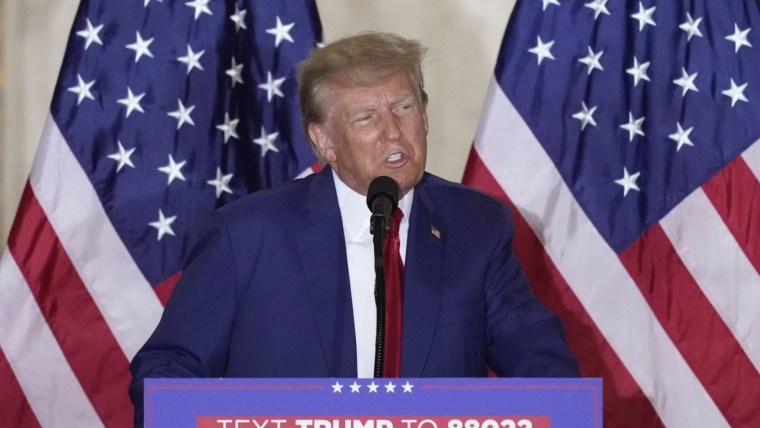
PALM BEACH, Fla. — Just hours after he left his fingerprints in a Manhattan courthouse and on American history, former President Donald Trump returned to his home turf at the Mar-a-Lago club here and proclaimed that he is being unjustly persecuted by prosecution.
"They can’t beat us at the ballot box, so they try to beat us through the law," Trump, the first former president ever charged with a crime, said Tuesday night to a room of supporters that included luminaries of his movement, such as defeated Arizona GOP gubernatorial nominee Kari Lake, voter fraud evangelist Mike Lindell and Reps. Marjorie Taylor Greene, R-Ga., Matt Gaetz, R-Fla., and Ronny Jackson, R-Texas.
"We are a nation in decline, and now these radical left lunatics want to interfere in elections by using law enforcement," Trump said, tying his prosecution and the multiple investigations he faces to his false claims of a rigged election in 2020. "We can’t let that happen."
Speaking for less than 30 minutes, Trump was more subdued than usual, and it seemed the long day had taken its toll on him. But he didn't stop with lambasting the case in New York. Rather, he turned his attention to additional legal jeopardy he faces.
He called on prosecutors in Atlanta to "drop" a case into his effort to overturn the 2020 election in Georgia, condemned an ongoing federal investigation into his handling of classified documents, mocked a New York state investigation into his business and described special counsel Jack Smith — who is overseeing the federal probe into his handling of classified documents and his actions around the Jan. 6 attack on the U.S. Capitol — as a "lunatic."
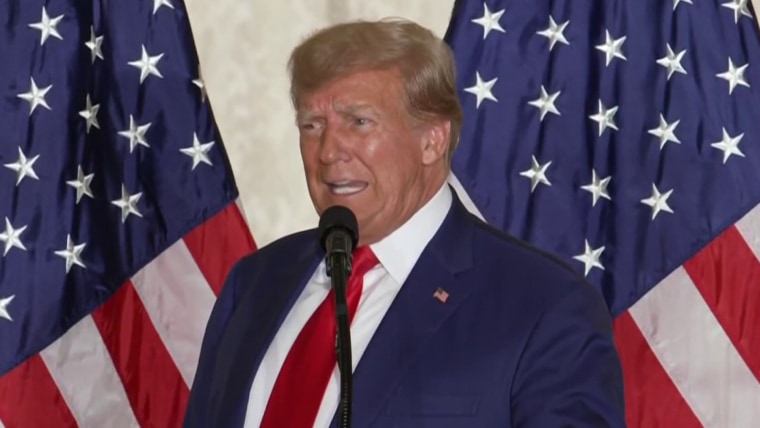
"With all of this being said, and with a very dark cloud over our beloved country, I have no doubt nevertheless we will make America great again," Trump said.
"The only crime that I have committed is to fearlessly defend our nation from those who seek to destroy it," he added.
The twin spectacles centered on one man — a former president standing first as a defendant and later as the favorite for the 2024 Republican nomination — brought into sharp relief a set of uniquely Trumpian paradoxes gripping the nation and testing its ideals.
The salacious allegations of Trump's safeguarding his 2016 campaign by deploying a fixer to buy the silence of a porn star paramour are somehow wrapped in a pedestrian 34-count indictment on felony charges of falsifying business records to keep the electorate in the dark about previous alleged affairs.
The whole world was watching as Trump pleaded not guilty, and yet legal experts say the case puts him in far less jeopardy than allegations that he tried to overturn Georgia's election results, incited an insurrection at the Capitol on Jan. 6, 2021, and illegally mishandled classified documents.
But the most seemingly irreconcilable truths may be that Trump's political fortunes are rising — at least in Republican primary polls — as his legal troubles mount.
Greene credited Trump's prosecutor, Manhattan District Attorney Alvin Bragg, with expanding the former president's lead over Florida Gov. Ron DeSantis in an interview Tuesday.
"Alvin Bragg is making the best case possible to Republican voters to vote for Donald Trump," Greene said. "Alvin Bragg is also making the best case possible to independent voters to vote for Donald Trump."
The latter assertion isn't supported by recent public opinion surveys, but it raises the specter of a nightmare scenario for the GOP: Trump's travails could propel him to the nomination, only to cost the party the White House in November 2024.
"We don’t know how any of this will play out — the legal process, the politics or the impact on the nation more generally," said Julian Zelizer, a professor of history and public affairs at Princeton University and the author of numerous books on American presidents. "But we can understand how this is a first effort, relevant even if it fails, to restore some sense of accountability with those who hold the highest levels of power."
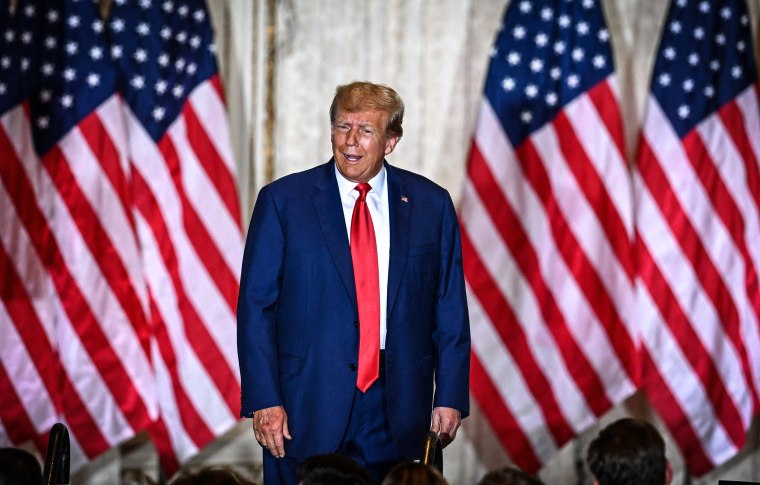
In that way, the conflicting black-and-white narratives of Trump's allies and critics — who portray him as a martyr and a crook, respectively — may elide the fuzzier question of when political action becomes criminal activity.
Kim Wehle, a law professor who worked in independent counsel Kenneth Starr's office during President Bill Clinton's impeachment, said Trump's positions as a candidate and a former president don't make his actions political rather than criminal.
“To call this political, when it is about a politician, is double-speak," Wehle said. "There are plenty of politicians who have been indicted, prosecuted and convicted over American history. The fact that he is embroiled in politics does not somehow lower the standard or change the standard for prosecution from the standpoint of lawyers and the law.”