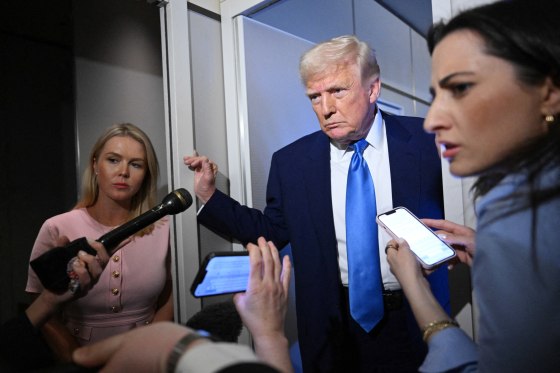
President Donald Trump announced sweeping new tariffs last week on all U.S. trade partners, including a new baseline 10% duty and higher levels on dozens of countries.
Trump dubbed the move “Liberation Day” and claimed his expansive use of tariffs will cause factories to move production back to the United States, ushering in a golden era for the U.S. economy.
Instead, the announcement has rocked markets, triggering one of the worst stock sell-offs on record and days of volatility as investors realized that Trump sought not merely to raise the cost of importing goods into the U.S., but rather reduce or even reverse longstanding U.S. trade deficits. Most economists say that is impossible at the scale Trump has proposed without wreaking global economic havoc.
Here’s what you need to know about Trump’s plan, how tariffs work, who pays for them in the short and the long run, and why they are even used in the first place.
How tariffs work
Tariffs are fees companies pay the federal government to import certain products into the United States. Since the money is collected by the government, it is considered a tax.
If a big-box retailer, for instance, is importing sneakers from China, it must pay a tariff to Customs and Border Protection officials at a port of entry before it can bring the shoes into the country to sell at its American stores. The same process applies to a manufacturer bringing in parts or raw materials to make a finished product at a U.S. plant or a food distributor importing fresh produce to sell to U.S. grocery stores.
The tariff is calculated as a percentage of the declared value of the good before it entered the United States, not its retail value. The money collected from tariffs goes to the Treasury Department, similar to tax revenue.
Tariffs are nothing new. Countries have used them for centuries to protect their domestic industries from foreign competition and raise revenue to fund their governments. But that began to change in the late 1990s, with the creation of the World Trade Organization and efforts by Western nations to open up trade. The goal was to lower costs on everyday goods for developed nations, while ostensibly promoting development for less-well-off nations.
But now, Trump is seeking to turn back the clock. He proposed tariffs that are steeper and more widespread than those imposed by any other president in modern American history — even broader than the 1930 Smoot-Hawley tariffs, which historians have said worsened the Great Depression.
Why Trump says he is putting tariffs in place
Trump and his top officials have given a variety of reasons and mixed messages for their plans to ratchet up the tariffs charged on goods coming into the country.
Trump has the tariffs were in response to actions taken by other countries that limit U.S. exports. Among the tariffs he announced last Wednesday were a 20% tariff on goods from the European Union, a 34% tariff on Chinese imports on top of others already imposed; and a 46% tariff of products from Vietnam.
“For decades, our country has been looted, pillaged, raped and plundered by nations near and far, both friend and foe alike,” Trump said at the White House Rose Garden. “American steelworkers, autoworkers, farmers and skilled craftsmen, we have a lot of them here with us today, they really suffered gravely. They watched in anguish as foreign leaders have stolen our jobs, foreign cheaters have ransacked our factories, and foreign scavengers have torn apart our once beautiful American dream. “
In Trump’s early weeks in office, he said he was using tariffs on Canada, Mexico and China to punish them for not doing more to stop the flow of fentanyl into the United States. Trump has also used tariffs as a negotiating tool to force concessions from countries, like threatening Colombia with a tariff if it didn’t accept deportation flights of its citizens.
Trump has said the most recent tariffs are a form of retaliation against countries that put their own tariffs on U.S. goods. He has said his tariffs would give companies incentives to move manufacturing to the United States by punishing companies that produce their products overseas. He has also said tariffs are a way to raise revenue for the federal government and suggested tariffs could replace income taxes.
Tariffs raise the cost of doing business with firms that operate outside the U.S. Yet even firms that manufacture in the U.S. can be affected, since many rely on foreign parts and materials as intermediate goods.
Whether consumers ultimately feel the impact of those higher costs may vary by industry and product.
Lots of negotiation occurs among a U.S. importer, an overseas producer and any middlemen before a tariff is collected, said Craig Fuller, CEO of FreightWaves, a supply-chain consultancy.
Some companies, including Target, Best Buy and Hyundai, have said they would pass some of the higher costs of the tariffs along to their customers. Walmart, meanwhile, has sought to pressure its Chinese suppliers to lower their costs in anticipation of the tariffs — and has been met with resistance.