LAS VEGAS — Nevada Democrats fiercely want to host the first-in-the-nation presidential primary, and they’re making a coordinated push like never before to remove the primacy of New Hampshire and Iowa.
They’ve printed out brochures promoting their state, sent letters to key members of the Democratic National Committee and lobbied them in person.
The problem? The efforts have left some of their early-state competitors fuming.
A DNC member from a state with an early contest, who asked not to be named without authorization to speak about the matter, accused Nevada leaders of going back on an informal commitment by delegations from four early states to hold off on lobbying for first-in-the-nation status in the presidential primary.
The member described a meeting among leaders of four early states at the Hilton Hotel in Washington last month at which members from the four states — Iowa, New Hampshire, Nevada and South Carolina — agreed to hold off on trying to jump in front of others, at least until the DNC’s Rules and Bylaws Committee had ironed out a new framework.
Little more than 12 hours later, Sen. Jacky Rosen, D-Nev., “was working out of a hotel room meeting with individual members of the [committee] trying to convince them Nevada should be first,” the member said. Two others who attended the meeting confirmed the member’s narrative.
Rosen, who didn’t attend the early-state meeting, had distributed a glossy Nevada promo brochure to advance Nevada’s argument. The move, however, irked other early-state officials who believed Nevada was going back on its agreement.
“The other early states were stunned by Nevada’s behavior,” the member said. “Lying in poker may be a winning play in Vegas, but lying in politics only leaves you friendless.”
A second person who attended said, “It was playing politics at a time when the team from Nevada didn’t need to do that.”
Artie Blanco, Nevada’s member of the DNC’s Rules and Bylaws Committee, who attended the meeting, was surprised by the blowback, saying she had a completely different take on the conversation.
“I’m taken aback that this sounds like some kind of personal attack, when it’s not about that, when I’ve shown support for all four states,” Blanco said Tuesday night. “That’s not how I interpreted that conversation. This is not against any states, but it’s also clear that our law was passed last year.”
In an interview last week, Rosen stressed that Democrats in her state were working on the bid in unison.
“This has been a team effort to push Nevada to be first in the nation,” Rosen said.
The late Sen. Harry Reid, who built a powerful political machine in the state, had fervently advocated for the party to oust Iowa’s caucuses and New Hampshire’s primary from their longtime leadoff perches in the Democratic presidential primary season. That was after Reid in 2008 muscled Nevada into the early-state primary lineup to become the first state in the West to hold a Democratic primary.
“I think after these four cycles it’s time for us to be first in the nation,” Rosen said.
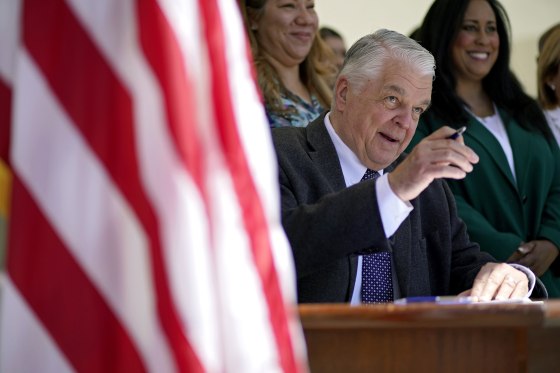
The entire Nevada Democratic congressional delegation, along with Gov. Steve Sisolak, sent a letter recently to members of a key DNC panel laying out Nevada’s case to become the first-in-the-nation state, according to a copy obtained by NBC News.
Demonstrating the political heft they’d put behind their bid, Sisolak, Sens. Rosen and Catherine Cortez Masto and Reps. Susie Lee, Dina Titus and Steven Horsford laid out Nevada’s political strengths in a letter to members of the Rules and Bylaws Committee.
“As a highly competitive battleground with strong union representation and one of the most diverse electorates in the country, our state offers a real test of who can put together a winning coalition,” said the letter, which was sent this month.

