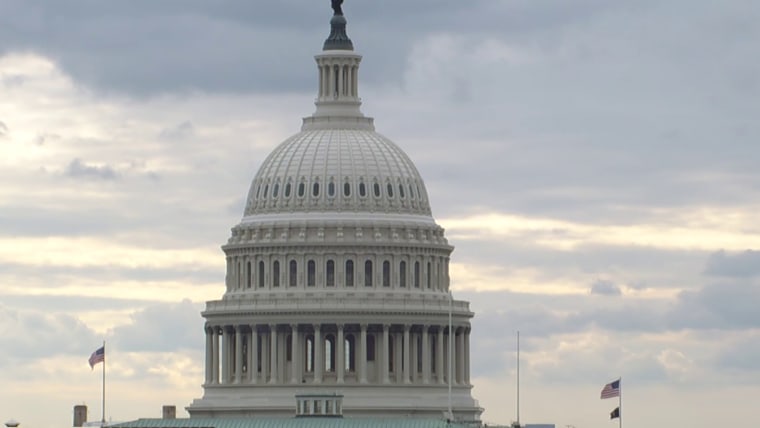
WASHINGTON — Key Senate negotiators say they’ve struck a tentative deal to enact tougher U.S. immigration and asylum laws, marking a significant breakthrough on a politically explosive issue as the 2024 election year gets underway.
But the pact is in jeopardy even before senators release the text of the bill, which they’re hoping to do in the coming days in anticipation of voting on it beginning next week.
Senate Majority Leader Chuck Schumer, D-N.Y., said Thursday that senators plan to release the “full text” of the immigration package, which will include aid funding for Ukraine and Israel, “as early as tomorrow” and “no later than Sunday.”
“That will give members plenty of time to read the bill before voting,” he said, adding he plans to hold the first procedural vote on the package “no later than Wednesday.”
The tentative agreement, struck by Sens. James Lankford, R-Okla., Chris Murphy, D-Conn., and Kyrsten Sinema, I-Ariz., represents an ambitious effort to tackle a problem that has bedeviled Congress for decades — in the middle of an election year.
“For all intents and purposes, we have an agreement,” Murphy said.
The measure faces uncertainty in the Senate, pushback from House Speaker Mike Johnson, R-La., and a steady bombardment of opposition from likely GOP presidential nominee Donald Trump that is endangering Republican support. Some in the party worry that it could give President Joe Biden a victory on a political vulnerability in his 2024 re-election bid.
“I feel like the guy standing in the middle of the field in a thunderstorm holding up the metal stick currently,” Lankford said, adding that process has been “really intense.”
Lankford maintained that he had kept Johnson informed of the scope and details of the border bill throughout the process, keeping the speaker’s staff in the loop throughout the final stages.
But Johnson’s office pushed back on Lankford’s characterization of the discussions, telling NBC News in a statement: “Senator Lankford nor his office has never provided Speaker Johnson’s office with proposed legislative text or a written description of the new expulsion authority. They have described it in conversation with less detail than what is available in published news reports.”
The deal would take a three-pronged approach to mitigating the chaos at the border. First, it would limit options for people outside the U.S. to pursue asylum. Second, it would raise the standard for people at the border to qualify for asylum. Third, it would speed up processing of claims, cut off avenues for appeal if they are rejected, and end “catch and release” by enforcing government monitoring of migrants throughout the process.
Sen. Kevin Cramer, R-N.D., said he’s favorably inclined to support it but said the prospects of getting a majority of the Senate GOP on board is “declining,” as some senators prefer not to “walk the plank” for a complicated bill if it is unlikely to clear the House.
“The path is getting narrower to get to 25,” Cramer said.
The bill needs 60 votes to break a filibuster in the Senate. But Sen. Thom Tillis, R-N.C., a proponent of the deal, said it’s unlikely to move forward without the support of at least half the Republican caucus, or 25 senators.
One holdup to releasing the text is securing enough funding to implement the policy changes.
“I’m getting worried,” Murphy told reporters on Thursday. “Republicans have to be serious about funding the deal that we have made. Our policy deal is done but it requires the bill to fund the changes that Republicans asked for.”
Another reason for the delay is that Senate Minority Leader Mitch McConnell, R-Ky., has been speaking to his members to make sure there’s enough support when the bill is released, according to a source with knowledge of the talks, so that it won’t have to be changed after the fact to accommodate conservative concerns. (McConnell’s office declined to comment.)
Further complicating matters, House Republicans are preparing to impeach Homeland Security Secretary Alejandro Mayorkas, accusing him of refusing to enforce immigration laws even as he has met with the Senate negotiators to discuss the new deal.