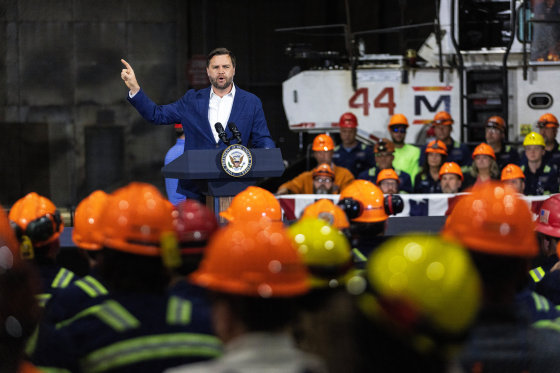
CANTON, Ohio — Vice President JD Vance dropped by a steel factory here Monday to trumpet the White House agenda — namely a “big, beautiful bill” that polls indicate most voters don’t like.
The visit also gave a glimpse of how Vance will be deployed, not just to sell President Donald Trump’s policies, but also to campaign for Republicans in next year’s midterm elections.
It was the second time in three weeks that Vance found himself talking up the megabill in a battleground for partisan control of the House. He played defense in Pennsylvania’s 8th District this month, offering a shoutout to Rep. Rob Bresnahan, a vulnerable Republican who was in the crowd. Vance switched to offense Monday in Ohio’s 13th District, scolding Rep. Emilia Sykes, an endangered Democrat, for voting against the bill.
“You know who we don’t have in the house right now? We do not have Congresswoman Emilia Sykes,” Vance said in his half-hour speech to workers and local political leaders at Metallus.
“And you know why she’s not here today?” Vance continued before he mentioned a couple of provisions in the bill that Trump often emphasizes. “Because she’s not celebrating no taxes on tips. She’s not celebrating no taxes on overtime. She’s not celebrating the highest rising take-home pay in 60 years, because she fought us every step of the way on the big, beautiful bill.”
Vance, a former senator from Ohio, also contended that Sykes and others who were unhappy with the bill would have been welcome at the White House to hash out their differences.
“The next piece of legislation that comes along, why don’t you work hard for the people in this room, and we’ll work right alongside with you?” Vance said. “Why don’t we have a Democratic Party, my friends, that instead of trying to tear down Donald J. Trump works with Donald J. Trump to build up this great American company and great American community?”
Sykes, in a telephone interview afterward with NBC News, took issue with Vance’s characterization of the bill and of her involvement in fighting it. She also questioned whether the no-tax-on-overtime clause would apply to many of the workers Vance visited with Monday.
“I certainly wished he would have used this opportunity and the office of the vice president to tell the truth,” Sykes said. “Instead, he chose the opportunity to lie to my friends and neighbors.”
Sykes added that she was not invited to the event.
“That’s why I was not there," she said. "And I’m sure I was not invited because I would tell the truth.”
The sniping offered a sampling of what’s to come as the White House leans on Vance to carry its message and preferred candidates in competitive congressional districts and states with toss-up governor’s and Senate races. The term-limited Trump has shown less of an appetite for campaign-style rallies and road show theatrics since he returned to the presidency in January. Vance, who is seen as a likely GOP presidential candidate in 2028, has picked up the slack, allowing him to bank the type of political goodwill that can be useful in the future.
Vance peppered his remarks Monday with appeals to working-class voters.
“You drive down the road, you drive past a beautiful factory, and you know someone who built a life in that factory,” Vance said. “You know a grandfather, a father, a cousin, an uncle, somebody whose American dream was provided by the wages and the dignity built in that factory.”
The “dignity” line had echoes of former Sen. Sherrod Brown, D-Ohio, who made the “dignity of work” a staple of his messaging but lost a re-election bid last year to Republican Bernie Moreno. Brown is weighing a comeback in next year’s midterm elections — either as a candidate for governor or to fill the rest of Vance’s unexpired Senate term.
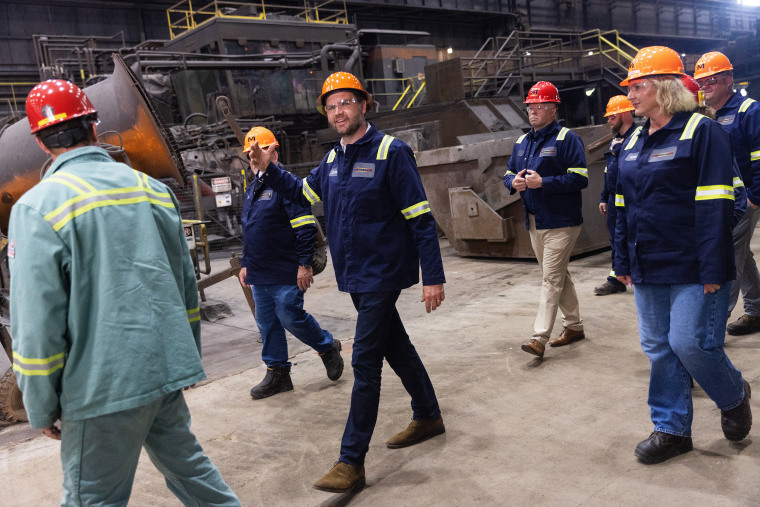
After his remarks, Vance posed for pictures with workers and autographed several of their hard hats with a black Sharpie marker. Donning an orange hard hat of his own, as well as safety goggles and a protective jacket, Vance then toured the factory floor for several minutes.
Ohio’s 13th District, which includes Akron, Canton and their surrounding areas, is one of five Democratic districts in the state and one of at least two that Republicans hope to flip in 2026. Many predict that a new congressional map due later this year will be even friendlier to the GOP — which maintains enormous influence over the process — despite a voter-approved measure designed to promote more bipartisanship in the state’s redistricting practices.
“I am perceiving a feeling of calm confidence that we’re adding two districts,” a Republican operative familiar with the soon-to-begin process said. “I’d be shocked if we didn’t.”

