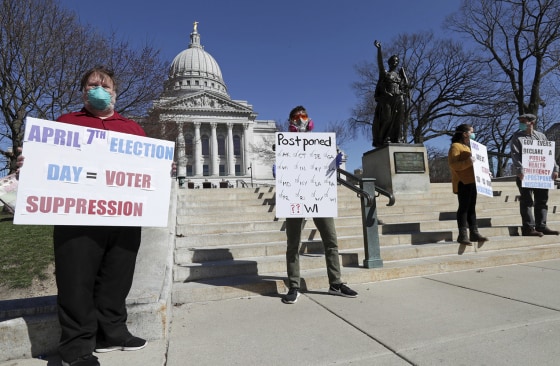
WASHINGTON — What’s been playing out as Wisconsin moves ahead with its presidential primary and other elections this Tuesday could very well be a harbinger of what might happen in November in our new Coronavirus Era.
- Voters who are discouraged or frightened about casting in-person ballots as they practice social distancing.
- Democrats and Republicans at odds over making it easier to submit mail-in ballots.
- Lawsuits and countersuits.
- Confusing judicial rulings.
- And uncertainty about the eventual turnout.
Here’s where things currently stand in Wisconsin: On Thursday, a federal judge refused to postpone the state’s elections but extended the deadline to submit absentee ballots to April 13.
On Friday, the same judge directed state election officials not to report any results until April 13.
Also on Friday, Gov. Tony Evers, a Democrat, ordered a special session for the state legislature, calling on it to stop in-person voting and turn it completely into all-mail election.
On Saturday, the GOP-controlled legislature gaveled in and then gaveled out — taking no action.
And Republicans appealed extending the deadline for absentee ballots to April 13, but the 7th Circuit declined to stay the order.
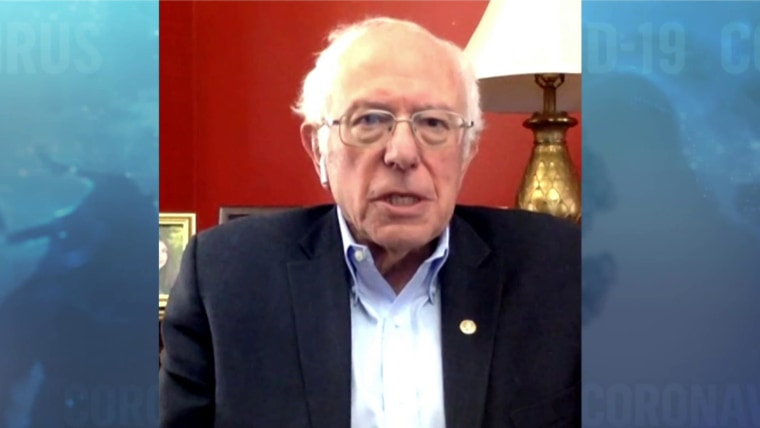
It all creates an unprecedented situation in Wisconsin, arguably the most important 2020 battleground state.
“The National Guard will be at polling sites; the state’s largest city, Milwaukee, will only have a handful of voting locations; and in-person turnout on Tuesday could trickle to the single digits, though requested absentee ballots already total 60 percent of all votes cast in the high-turnout spring 2016 election,” the Wisconsin State Journal writes.
President Trump also has weighed in Wisconsin’s upcoming election, arguing against mail-in voting.
“It shouldn’t be mail-in voting. It should be: You go to a booth and you proudly display yourself. You don’t send it in the mail where people pick up — all sorts of bad things can happen,” the president said on Friday.
The rub: Trump, now a registered voter in Florida, requested a vote-by-mail ballot for Florida’s GOP primary last month.
“Denial and dysfunction”
On Friday, we wrote how the Trump administration’s response to the coronavirus outbreak might be the biggest failure of the federal government in our lifetimes.
And over the weekend, the Washington Post put all of those failures into a 6,000-word narrative piece.
Some highlights from the article:
- “[T]he United States will likely go down as the country that was supposedly best prepared to fight a pandemic but ended up catastrophically overmatched by the novel coronavirus, sustaining heavier casualties than any other nation.”
- “The failure has echoes of the period leading up to 9/11: Warnings were sounded, including at the highest levels of government, but the president was deaf to them until the enemy had already struck.”
- “The Trump administration received its first formal notification of the outbreak of the coronavirus in China on Jan. 3. Within days, U.S. spy agencies were signaling the seriousness of the threat to Trump by including a warning about the coronavirus — the first of many — in the President’s Daily Brief.”
- “And yet, it took 70 days from that initial notification for Trump to treat the coronavirus not as a distant threat or harmless flu strain well under control, but as a lethal force that had outflanked America’s defenses and was poised to kill tens of thousands of citizens. That more-than-two-month stretch now stands as critical time that was squandered.”
- “The most consequential failure involved a breakdown in efforts to develop a diagnostic test that could be mass produced and distributed across the United States, enabling agencies to map early outbreaks of the disease, and impose quarantine measures to contain them.”
Tweet of the day
Data Download: The numbers you need to know today
337,898: The number of confirmed cases of coronavirus in the United States, per the most recent data from NBC News and health officials. (That’s 92,763 more than Friday morning.)
9,626: The number of deaths in the United States from the virus so far. (That’s 3,710 more than Friday morning).


