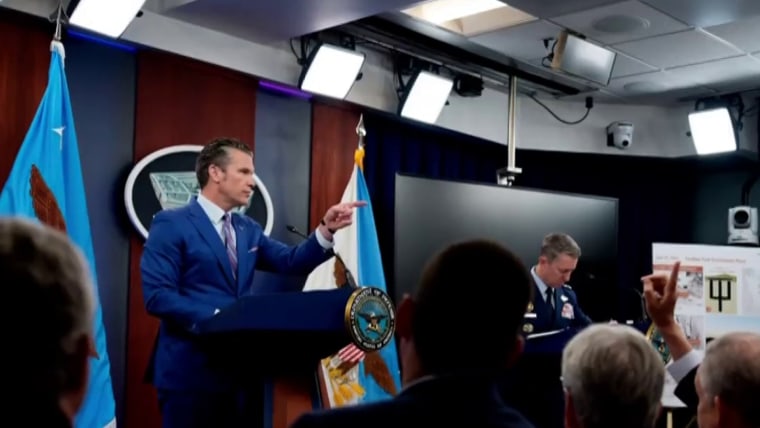
The Pentagon press corps has left the building, with the vast majority of the reporters turning in their credentials rather than agree to Defense Secretary Pete Hegseth's policy cracking down on the solicitation or publication of information not authorized by the government for public release.
The reporters, including those at NBC News, will continue to cover the Defense Department from outside its iconic Northern Virginia headquarters.
Hegseth framed the policy as an attempt to stop leaks of classified information.
"[I]f they sign on to the credentialing, they're not going to try to get soldiers to break the law," he said at the White House earlier this week.
Trump also framed it as a policy that would ultimately protect service members.
"I think it sort of bothers me to have soldiers and, even, you know, high-ranking generals walking around with you guys on their sleeve, asking them, because they can make a mistake and a mistake can be tragic," Trump said.
The Pentagon did not return a request for comment.
Most unauthorized leaks and other disclosures of internal defense information do not involve classified information, but they can expose wrongdoing — and embarrass Pentagon leaders. In many cases in recent years, reporting has highlighted substandard treatment of troops and veterans that might not otherwise have come to light or been addressed if not for reports based on unauthorized disclosures or the access journalists have had to military officials up and down the ranks.
Here are a few examples:
Walter Reed medical scandal
In 2007, with American forces deployed to Iraq and Afghanistan, The Washington Post published a series of stories on the brutal conditions troops faced not in war zones, but as they recovered from injuries at Walter Reed Army Medical Center.
They revealed conditions of black mold, cockroaches, mouse droppings and substandard care.
The Post reported that its sources included dozens of soldiers. But some of the sources declined to give their names because "they feared Army retribution if they complained publicly."
The defense secretary at the time, Robert Gates, visited Walter Reed in the immediate aftermath of the revelations, thanked the reporters for exposing the problem and vowed that responsible parties would be held accountable.
"This is unacceptable, and it will not continue," Gates said. He solicited and accepted the resignation of then-Army Secretary Francis J. Harvey.
Vulnerable Humvees
In 2004, during a trip to Kuwait, then-Defense Secretary Donald Rumsfeld met with more than 2,000 troops in an airplane hangar.
He was questioned by soldiers about the government's failure to provide up-armored Humvees to protect against roadside bombs in Iraq, an issue that had been covered extensively by the media throughout the year, and spoke with soldiers who were frustrated at not receiving better-equipped vehicles.
At the time, reporters were embedded with military units, which the Pentagon saw as a way to build trust between the department and the media. A reporter at a Tennessee newspaper later claimed credit in a private exchange for working with a soldier on questions for Rumsfeld, noting that journalists were not allowed to pose queries at the event.
"You go to war with the army you have, not the army you might want or wish to have at a later time,” Rumsfeld said, pushing back. He further argued that more armor would not make vehicles impervious to attack.

