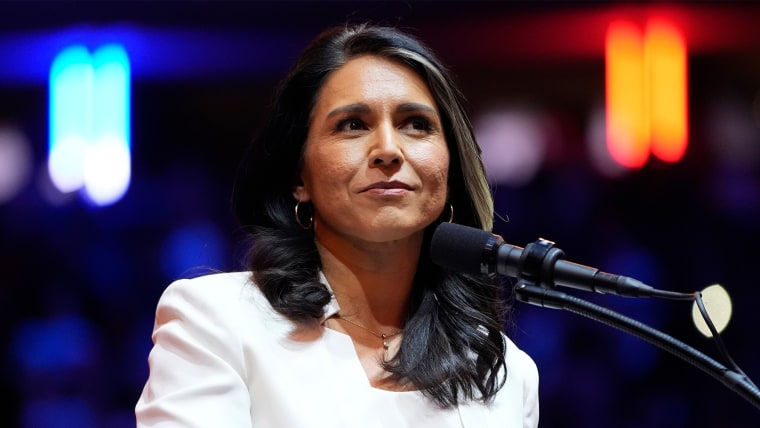
Days after Russia launched an unprovoked full-scale invasion of Ukraine in 2022, with missiles and artillery rounds raining down on Kyiv and other cities, former Democratic lawmaker Tulsi Gabbard posted a perplexing video message.
“It’s time to put geopolitics aside and embrace the spirit of aloha, respect and love, for the Ukrainian people by coming to an agreement that Ukraine will be a neutral country—i.e. no military alliance with NATO or Russia,” the former Hawaii congresswoman wrote on social media. Such an arrangement would “allow the Ukrainian people to live in peace. Aloha.”
Unlike her former colleagues in Congress and the leaders of Western democratic countries, Gabbard offered no condemnation of Russia and no reference to the unprovoked nature of the attack.
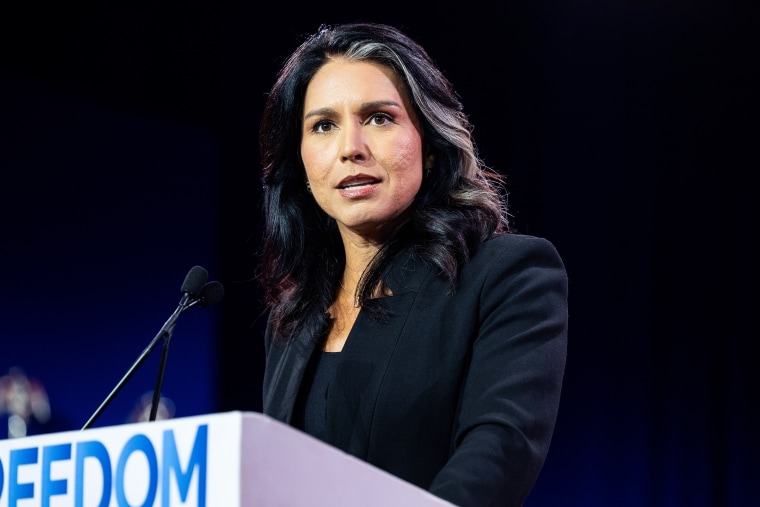
For Gabbard’s critics, the video message reflects an alarming pattern of siding with Russia and other authoritarian regimes, raising questions about whether she should serve as America’s top-ranking intelligence official. Her selection has alarmed lawmakers on both sides of the aisle, though most Republicans have refrained from public criticism.If confirmed by the Senate as President-elect Donald Trump’s director of national intelligence (DNI), Gabbard would oversee 18 spy agencies and have the final say over what intelligence is delivered to the commander in chief.
The job of the DNI is to provide the president with the unvarnished truth as best as the intelligence community can ascertain it. But current and former intelligence officials fear that Gabbard would refuse to relay intelligence reporting that doesn’t fit in with her — or the president’s — worldview.
“Would that predisposition translate into pressure on analysis to fit the administration’s policy goals?” one senior former intelligence official said. “We’ll see.”
Previous administrations have clashed with the CIA and intelligence agencies over assessments that didn’t support their policy agendas or their views about a particular threat or an adversary’s intentions. George W. Bush’s administration was accused of cherry-picking intelligence that backed up its assertions about Iraqi leader Saddam Hussein’s weapons programs.
However, Gabbard would pose a potentially unprecedented dilemma for U.S. intelligence agencies — a top official who may not share an underlying premise about which countries are America’s major enemies.
The DNI’s job “is to define the world as it is, as opposed to advocating for a world as you want it to be,” the former intelligence official said.
Former U.S. intelligence officials and lawmakers also worry that Gabbard and the new Trump administration might decide to scale back intelligence sharing with Ukraine, possibly in an attempt to force Kyiv to agree to a peace deal.
Such a move would be devastating for Ukraine’s war effort, which is heavily dependent on American intelligence. Trump and those he has picked to serve in his administration have expressed skepticism about continuing to provide large-scale military aid to Ukraine, but have stopped short of saying they plan to withhold intelligence from Kyiv.
Gabbard has rejected accusations she is a mouthpiece for Russia or the Syrian regime and has portrayed herself as a target of interventionist hawks trying to silence her. Her office did not respond to a request for comment.
During her campaign for the Democratic presidential nomination in 2020, Gabbard told an audience in New Hampshire that she would be prepared to meet Russian President Vladimir Putin or Syrian President Bashar al-Assad to help avoid conflict. But she said America’s political culture has become hostile to the idea of diplomacy.
“I think it’s dangerous that we are in a place now where our media culture and political culture are openly and roundly criticizing diplomacy,” Gabbard said. “This is one of the reasons why we find ourselves in a perpetual state of ongoing regime change wars.”
But lawmakers and former intelligence officials say some of her comments, and a secret visit in 2017 to meet Syria’s Assad, have cast doubt on her judgment and raised questions about whether she is inclined to make excuses for foreign adversaries.
Gabbard’s past comments related to Russia and Syria suggest “somebody who’s predisposed to conspiracy, somebody who’s predisposed to disparaging fact-based information,” another former senior intelligence official said.
Gabbard has posted on social media about U.S. “bio labs” in Ukraine, which she described as dangerous. But her critics say her post closely echoed Russian disinformation falsely claiming the existence of American biological weapons labs in Ukraine. In fact, Washington has supported civilian Ukrainian biological research laboratories to promote public health, not weapons labs.
Gabbard later sought to “clarify” her statements, saying she was only referring to bio research and not weapons labs.

