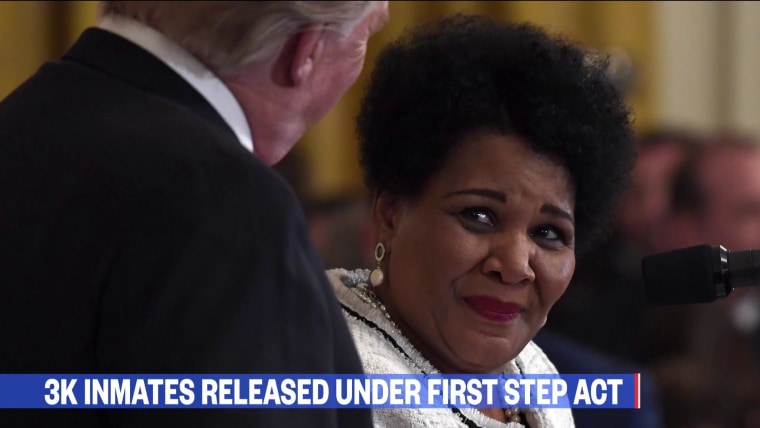
In 2004, when Tanesha Bannister was 29, a judge sentenced her to life in prison for selling crack, convincing the single mother of two she'd never be free again.
Two decades earlier, the country had responded to the crack cocaine epidemic with laws that hoped to stem both violence and social decay caused by low-cost crack cocaine. Over time, the 1986 law mandating a 100-to-1 crack versus powder cocaine sentencing ratio marooned millions of Americans, mostly black men, in America’s prison system.
But as her time in prison stretched on, Bannister, who is black, began to question the legitimacy of her punishment for a non-violent crime. She petitioned the administrations of President Barack Obama and President Donald Trump for a reprieve to no avail.
Then, in May, she became one of the more than 4,500 people released or who have seen their prison terms shortened since December 2018, when Trump signed into law one of the most significant changes to the federal criminal justice system in the 21st century.
"Basically after being let down for so many times ... it was just like life was breathed all over again," Bannister, now 45, said.
Nearly a year after the First Step Act's passage, NBC News spoke to over a dozen people, including former and current elected officials, liberal and conservative advocates, and formerly incarcerated individuals, among others, who championed the reforms. They all agreed that the law's effects are tangible, and many believe the bipartisan coalition that produced it appears durable.

“I think the biggest win is that this is now a safe issue after years and years and years of the two parties trying to use criminal justice as a way to tear each other down,” said Jessica Jackson, co-founder of #cut50, a bipartisan criminal justice reform nonprofit.
However, some are skeptical the alliance can hold. Many of the next steps advocates have underscored as necessary to bring about true change, like reexamining lengthy sentences for violent offenses and restructuring policing practices, may be a tougher sell.
"As some people might say, it's easier to kind of agree on some of the low-hanging fruits, but the higher you reach, the more difficult consensus is going to be,” said Tim Head, the executive director for the Faith & Freedom Coalition, a conservative nonprofit that supports the act as well as other criminal justice reform efforts.
What the First Step Act achieved
More than 3,000 inmates have been released and another roughly 1,700 people convicted of crack cocaine offenses have seen their sentences reduced thanks to the First Step Act, according to data from the Federal Bureau of Prisons and the U.S. Sentencing Commission. Some of that activity stems from a 2011 change made by the federal sentencing commission affecting people convicted of certain drug crimes and a provision of the First Step Act. That provision made the sentencing guidelines of the Obama-era Fair Sentencing Act of 2010 retroactive.
The majority of those released under both acts have been black men, the group which the "war on drugs" campaign of the '70s and '80s effectively targeted.
But the effects of the act's other major provision — the relaxing of the notorious "three strikes" rule to mean a 25-year sentence, rather than life in prison, for three or more convictions — are so far difficult to measure. A year in, little data has been collected around how many people had been sentenced under the new guidelines.
The act also a required the development of a new risk assessment tool that aims to determine which inmates are most likely to re-offend if released and to identify ways to assist those who are released. It was completed in July. Meanwhile, roughly 16,000 federal prisoners have enrolled in drug treatment programs created by the act, according to the Justice Department.

The success — or limitations — of the tool and the new programs still remain to be seen, but advocates say the overall represent a major shift in thinking.
"It's part of wider system transformation from one that was based on gut instinct and anecdotes and headlines to decisions that are made based on evidence and research," said Adam Gelb, the founder of the Council on Criminal Justice, a bipartisan criminal justice nonprofit.
However, he added, the nuances of implementation matter.
"We're talking about human behavior and it's never going to be a perfect assessment of someone's readiness for release nor a perfect judgment about the length of time they deserve to spend behind bars for the purposes punishment," he said.
Head, the executive director of the Faith and Freedom Coalition, said the act's changes, which also include mandating BOP train its 31,000 employees on de-escalation techniques and mental health awareness, intended to shift "the culture of our federal system from pure punishment, to one of at least considering rehabilitation in a much more meaningful way."