
A Louisiana law requiring public schools to display the Ten Commandments in every classroom can stand, the 17 active judges on the 5th U.S. Circuit Court of Appeals have ruled — vacating an earlier preliminary injunction.
The court wrote that it’s too early for the judges to decide whether it would violate the Constitution to have the Ten Commandments posted in every classroom.
“An unripe challenge does not become ripe merely because a party asserts that the challenged action would be unlawful on any conceivable set of facts,” the judges wrote.
A lower court in Louisiana initially blocked the law, and a three-judge panel on the 5th Circuit had previously agreed with the lower court. The full 5th Circuit Friday, however, did not.
The decision comes as the court has considered a pair of Ten Commandments laws — one from Louisiana and one from neighboring Texas. Last month, the active judges on the 5th Circuit heard the cases from both states.
Friday's decision pertains only to Louisiana.
“Asking us to declare — here and now, and in the abstract — that every possible H.B. 71 display would violate the Establishment Clause would require precisely what Texas forbids: the substitution of speculation for adjudication," the court wrote, using italics and referencing what the 5th Circuit decided in a similar Texas case. "It would oblige us to hypothesize an open-ended range of possible classroom displays and then assess each under a context-sensitive standard that depends on facts not yet developed and, indeed, not yet knowable."
The court continued: "That exercise exceeds the judicial function. It is not judging; it is guessing. And because it rests on conjecture rather than a concrete factual record, it does not cure the ripeness defect—it compounds it.”
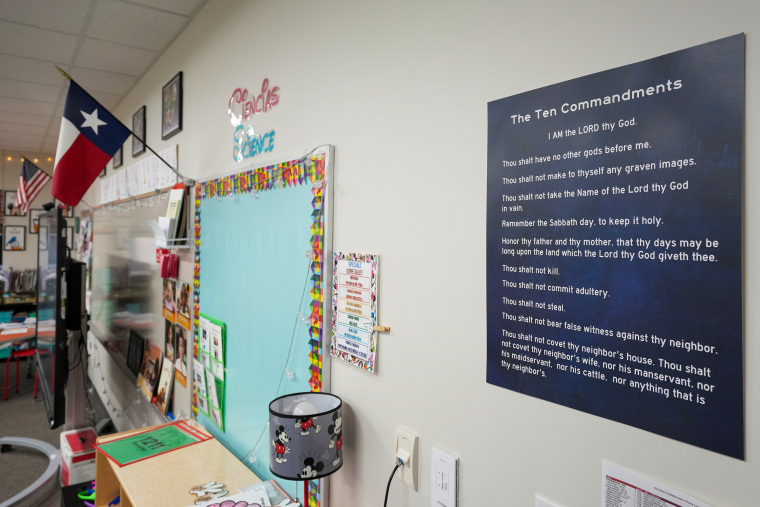
Louisiana Attorney General Liz Murrill said in a statement that "don't kill or steal shouldn't be controversial."
"My office has issued clear guidance to our public schools on how to comply with the law, and we have created multiple examples of posters demonstrating how it can be applied constitutionally," Murrill said. "Louisiana public schools should follow the law."
The plaintiffs' legal representation — the ACLU, ACLU of Louisiana, Americans United for Separation of Church and State, the Freedom From Religion Foundation and pro bono counsel Simpson Thacher & Bartlett LLP — said in a statement that Friday's ruling is "extremely disappointing and would unnecessarily force Louisiana’s public school families into a game of constitutional whack-a-mole in every school district."
"Longstanding judicial precedent makes clear that our clients need not submit to the very harms they are seeking to prevent before taking legal action to protect their rights," they said. "But this fight isn’t over. We will continue fighting for the religious freedom of Louisiana’s families."
ACLU of Louisiana Executive Director Alanah Odoms said in a written statement that the decision is "cowardly."
"By forcing a singular religious text onto the walls of our public schools, the Fifth Circuit has flung open the door to the religious coercion of Louisiana’s children. This law transforms the public school classroom, a place that should be safe and inclusive, into a government-sanctioned house of worship," Odoms said.