They are a distinct minority in their own party and, for that matter, their country: Republican holdouts amid an ever-widening consensus that Russia’s unprovoked invasion of Ukraine poses a mortal threat to American interests.
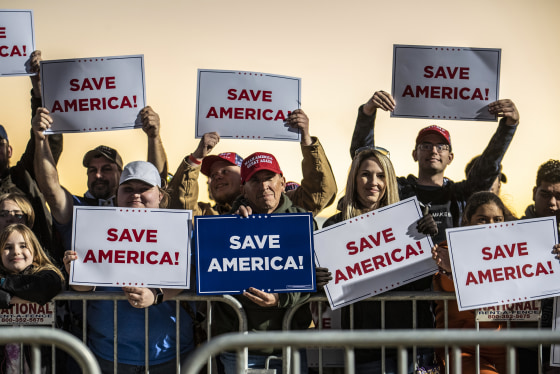
A far right wing of the Republican Party tightly bound to former President Donald Trump is fighting to push the GOP toward the “America First” isolationism that underpinned his 2016 presidential bid.
For the first time since Trump’s rise, his party is pushing back.
That much was clear from the House vote Thursday on a bill ending normal trade relations with Russia as punishment for attacking Ukraine. A total of 202 Republicans joined with 222 Democrats in voting to allow the Biden administration to raise tariffs on Russia, a rare bipartisan consensus in an era of fierce polarization.
Eight Republicans voted against the measure, including Trump loyalists like Rep. Marjorie Taylor Greene of Georgia. In a speech on the House floor Thursday, Greene gave a succinct summary of an America First argument that has been getting little traction in the face of deepening sympathy for the Ukrainians’ suffering. After objecting to the abundant attention the war is getting, she said that what “real Americans care about are gas prices that they can’t afford,” inflation and security along the southern border.

Echoing that sentiment, Rep. Lauren Boebert of Colorado, whom Trump has endorsed for re-election, explained her vote: “Congress keeps focusing on distractions abroad and not our own challenges brought on by Joe Biden at home.”
Both Greene and Boebert are part of a loose band of conservative lawmakers, pundits and foreign policy thinkers who, under the banner “America First,” see the war as peripheral to so-called pocketbook concerns important to families. What’s more, some of them argue that GOP leaders are reverting to Bush-era neoconservative positions that enmeshed the U.S. in "unwinnable wars."
“We have so many problems in this country that are a bigger concern to our citizens and should be a bigger concern to our leaders than what’s happening in Russia and Ukraine,” J.D. Vance, a Republican Senate candidate in Ohio, told NBC News.
“Our voters do not want us to sacrifice American blood and treasure in Ukraine,” he added. “They want us to look after our own people first.”
Polling suggests otherwise. Surveys show that majorities of Americans are prepared to accept financial sacrifices if it means helping Ukraine defend its sovereignty. And polls suggest that Americans are absorbed in coverage of the war and inspired by Ukrainian President Volodymyr Zelenskyy’s resistance to the Russian siege.
That puts them at odds with another America First-er who’s gotten Trump’s endorsement, Rep. Madison Cawthorn of North Carolina. The 26-year-old congressman called Zelenskyy a “thug.”
An Economist/YouGov poll from earlier this month found the overwhelming majority of Republicans approve of sending weapons to Ukraine. A Quinnipiac poll released this month showed that more than two out of three Republicans support a ban on Russian oil imports, even if that means higher gas prices at home. As for Russian President Vladimir Putin, GOP voters viewed him with contempt.
A Republican Senate aide, granted anonymity because the aide was not authorized to speak on the issue, told NBC News the war in Ukraine, and the response from isolationist-leaning conservatives, “has shown some of the online right to be kind of out of touch,” adding this conservative faction is “struggling” with its message in light of Russia’s unprovoked assault.
“I think if it were to turn into a … war with American lives at stake, it wouldn’t be very popular,” the aide said, “but it is also obviously jarring to the average person and people don’t like the U.S. to just take a passive role in the world.
Undeterred, the "America First" adherents believe that Trump’s approach to foreign policy is durable and denied they were in retreat. Steve Bannon, a former senior adviser in the Trump White House, said on his podcast earlier this month that “no Republican should vote for any money for Ukraine … until we get a full briefing and disclosure of exactly what is going on with facts.” In a text message, Bannon said that “of course” he sees public opinion on the right shifting to his stance on Ukraine, adding, “it’s changed already.” Asked for examples of such a shift, he did not respond.
Rachel Bovard, policy director at the Conservative Partnership Institute and a proponent of limited U.S. engagement abroad, said that American Conservative magazine would hold an “emergency” conference in Washington on March 31 to discuss Ukraine. She said there had been a worrisome “resurgence” of neoconservative thinking among Republicans.
“The America First foreign policy has made a lot of inroads,” she said in an interview. Establishment Republicans, she added, have “failed.”
“They’re speaking to a generation of us that watched them fail,” she said. U.S.-led wars in Iraq and Afghanistan both failed, she said, and “now, they’re making the same argument about Ukraine to a highly skeptical audience.”