President Donald Trump on Monday ordered new sanctions on Turkey amid sustained criticism from Republican lawmakers over his decision to withdraw U.S. forces from Syria to make way for a Turkish operation.
Trump said on Twitter he would authorize sanctions "against current and former officials" in Turkey’s government “and any persons contributing to Turkey’s destabilizing actions in northeast Syria.”
Vice President Mike Pence, speaking to reporters outside the White House after Trump's announcement, said Trump signed the executive order implementing the sanctions alongside South Carolina Sen. Lindsey Graham, a staunch supporter of the president who has nonetheless been one of the loudest GOP voices urging Trump to reverse course.
Pence said that, in a phone call earlier Monday, Trump urged Turkish President Recep Tayyip Erdogan to end the invasion and agree to an immediate ceasefire. Pence said Trump also spoke to leaders in the region today, including Kurdish General Mazloum. When asked if the sanctions would affect Erdogan's upcoming planned visit to Washington, Pence said no decision had been made.
Trump said he plans to hike tariffs on steel up to 50 percent and “immediately” halt trade negotiations with the country, specifically a $100 billion trade deal.
Trump's move to withdraw American troops from northern Syria received bipartisan condemnation and sparked fears of a renewed humanitarian crisis in the region and a resurgent ISIS threat.
Numerous Republicans — including Graham and several other top Trump allies in Congress — vehemently opposed the president’s decision to remove U.S. forces from the northern border of Syria and allow a Turkish offensive there because it marked a major blow to the Kurdish-led Syrian Democratic Forces, or SDF, a key partner to the U.S. in its fight against the Islamic State.
Trump has largely defended his actions while warning Turkey not to take action against the Kurds. Last week, he threatened to “totally destroy and obliterate the Economy of Turkey” if the country did anything he considered “off limits.” He also called his decision “very smart” in a tweet Sunday.
"Very smart not to be involved in the intense fighting along the Turkish Border, for a change. Those that mistakenly got us into the Middle East Wars are still pushing to fight. They have no idea what a bad decision they have made. Why are they not asking for a Declaration of War?" he tweeted.
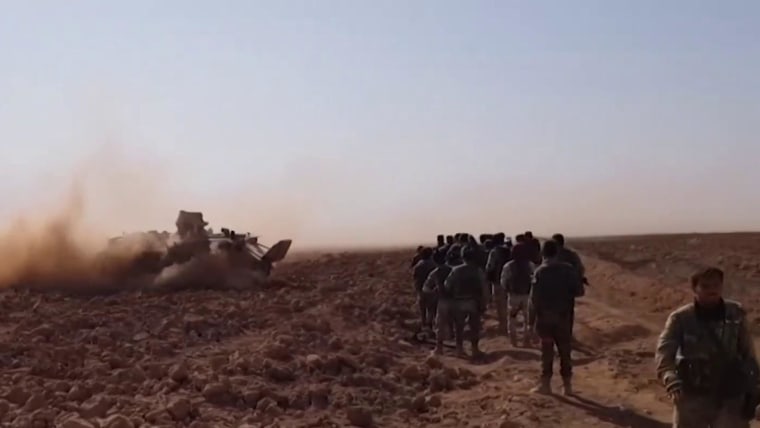
Over the weekend, the U.S. military expedited plans to withdraw from Syria. In an interview on CBS' "Face the Nation" in an interview Sunday, Defense Secretary Mark Esper said roughly a thousand troops will leave the area "as safely and quickly as possible.” About 300 soldiers will remain in the U.S. military's Al Tanf base in the south, two U.S. military officials in the region previously told NBC News.
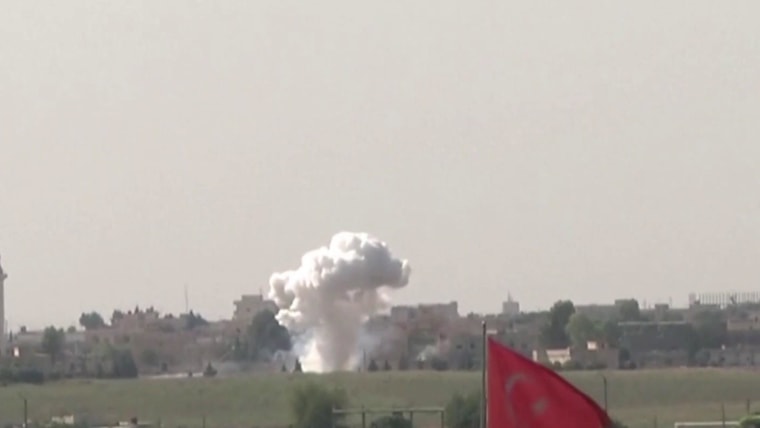
However, since the withdrawal decision was announced, the Turkish military has escalated its military operation in the region. The SDF is led by the Kurdish People's Protection Units (YPG), which Turkey views as a terrorist group. Turkish forces claimed over the weekend to have taken over a Syrian border town, though NBC News has not independently verified the claim.
About 100,000 people have been displaced within the first three days of the attack, according to the United Nations' Humanitarian Affairs Office. As a result, the administration released $50 million in aid to Syria "to protect persecuted ethnic and religious minorities," White House press secretary Stephanie Grisham said in a statement on Saturday.
Esper called Turkey's actions "unnecessary and impulsive" in a statement on Monday. He said that as a result the U.S. would withdraw U.S. military personnel from northeast Syria.
"Despite the opposition and repeated warnings from the United States and the international community, Turkish President Erdogan ordered a unilateral invasion of northern Syria that has resulted in widespread casualties, refugees, destruction, insecurity, and a growing threat to U.S. military forces," he said.
"President Erdogan bears full responsibility for its consequences, to include a potential ISIS resurgence, possible war crimes, and a growing humanitarian crisis. The bilateral relationship between our two countries has also been damaged."
Esper said he will NATO next week in Brussels to urge allies to "take collective and individual diplomatic and economic measures" against Turkey.
U.S. allies in Europe have sought to step up the pressure on Turkey, with both Germany and France saying they would halt weapons exports to Ankara.
British Prime Minister Boris Johnson expressed "grave concern about Turkey’s military operation" in a call with Erdogan Saturday, his government said.

