The Trump administration moved Friday to withdraw from a key missile treaty with Russia that has formed a cornerstone of nuclear arms control efforts for decades, accusing President Vladimir Putin's government of breaching the pact and raising fears of a new Cold War-style arms race with Moscow.
President Donald Trump, announcing the U.S. intent to withdraw from the Intermediate-Range Nuclear Forces (INF) Treaty, said Russia had been violating the agreement "with impunity."
"We cannot be the only country in the world unilaterally bound by this treaty, or any other," Trump said in a statement.
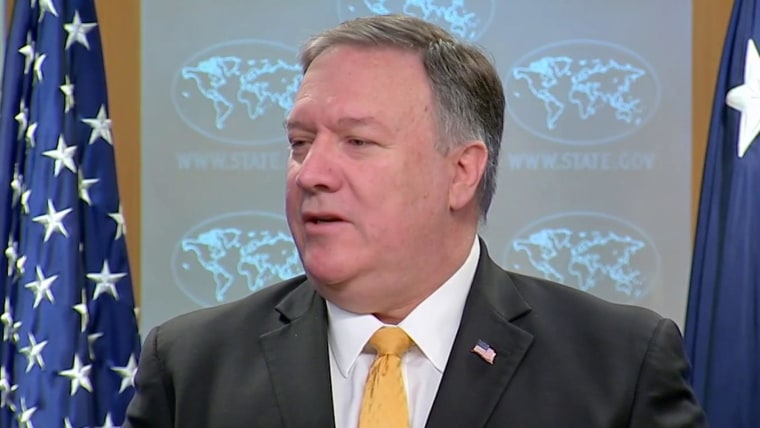
His tough words for Russia were echoed by Secretary of State Mike Pompeo, who said the U.S. would formally notify Moscow on Saturday that the U.S. will withdraw. Pompeo said Russia was in "material breach" of the pact and that NATO allies had "stood with us in our mission to uphold the rule of law and protect our people."
"We provided Russia an ample window of time to mend its ways and for Russia to honor its commitment," Pompeo said. "Tomorrow that time runs out."
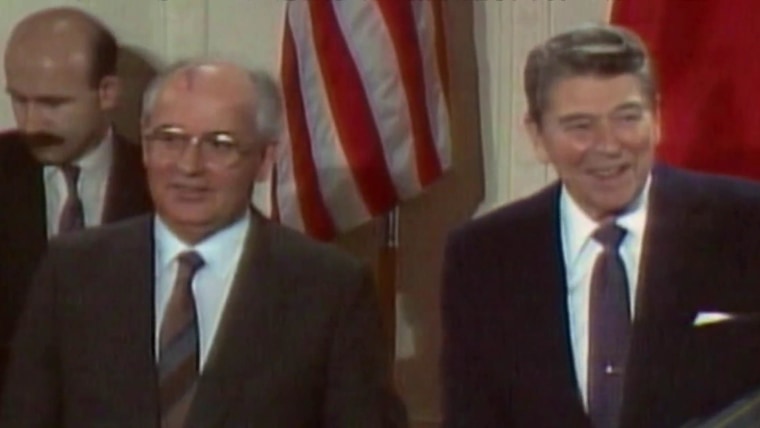
The 1987 treaty bans deployment and required the destruction of ground-based missiles with a range of between 500 and 5,500 kilometers — or 310 to 3,410 miles — whose presence in Europe became a point of crisis during the Cold War. Signed by President Ronald Reagan and Soviet leader Mikhail Gorbachev, the pact has been viewed for decades as a model for arms control agreements between major powers.
Related

But the U.S. has accused Russia of violating the agreement since at least 2014, a charge that Russia denies. Senior Trump administration officials said Friday that they had tried 35 times through diplomatic engagements to bring Russia into compliance and had provided Moscow with specific days on which the U.S. believes Russia tested the banned missiles, only to be rebuffed.
Trump had signaled in October that he planned to leave the deal, as U.S. diplomats sought to use that threat to coerce Russia into changing course and complying. Under the terms of the agreement, the withdrawal is not immediate: The U.S. will "suspend" its obligations starting Saturday but the withdrawal won't be complete until the expiration of a six-month window that ends in August.
That leaves open the possibility that Russia could still change course and the deal could be salvaged. Still, senior U.S. officials said they were not optimistic about that possibility.
For Trump, who has repeatedly vexed NATO with his threats to pull out of the alliance and his demands that members spend more on defense, the decision marked a rare point of agreement. The alliance issued a statement declaring that "allies fully support this action."
"We urge Russia to use the remaining six months to return to full and verifiable compliance to preserve the INF Treaty," said NATO, formed by Western nations in the wake of World War II as a hedge against Soviet military power.
Iranian Foreign Minister Mohammad Javad Zarif criticized the move in a sharply-worded tweet.
"Yet another withdrawal from an accord by the Trump administration; this time the #INFTreaty," wrote Zarif, who also referenced the U.S. decision to withdrawal from the Iran nuclear deal. "Seems this clique is allergic to anything w/ US signature on it. Message: Any deal with US govt is not worth the ink; even treaties ratified by Congress."
The Kremlin, ahead of Trump's widely anticipated announcement, said it viewed the decision with regret. While insisting it is complying with the treaty, Russia has accused the U.S. of violating the treaty itself, including through the use of armed drones that are not technically missiles but operate within the range prohibited by the treaty.
Non-proliferation experts have warned that without the deal, the U.S. and Russia will have free rein to deploy land-based missiles.
Thomas Countryman, a veteran U.S. diplomat who now chairs the Arms Control Association, said that "without the treaty, there is a serious risk of a new intermediate-range, ground-based missile arms race in Europe and beyond."
But senior officials said that despite pulling out, the U.S. didn't plan to deploy intermediate-range missiles in Europe and said the U.S. would continue to work with Russia to prevent such a competition.
For the U.S., the proliferation of intermediate-range missiles has become a growing concern because of China, which is not party to the treaty and not banned from deploying them. Senior U.S. officials said that China now has more than 1,000 of the missiles.


