WASHINGTON — In a moment that could take on new significance almost 150 years later, Omaha election official Charles Wilkins on April 5, 1880, refused to register John Elk to vote on the grounds that he was Native American, and therefore not an American citizen.
Elk — believed to have been a member of what is now known as the Winnebago Tribe of Nebraska — objected, saying he had severed all ties with his tribe and had willingly subjected himself to the authority of the United States.
He launched a legal challenge, arguing among other things that he was a citizen at birth because he was born within United States territory.
But the Supreme Court, in an 1884 case called Elk v. Wilkins, ruled against him, saying that Native Americans born within the territory of the United States did not have birthright citizenship. They had the same status as “the children of subjects of any foreign government born within the domain of that government,” the court said.
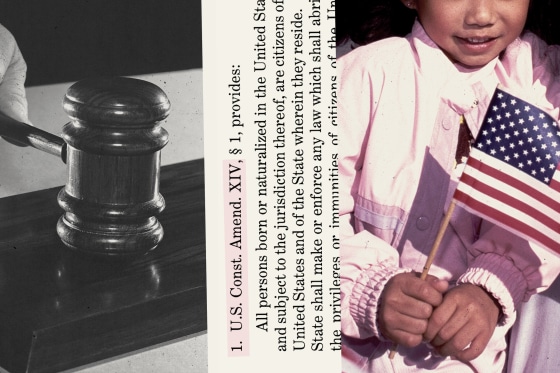
President Donald Trump’s administration is now citing that case as it defends his plan to end automatic birthright citizenship, putting a new spin on the long-standing interpretation of the Constitution’s 14th Amendment. The Supreme Court hears oral arguments in the case on Wednesday.
Trump’s executive order, issued on the first day of his second term, seeks to limit birthright citizenship only to people with at least one parent who is a U.S. citizen or a legal permanent resident.
The order is not in effect; lower courts put it on hold.

Solicitor General D. John Sauer, representing the government, referenced Elk in court papers, saying the Supreme Court has “squarely rejected the premise that anyone born in U.S. territory, no matter the circumstances, is automatically a citizen so long as the federal government can regulate them.”
White House spokeswoman Abigail Jackson said in a statement that the case gives the Supreme Court the chance to "restore the meaning of citizenship in the United States to its original public meaning."
The Trump administration’s arguments about the relevance of the Elk ruling are strongly contested by the American Civil Liberties Union, which is leading the challenge to Trump’s executive order.
“At a fundamental level, this case is about an attempt to strip citizenship from the children of immigrants who have always been citizens of the U.S. The Native American questions the government raises are really beside the point,” ACLU lawyer Cody Wofsy said in an interview.
Tribal status is 'unique'
Notably absent from any of the dozens of briefs filed in the case is anything from Native American tribes or organizations. Two scholars of Native American law, Bethany Berger at the University of Iowa College of Law and Gregory Ablavsky at Stanford Law School, did file a brief backing the ACLU’s challenge.
Experts on Native American law told NBC News the administration’s reliance on Elk was problematic, both rhetorically and legally.
“We believe the reliance on Elk to deny birthright citizenship to children of undocumented immigrants is misplaced. It’s a misreading and a misunderstanding,” said Leonard Fineday, general counsel of the National Congress of American Indians, which represents tribes.
The Elk decision rests solely on the specific nature of “quasi-sovereign tribal government” and is limited to that context, he added.
Monte Mills, director of the Native American Law Center at the University of Washington School of Law, agreed, saying it was ironic that the government would rely on such a ruling.
“It does betray a lack of understanding and awareness or willingness to acknowledge the nuance of Native American law,” he added.
Another lawyer who works on Native American issues, who declined to be named because he did not want to be seen to be speaking on behalf of tribes with diverse views, said Indian law, a technical term still in use, is complex and not applicable to other areas of law. That’s in part because there was never a blanket rule that applied to all tribes when it came to their legal relationship with the United States.