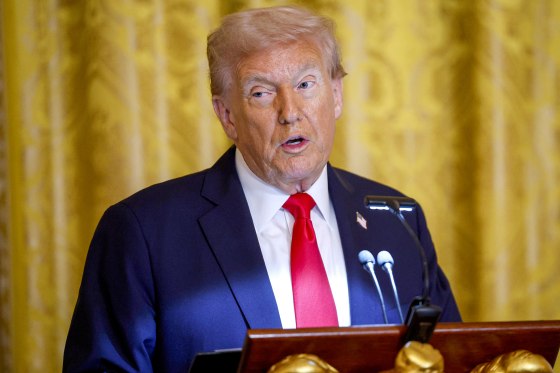
WASHINGTON — President Donald Trump's strategy to persuade the Supreme Court to uphold his sweeping tariffs is not subtle.
To some opponents of his tariffs, Trump's frequent use of apocalyptic rhetoric about his signature policy ahead of the Nov. 5 oral argument is an obvious attempt to influence the court by focusing on the potential consequences of a ruling against him.
“I will tell you that’s one of the most important cases in the history of our country because if we don’t win that case, we will be a weakened, troubled, financial mess for many, many years to come,” Trump said at the White House on Oct. 15, in just one example of his repeated comments on the subject.
Trump, who has a long history of harshly criticizing judges who rule against him, has even suggested he might attend the Supreme Court in person for the oral argument Nov. 5. There is no official record of any sitting president ever attending a Supreme Court argument, according to the court and the nonprofit Supreme Court Historical Society.
The White House did not respond to a request seeking comment about Trump’s remarks, whether he intends to influence the court or if he will attend the oral argument.
It is not the first time a president has used his bully pulpit to lean on the Supreme Court in a case crucial to his agenda. In 2012, President Barack Obama faced criticism when he said it would be an “unprecedented, extraordinary step” if the Supreme Court struck down the Affordable Care Act, known as Obamacare.
The court later that year narrowly upheld the law, which was Obama’s signature domestic achievement.
Trump is known to take a keen interest in cases in which he is personally involved, including criminal and civil cases that were brought against him after he completed his first term as president. He frequently appeared in court for hearings in those cases, even when not required to.
Last year, during his criminal trial in New York over "hush money" payments to adult film star Stormy Daniels, the judge refused to allow Trump permission to attend Supreme Court oral arguments in April in the separate election interference case regarding the scope of presidential immunity. Trump secured a major win in that case.
This time around, the court, with a 6-3 conservative majority including three justices Trump appointed, will be considering whether Trump had the power to unilaterally impose the tariffs under a law reserved for use in times of emergency called the International Emergency Economic Powers Act.
Although the court has ruled in Trump’s favor on numerous occasions in the first few months of his term, experts believe the tariffs case is a closer call.
Trump's remarks over the course of this year reflect a consistent theme: In his view, the tariffs are raising so much revenue and are so important to the country that a court ruling saying that he does not have the authority to impose them would be cataclysmic.
"If we win the tariff case, which hopefully we will, it’s vital to the interests of our country. We’re the wealthiest country there is. If we don’t, we’ll be struggling for years to come,” Trump said on the Fox News show "Sunday Morning Futures" on Oct 19.
He has also weighed in on the litigation via his Truth Social feed.
On Aug. 8, he said there would be a "Great Depression" if the tariffs were not upheld. Later that month, he said that it would be a "total disaster for the country" if they were struck down.
Trump is also quick to accuse others of seeking to put pressure on the justices. On Thursday night, he posted that he was ending trade negotiations with Canada because he thought the country was trying to influence the Supreme Court to rule against him on tariffs via an ad sponsored by the province of Ontario.
“They only did this to interfere with the decision of the U.S. Supreme Court, and other courts,” Trump wrote.
Tariff revenues for the year have raised $174.04 billion, according to the most recent Treasury Department numbers. Treasury Secretary Scott Bessent, on Sept. 7, told "Meet the Press" that the government would have to issue refunds for about half the tariff revenues it has collected if the administration loses at the Supreme Court.