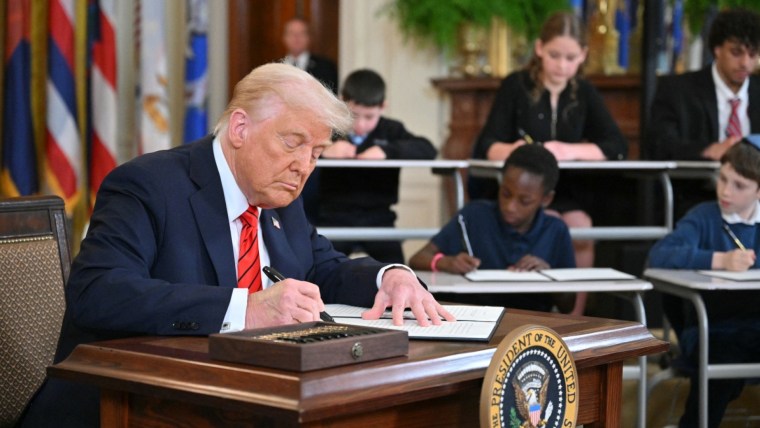
President Donald Trump signed an executive order Thursday in an effort to “begin eliminating the federal Department of Education.” With the stroke of his pen, he officially set in motion a plan to shutter the 46-year-old agency, as he said, “once and for all.”
But the order stops short of immediately closing the department, which cannot be done without congressional approval. Rather, according to the text of the order released by the White House, it directs Education Secretary Linda McMahon to “take all necessary steps to facilitate the closure of the Department of Education and return authority over education to the States and local communities while ensuring the effective and uninterrupted delivery of services, programs, and benefits on which Americans rely.”
At the signing, Trump said federal Pell grants (a common type of federal undergraduate financial aid), Title I funding and resources and funding for children with disabilities would be “preserved in full and redistributed to various other agencies and departments.”
“But beyond these core necessities, my administration will take all lawful steps to shut down the department,” he said, adding that he would do so “as quickly as possible.”
The move still promises to upend the key functions the department performs in the broader education system, which include oversight of the federal student loan portfolio, civil rights enforcement in schools and the distribution of billions of dollars to help impoverished and disabled students.
Several big questions about the Education Department’s future remain unanswered. But there is still a significant amount known about the agency’s history and duties — as well as the many plans conservatives have circulated for decades to unwind the agency.
What does the Education Department do?
In 1979, Democratic President Jimmy Carter signed legislation that made the Education Department a Cabinet-level agency. Until that point, the government had a Department of Health, Education and Welfare, created during the Eisenhower administration.
Conservatives have been clamoring to abolish it for more than 40 years — essentially since it was created. Carter’s successor, President Ronald Reagan, vowed to shut it down one year after it opened — and Republicans have basically repeated that call since.
The Education Department is one of the smallest Cabinet-level departments. Its $268 billion appropriation last year represented 4% of the U.S. budget. McMahon announced earlier this month a plan to cut roughly half of the agency’s staff.
Among its most prominent duties, the agency manages the $1.6 trillion federal student loan portfolio for college and postsecondary students. It also distributes billions of dollars in funding for K-12 schools through programs that serve more than 50 million students in nearly 100,000 public schools and 32,000 private schools.
That funding includes more than $15 billion for thousands of so-called Title I schools — schools that receive federal dollars to help low-income families. And it includes more than $15 billion in funding for programs — under the auspices of the Individuals with Disabilities Education Act (IDEA), which provides grants to states for the education of children with disabilities — that ensure disabled students have access to a free and appropriate public education.
The Education Department’s Office for Civil Rights enforces laws aiming to prevent discrimination in schools, and the agency’s Institute of Education Sciences runs data collection, statistics and research monitoring student outcomes.
The vast balance of power on education, however, still lies with states and local districts, which fund the bulk of K-12 education and set all curriculums.
The U.S. Education Department has no say in curriculum matters. It does not set requirements for enrollment and graduation in schools, nor does it have a say in the selection or use of school or library books, textbooks or resources.
Schools that receive federal money through Title I programs and IDEA must meet specific conditions and maintain specific reporting rules. Conservatives have long claimed that those requirements are arduous and have pushed for allowing states to have flexibility and freedom to spend the money as they wish.
What would it look like to wind down the Education Department?
Even though Trump cannot fully end the Education Department himself, McMahon agreed at her confirmation hearing that the administration hopes to present a plan that Congress would support, and Republicans in the House have introduced various plans that seek to eliminate the department. Still, with narrow Republican majorities in the House and Senate, it’s unlikely to move forward.
Yet short of that, the administration has other ways to shrink the department’s footprint.
White House press secretary Karoline Leavitt said ahead of the executive order’s signing that “critical programs will be protected” and that, specifically, student loans and federal Pell Grants would continue to be handled by the department. In addition, a senior administration official said Wednesday night that Title I, student loans and students with disabilities — who rely on IDEA funding — will not be affected.

